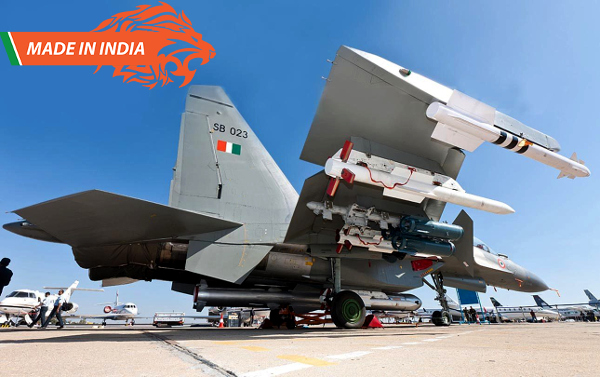
India has set an ambitious target of raising annual defence production to ₹3 lakh crore and defence exports to ₹50,000 crore by 2029, reflecting the government’s wider effort to transform the country into a major centre for military manufacturing, technology development and global defence trade.
Minister of State for Defence Sanjay Seth reiterated these targets on September 1, 2026, while addressing the Second Annual Trident Lecture organised by the Centre for Joint Warfare Studies at the Manekshaw Centre in New Delhi. The event brought together senior military officers and strategic experts to discuss the changing character of warfare, the growing importance of joint operations, multidomain capabilities and closer interaction between the Armed Forces, industry, academia and the wider technology ecosystem.
The production and export targets come at a time when India’s defence-industrial base is expanding rapidly. Defence production reached approximately ₹1.78 lakh crore in FY 2025-26, the highest level recorded so far, while defence exports rose to a record ₹38,424 crore. These figures indicate that India has already moved significantly beyond the period when its defence industry was largely focused on licence production and domestic assembly of imported systems.
Defence Production Moves Towards ₹3 Lakh Crore
The government’s target of ₹3 lakh crore in annual defence production represents a substantial expansion from the current level. Moving from ₹1.78 lakh crore to ₹3 lakh crore would require an increase of more than ₹1.2 lakh crore over the next several years, making sustained serial production across multiple major programmes essential.
Public-sector defence companies continue to account for the majority of India’s defence output, but the private sector is playing an increasingly important role. Large Indian companies, specialised manufacturers, MSMEs and start-ups are now participating in programmes covering aerospace, missiles, artillery, naval systems, armoured vehicles, ammunition, electronics, drones and advanced materials.
The future growth of the sector is therefore expected to depend not only on the traditional Defence Public Sector Undertakings but also on the development of a much broader industrial supply chain capable of supporting high-volume production and increasingly sophisticated military technologies.
India’s defence manufacturing strategy is also moving beyond simple import substitution. The objective is gradually shifting towards the creation of domestic design capability, ownership of intellectual property and the ability to manufacture, maintain and upgrade critical systems within the country over their entire operational life.
Defence Exports Reach Record Levels
India’s defence export performance has expanded even faster than overall production. Exports reached ₹38,424 crore in FY 2025-26, compared with only ₹686 crore in FY 2013-14. This represents a dramatic increase over the past decade and places the ₹50,000 crore export target within comparatively closer reach.
Indian defence products are now reaching customers across more than 80 countries. Exported equipment includes missiles, artillery-related systems, naval platforms, radars, electronic systems, ammunition, protective equipment and a growing range of components and subsystems supplied to international defence manufacturers.
The private sector contributed approximately ₹17,353 crore, or 45.16% of total defence exports during FY 2025-26, while Defence Public Sector Undertakings contributed around ₹21,071 crore, or 54.84%. This near-balanced contribution demonstrates how rapidly India’s private defence industry has moved into overseas markets.
Reaching the ₹50,000 crore target will nevertheless require Indian companies to compete consistently against established defence manufacturers from the United States, Europe, Russia, Israel, South Korea, Türkiye and other major exporting nations. International customers increasingly judge equipment not only on acquisition cost but also on reliability, delivery schedules, ammunition availability, training, maintenance support and lifecycle service.
India will therefore need to build long-term support systems around its exports rather than treating them as one-time equipment sales.
From Import Dependence to Industrial Self-Reliance
India’s defence-industrial policy has changed significantly over the past decade. The country was once heavily dependent on foreign suppliers for combat aircraft, helicopters, submarines, artillery, air-defence systems, sensors and several categories of ammunition and specialised components.
The current strategy seeks to reduce that dependence through a combination of domestic procurement preference, Positive Indigenisation Lists, greater private-sector participation, technology-development programmes and increasingly large orders for Indian-designed and Indian-manufactured equipment.
The objective is not necessarily to eliminate every imported component. Modern defence platforms involve highly complex global supply chains, and complete technological independence in every area would be unrealistic in the short term. The more immediate goal is to ensure that India possesses domestic control over critical technologies, manufacturing processes, maintenance capability and wartime supply chains.
That distinction has become increasingly important as recent international conflicts have demonstrated how vulnerable military operations can become when countries depend excessively on overseas suppliers for missiles, ammunition, spare parts and replacement components.
Operation Sindoor Highlights the Importance of Indigenous Capability
Sanjay Seth also linked India’s expanding defence manufacturing base with recent operational experience, pointing to Operation Sindoor as an example of the growing importance of indigenous military capability.
The government has repeatedly highlighted systems such as the Akash air-defence missile, Akashteer air-defence command-and-control network and BrahMos supersonic cruise missile while discussing India’s operational preparedness and domestic defence capabilities.
The significance of these systems extends beyond their battlefield performance. A country that possesses domestic production capability can replenish ammunition, repair damaged equipment, modify existing systems and increase output during a prolonged conflict without being entirely dependent on foreign political decisions or external supply chains.
This ability to sustain operations is increasingly being recognised as a core component of national security. Defence production is therefore no longer being viewed purely as an industrial or economic activity, but as part of the country’s broader capacity to fight and sustain a high-intensity conflict.
Jointness Becomes Central to India’s Military Transformation
The Trident Lecture also focused heavily on the growing requirement for greater jointness among the Army, Navy and Air Force.
Chief of Integrated Defence Staff Air Marshal Tejinder Singh discussed the evolving contours of jointness and integration, while Vice Chief of the Army Staff Lieutenant General Sandeep Jain addressed multidomain operations and the need for closer operational coordination among the Services.
Modern warfare increasingly depends on the ability of different military platforms and commands to operate as part of a single connected network. An aircraft may identify a target that is subsequently engaged by a ground-based missile system, while satellites, drones, electronic-intelligence assets and naval platforms contribute simultaneously to a common operational picture.
This type of warfare requires secure communications, interoperable sensors, shared data networks and command structures capable of coordinating operations across different domains. As a result, India’s defence-industry expansion will need to focus not only on producing more aircraft, missiles, tanks and warships but also on developing the digital systems that connect them.
Multidomain Warfare Expands Beyond Land, Sea and Air
The concept of multidomain warfare featured prominently in the discussions because the modern battlefield now extends well beyond conventional land, maritime and air operations.
Cyber warfare can disrupt communications and command networks, electronic warfare can interfere with radar and navigation systems, and space-based assets can provide intelligence, surveillance and communication support. Autonomous systems and artificial intelligence are also beginning to influence targeting, decision-making and battlefield awareness.
Future conflicts are therefore likely to involve tanks, aircraft and warships operating simultaneously with satellites, unmanned systems, cyber capabilities, electronic warfare platforms and long-range precision weapons.
For the Indian defence industry, this means that future manufacturing growth cannot be measured simply by the number of conventional platforms produced. The country will also need domestic capabilities in semiconductors, secure communications, artificial intelligence, advanced sensors, electronic warfare, autonomous navigation and battlefield-management systems.
Civil-Military Fusion Gains Importance
Another important theme at the Trident Lecture was civil-military fusion, which focuses on creating closer links between civilian technology, academic research, industry and military requirements.
Many of the technologies now transforming warfare originated in civilian markets. Artificial intelligence, commercial satellite systems, advanced telecommunications, robotics, semiconductors, cybersecurity and autonomous technologies all have applications that extend well beyond the military.
This has created an opportunity for India’s broader technology ecosystem to contribute directly to national defence. Start-ups, universities, research institutes and specialised engineering companies are increasingly being encouraged to work with the Armed Forces and traditional defence manufacturers.
The result is a defence ecosystem that is gradually becoming more diverse and less dependent on a small group of established public-sector companies.
More Than 16,000 MSMEs Join the Defence Supply Chain
India’s defence industrial base now includes more than 16,000 MSMEs, which supply everything from precision components and electronic assemblies to specialised software, composite materials, mechanical systems and advanced manufacturing services.
Their role is critical because major defence platforms are built through complex supply chains containing thousands of components. No aircraft manufacturer, shipyard or missile producer can manufacture every subsystem independently.
A strong domestic supplier network therefore becomes essential for reducing import dependence and ensuring production can continue during periods of international disruption.
The expansion of these MSME networks also allows the economic benefits of defence manufacturing to spread beyond the largest companies into specialised industrial clusters across the country.
Start-Ups Become Part of Military Procurement
The government’s Innovations for Defence Excellence programme has emerged as another important pillar of this transformation.
Hundreds of Indian start-ups and innovators are now working on defence challenges identified directly by the Armed Forces. Their projects span drones, counter-drone systems, robotics, autonomous vehicles, surveillance technologies, artificial intelligence, electronic warfare and maritime systems.
This model allows the military to access technologies developed outside traditional defence establishments while giving smaller companies a clearer path toward military testing and procurement.
For India, this approach is particularly important in technology areas where rapid innovation may be more valuable than large-scale traditional development programmes.
Defence Industrial Corridors Support Manufacturing Expansion
The Uttar Pradesh and Tamil Nadu Defence Industrial Corridors are also intended to support the production increase required to reach the ₹3 lakh crore target.
Large manufacturers, component suppliers, research facilities and specialised infrastructure are being encouraged to establish operations within these corridors, creating concentrated defence-manufacturing ecosystems.
Such clusters can reduce logistics costs, improve access to suppliers and make it easier for smaller companies to participate in major defence programmes.
They could also become increasingly important for exports if international defence manufacturers choose to establish production facilities in India and integrate Indian plants into their global supply chains.
Research and Development Must Produce New Technologies
Scaling production alone will not make India a globally competitive defence manufacturer. The country will also need to improve its ability to develop technologies that remain dependent on overseas suppliers.
India continues to face important capability gaps in areas such as aero-engines, advanced sensors, specialised semiconductor technologies, propulsion systems and certain high-end materials.
Increasing investment in research and development, therefore, remains critical to the government’s long-term manufacturing strategy.
Greater participation by private companies, start-ups and academic institutions in defence R&D is intended to create additional centres of innovation outside the traditional government laboratory structure.
The ultimate measure of success will not simply be the amount of money invested in research, but whether that investment produces deployable systems, commercially viable intellectual property and technologies that can eventually be exported.
The ₹50,000 Crore Export Target Is Within Reach
Of the government’s two major 2029 targets, the defence-export objective appears closer to achievement.
Exports of ₹38,424 crore mean that India needs an additional increase of approximately ₹11,576 crore to reach ₹50,000 crore. This represents growth of roughly 30% from the current level.
The production target is considerably more demanding. Moving from ₹1.78 lakh crore to ₹3 lakh crore requires an expansion of nearly 69%.
However, several large indigenous programmes are expected to enter or expand serial production over the coming years. These include aircraft, helicopters, missiles, naval vessels, artillery, air-defence systems and armoured platforms.
If these programmes remain on schedule, they could contribute significantly to the additional industrial output required to reach the government’s production objective.
Defence Manufacturing Becomes Part of India’s Wider Industrial Strategy
The expansion of defence production is increasingly being linked with India’s broader economic and industrial ambitions.
Advanced military manufacturing requires capabilities in aerospace engineering, metallurgy, electronics, precision machining, semiconductors, composite materials, propulsion and artificial intelligence.
Many of these technologies also have significant civilian applications. An aerospace supply chain developed for military aircraft can support civil aviation, while expertise in electronics, sensors and semiconductors can strengthen telecommunications, industrial automation and advanced manufacturing.
Defence investment therefore has the potential to generate wider technological and industrial benefits beyond the requirements of the Armed Forces.
The Next Challenge Is Scale, Technology and Global Competitiveness
India’s defence manufacturing transformation has now reached a stage where the central challenge is no longer simply creating domestic production capability. The next phase will require the country to achieve scale, technological depth and global competitiveness simultaneously.
The record ₹1.78 lakh crore in production and ₹38,424 crore in exports demonstrate how far the industry has already expanded. Reaching ₹3 lakh crore in production and ₹50,000 crore in exports will require stronger cooperation between DPSUs, private manufacturers, MSMEs, start-ups, research institutions and the Armed Forces.
It will also require greater emphasis on timely delivery, export-quality production, indigenous intellectual property and domestic control over strategically important technologies.
The targets announced for 2029 should therefore be viewed as part of a larger national objective. India is seeking to move beyond its traditional role as one of the world’s major defence buyers and establish itself as a country capable of designing, manufacturing, sustaining and exporting increasingly sophisticated military systems.
You may also like
-
India’s ₹1,000 Crore Space Venture Capital Fund to Accelerate Indigenous Space Startups and Advanced Technologies
-
Biocon Secures Global Patent Settlement with Genentech for Pebrilzo Biosimilar, Targets European Launch in 2027
-
Segritech Develops AI-Powered Fruit Grading Machines to Improve Farmers’ Income and Reduce Post-Harvest Losses
-
Bharat Small Reactors Take Centre Stage at ICC India Energy Summit as India Advances 100 GW Nuclear Power Mission
-
OSTO Launches AI-Native Cybersecurity Platform for Indian Startups and SMEs
