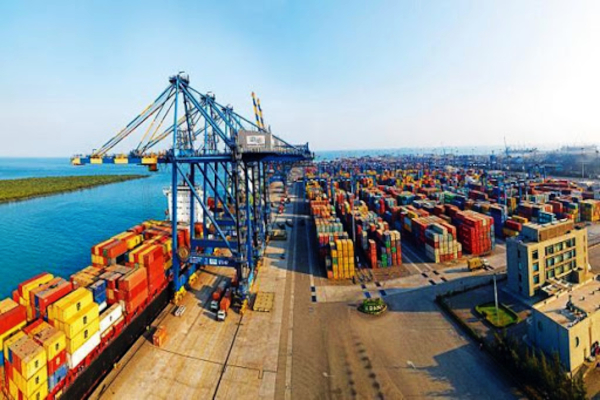
India is taking steps to manufacture advanced maritime and port cranes within the country as part of a broader effort to strengthen its maritime industrial base and reduce reliance on imported equipment, particularly from China.
The most concrete initiative so far involves state-owned BEML Limited, which has entered into a strategic partnership with South Korea’s HD Korea Shipbuilding & Offshore Engineering and HD Hyundai Samho Heavy Industries to jointly design, develop and manufacture a new generation of port and maritime cranes in India.
The agreement covers not merely assembly but the design, development, manufacture, integration, installation, commissioning and long-term support of conventional as well as autonomous port cranes. The systems are intended to be produced in India, with domestic capabilities also being created for spares, servicing and training. BEML explicitly says one of the objectives is to reduce import dependence while building Indian capability in high-capacity, smart and energy-efficient crane systems.
Why Port Cranes Have Become a Strategic Issue
Modern container ports depend on enormous specialised machines to transfer cargo rapidly between ships, container yards, trucks and trains. These include Ship-to-Shore cranes, Rail-Mounted Gantry cranes and Rubber-Tyred Gantry cranes, along with increasingly automated cargo-handling systems.
China has developed an exceptionally strong position in this sector. Industry estimates cited in reporting on the Indian programme indicate that around 70% of the world’s container-handling or quay cranes are manufactured in China. This concentration means that countries undertaking large-scale port expansion often have limited alternatives when ordering the largest and most technologically advanced container cranes.
India has experienced this dependence directly. Some of the country’s newest port infrastructure has relied on Chinese equipment. For example, cranes supplied to the Vizhinjam International Seaport were manufactured by Shanghai-based ZPMC, one of the world’s dominant producers of container-handling cranes.
With India planning a major expansion of port capacity over the coming decades, continuing to source a critical part of port infrastructure overwhelmingly from overseas would leave the country exposed to disruptions in supply, maintenance, spare parts and future equipment upgrades.
BEML to Build Next-Generation Cranes in India
The BEML initiative represents one of India’s clearest attempts to close this industrial gap.
In December 2025, BEML signed an MoU with HD Korea Shipbuilding & Offshore Engineering, or HD KSOE, and HD Hyundai Samho Heavy Industries. The three companies intend to establish an Indian ecosystem capable of producing advanced cranes for ports, shipyards and maritime-industrial facilities.
BEML brings large-scale Indian heavy-engineering and manufacturing capability, while its Korean partners contribute experience in shipbuilding, marine engineering, industrial cranes and automation.
According to BEML’s official announcement, the partnership will seek to manufacture advanced, high-capacity, smart and energy-efficient cranes in India, including future autonomous systems. The programme is also intended to develop domestic maintenance, spares and technical-support capability instead of creating a system dependent permanently on overseas suppliers.
The Government of India has subsequently highlighted the BEML-Hyundai collaboration at the bilateral level. During India-South Korea maritime discussions in 2026, both governments formally welcomed the agreement to jointly design, manufacture and support next-generation conventional and autonomous maritime and port cranes in India.
India Already Has Another Port-Crane Manufacturing Route
BEML is not the only Indian company entering this field.
Engineering major Larsen & Toubro has an existing licensing arrangement with Finnish company Konecranes for manufacturing and distributing several types of port cranes in India. The agreement covers Ship-to-Shore cranes, Rubber-Tyred Gantry cranes, Rail-Mounted Gantry cranes and shipyard cranes.
This means India is gradually developing more than one industrial route for domestic port-crane production: one involving BEML and South Korean technology, and another involving L&T and Konecranes.
That is important because genuine self-reliance requires an industrial ecosystem with multiple manufacturers, suppliers and technology partners rather than dependence merely shifting from one foreign supplier to another.
Government Considering Dedicated Support for Maritime Crane Manufacturing
The Ministry of Ports, Shipping and Waterways has also been examining a dedicated maritime crane manufacturing support scheme.
Industry reporting in March 2026 indicated that the proposal could combine capital subsidies with production-linked assistance for several years to make Indian-built cranes competitive with Chinese products while domestic manufacturing volumes increase.
The government is simultaneously considering wider incentives for domestic manufacture of construction and infrastructure equipment, including cranes and high-precision mechanical and hydraulic components. A ₹200-crore allocation for an equipment-localisation initiative was announced in the FY2026-27 Budget framework, while subsequent discussions considered extending support to equipment required by ports and container infrastructure.
However, an important distinction should be maintained: the dedicated maritime-crane subsidy scheme has been reported as being under development, rather than as a fully notified and operational central scheme. The BEML partnership itself, by contrast, is officially confirmed.
India’s Port Expansion Will Create a Large Domestic Market
India’s push to manufacture cranes locally coincides with an enormous expansion of its port network.
Under the Maritime Amrit Kaal Vision, India ultimately aims to increase national port-handling capacity towards 10,000 million tonnes per annum by 2047. BEML itself cites this expansion as one of the reasons for creating a domestic maritime-equipment industry.
More immediately, the Ministry of Ports, Shipping and Waterways is targeting more than 700 MTPA of additional port capacity by 2030, accompanied by higher mechanisation and greater private-sector participation.
Ports such as Vadhvan, Vizhinjam, JNPA, Deendayal Port and V.O. Chidambaranar Port are expected to require increasingly sophisticated cargo-handling systems as India’s containerised trade expands.
Vizhinjam’s expansion alone includes additional Ship-to-Shore and yard cranes as the port prepares eventually to handle vessels with capacities reaching 28,000 TEU and an operational throughput of as much as 5.7 million TEU annually.
This creates the scale of domestic demand needed to support an Indian crane-manufacturing industry.
Automation Will Be as Important as Steel
Building a modern port crane involves considerably more than fabricating a giant steel structure.
New-generation Ship-to-Shore and gantry cranes increasingly incorporate electric drives, precision motion controls, anti-sway systems, cameras, sensors, remote operating stations, automated container positioning, condition-monitoring systems and autonomous control software.
India therefore needs to localise not only crane structures but progressively also drives, electronics, control systems, high-precision mechanical components and software.
The BEML-Korean partnership specifically includes autonomous maritime and port cranes, indicating that India is targeting the next generation of cargo-handling technology rather than merely reproducing older manually operated equipment.
India’s wider maritime strategy also envisages electrifying more than half of port material-handling equipment by 2030, beginning with cranes transferring cargo between ships and shore before expanding to yard equipment such as RTGs, reach stackers and forklifts.
Reducing Dependence on China Without Closing India to Technology
The Indian strategy is therefore not simply to replace Chinese cranes with completely indigenous designs immediately. Instead, India appears to be following a phased model similar to that used successfully in several other manufacturing sectors.
Global technology is being brought into partnerships with Indian manufacturers, while production, integration, servicing and eventually more components are moved into India.
South Korean and European partnerships provide India with alternative technology sources while Indian companies build the necessary manufacturing skills and supplier ecosystem.
Over time, increasing localisation could give Indian ports greater control over procurement schedules, spare parts, maintenance and technological upgrades while creating an export-capable heavy-engineering industry of their own.
From Importing Port Infrastructure to Manufacturing It
India’s maritime self-reliance programme is increasingly moving beyond ships themselves.
The government is simultaneously promoting domestic shipbuilding, shipping containers, port equipment, dredging systems and cargo-handling machinery. A proposed Container Manufacturing Assistance Scheme, for example, carries a planned outlay of ₹10,000 crore as India attempts to establish a much larger domestic container-manufacturing ecosystem.
Port cranes represent another strategically important link in this chain.
For decades, building a modern port could mean importing not only specialised technology but some of its largest and most important pieces of machinery. The BEML-Hyundai initiative and L&T-Konecranes manufacturing arrangement provide the foundations for changing that model.
If the planned manufacturing programmes reach commercial scale and India succeeds in progressively localising critical components, future Indian container terminals could increasingly be equipped with cranes manufactured in India rather than imported as complete systems from China.
That would make the programme significant not simply as another Make in India initiative, but as part of a broader attempt to ensure that the physical machinery underpinning India’s rapidly expanding maritime trade is supported by a more diversified and resilient domestic industrial base.
Reference:
Official primary source: BEML’s 5 December 2025 announcement confirms that the cranes will be produced in India and specifically identifies reducing import dependence as an objective of the collaboration.
BEML official announcement — Maritime & Port Crane Ecosystem in India
Government of India — India–South Korea maritime cooperation statement
You may also like
-
India’s Economic Warfare Challenge: Strategic Autonomy, Energy Security and the Rise of a Global Power
-
India-US Trade Deal Stalemate: Why Washington’s Tariff Pressure Has Failed to Secure an Agreement
-
US Double Standards in Foreign Policy: 16 Recent Cases Involving India, Russia, China and Global Trade
-
India’s Arctic Energy Ambitions: Russian Oil, LNG and a New Sea Route to Indian Ports
-
India and Russia Explore Joint Icebreaker Construction as Maritime Industrial Cooperation Expands
