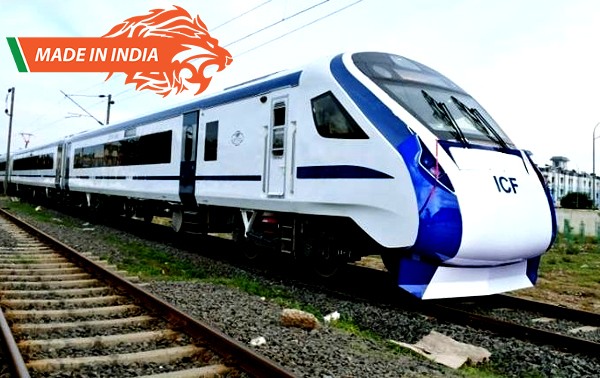
India’s approved Bengaluru–Mumbai Vande Bharat Sleeper service is shaping up as more than just another train launch. It marks the expansion of India’s sleeper-train modernisation push into one of the country’s busiest business and technology corridors, linking Mumbai’s financial weight with Bengaluru’s innovation economy through a premium overnight rail product. Railway Minister Ashwini Vaishnaw has approved the new service between KSR Bengaluru and Mumbai CSMT, according to Indian Express, but the detailed timetable, halt pattern and launch date are still awaited in a formal operating notification.
That distinction matters. India already entered the Vande Bharat sleeper era in January 2026 with the first commercial service on the Howrah–Kamakhya route, and official railway releases say the new sleeper format carried 1.21 lakh passengers across 119 trips in its first three months, with occupancy above 100 percent. More broadly, the Vande Bharat network carried about 3.98 crore passengers in FY2025–26, taking cumulative ridership since inception to more than 9.1 crore through about 1 lakh trips. Those numbers suggest Indian Railways is no longer experimenting with the Vande Bharat brand; it is scaling it into a serious inter-city and now overnight mobility platform.
For the Bengaluru–Mumbai sector, the appeal is obvious. The existing Udyan Express remains a key rail link, but current journey times are roughly 22 to 23.5 hours depending on direction and timetable source. Recent reports on the approved Vande Bharat Sleeper indicate Railways is aiming to bring that down substantially, with estimates clustering around 16 to 18 hours, making it far more competitive for overnight travelers who want to save daytime working hours without shifting to air travel. That makes the proposed service attractive not only for tourists, but also for business travelers, students, families and inter-state professionals moving between two major urban economies.
The train itself is designed to support that premium positioning. Official Railway and BEML materials describe the Vande Bharat Sleeper as a 16-coach, fully air-conditioned trainset with capacity for 823 passengers across First AC, AC 2-tier and AC 3-tier accommodation. It is built for operating speeds up to 160 kmph, with testing up to 180 kmph, and includes automatic exterior doors, ergonomic berths, modular pantry arrangements, modern toilets, Divyangjan-friendly provisions, USB charging, enhanced luggage space and KAVACH-linked safety architecture. In short, Railways is trying to turn the overnight journey from a slow necessity into a faster, technology-heavy and brand-led travel experience.
This is where the “club of nations” idea begins to make sense. Overnight rail continues to hold value in countries that combine distance, tourism and city-to-city business travel. Scotland’s Caledonian Sleeper explicitly markets travel while you sleep between Scotland and London, Canada’s VIA Rail continues to run The Ocean with Sleeper Plus accommodation between Montréal and Halifax, and Australia still sells long-haul overnight-style rail experiences such as the Great Southern between Adelaide and Brisbane. India’s Vande Bharat Sleeper is not identical to those services in business model or route profile, but it is clearly placing India in the same broader global conversation: using modern overnight trains as a premium, time-saving alternative to road and air on select corridors.
At the same time, the Bengaluru–Mumbai route still carries an element of uncertainty. Media reports agree that approval has been granted, but they do not fully agree on the final alignment. One set of reports points to a Solapur–Guntakal-oriented routing, while local protests in western Maharashtra have pushed for a Pune–Miraj–Belagavi alignment instead. Until Railways issues the final schedule, it is safest to say the project is approved, strategically important and likely to become one of the most watched sleeper-train launches of the year, but not yet fully frozen in operational detail.
The larger significance is that Indian Railways is beginning to redraw the map of long-distance travel in layers. Chair-car Vande Bharat trains transformed same-day inter-city journeys. The sleeper version is now targeting the next frontier: routes long enough to require a berth, but important enough to justify faster, cleaner and more aspirational overnight travel. If Bengaluru–Mumbai launches on the expected timeline, it will stand as one of the clearest signals yet that India is no longer merely adding new trains; it is redesigning the experience of distance itself.
Reference:
https://www.travelandtourworld.com/news/article/india-joins-australia-uk-scotland-cuba-and-canada-as-bengaluru-mumbai-vande-bharat-sleeper-revolution-begins-latest-update/
https://indianexpress.com/article/india/bengaluru-mumbai-vande-bharat-sleeper-train-gets-railway-minister-ashwini-vaishnaws-nod-10630692/
https://timesofindia.indiatimes.com/city/mumbai/railways-approves-overnight-mumbaibengaluru-vande-bharat-sleeper/articleshow/130192908.cms
https://timesofindia.indiatimes.com/city/pune/bengaluru-mumbai-vande-bharat-sleeper-train-likely-to-be-rerouted-via-solapur-guntakal-route-rail-activists-protest/articleshow/130291224.cms
https://www.deccanherald.com/india/karnataka/bengaluru/bengaluru-mumbai-vande-bharat-sleeper-train-approved-travel-time-likely-17-18-hours-3964667
https://www.pib.gov.in/PressReleasePage.aspx?PRID=2250963&lang=1®=3
https://www.pib.gov.in/PressReleasePage.aspx?PRID=2252124&lang=1®=3
https://nfr.indianrailways.gov.in/view_detail.jsp?dcd=2982&id=0%2C4%2C268&lang=0
https://www.pib.gov.in/PressReleasePage.aspx?PRID=2214695&lang=1®=3
https://www.bemlindia.in/wp-content/uploads/2024/09/01092024.pdf
https://www.sleeper.scot/
https://www.viarail.ca/en/explore-our-destinations/trains/atlantic-canada/montreal-halifax-ocean
https://www.journeybeyondrail.com.au/great-southern/
You may also like
-
PM Dhan-Dhaanya Krishi Yojana Completes One Year: Gaya, Nagaur and Umaria Emerge as Best-Performing Districts
-
Political Protests in India: Economic Losses, Export Disruptions and the Impact on Investor Confidence
-
Jeeraphool Rice of Chhattisgarh — Surguja’s Fragrant Cumin-Shaped Heritage Grain
-
India’s E-Commerce Platforms Record ₹24,000 Crore Festive Sales in Two Days as Meesho Reports 75% Surge in Orders
-
India’s Economic Warfare Challenge: Strategic Autonomy, Energy Security and the Rise of a Global Power
