
A new study has revealed that Jamun (genus Syzygium) originated much earlier than previously thought, with India playing a central role in its evolution.
Earlier, scientists believed that Syzygium originated in Australia or Southeast Asia around 51 million years ago. However, new research suggests a much older origin—about 80 million years ago in East Gondwana, with India acting as a major centre for early diversification.
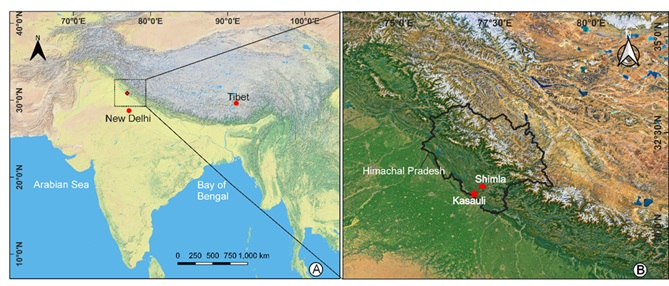
The study was led by the Birbal Sahni Institute of Palaeosciences along with collaborators from Academy of Scientific and Innovative Research and Tribhuvan University. Researchers collected fossil samples from the Kasauli Formation in Himachal Pradesh, dating back around 20 million years (Miocene period).
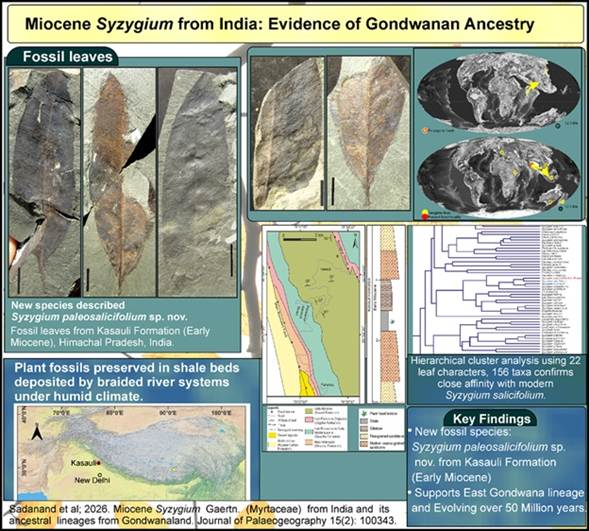
Using advanced techniques such as microscopy, morphological analysis, and statistical validation, scientists examined fossil leaves and compared them with modern plant species and global databases. They also reassessed older fossil records from India spanning 60 to 20 million years ago.
Key findings include:
- Discovery of 11 well-preserved fossil leaves of Syzygium from about 20 million years ago
- Identification of a new species named Syzygium paleosalicifolium
- Evidence that Syzygium existed in India as early as 55 million years ago (Eocene period)
- Strong indication that the plant spread from India to Southeast Asia and Australia
This research significantly revises the understanding of the plant’s origin and global spread, positioning India as a crucial hub in its evolutionary history.
Published in the Journal of Palaeogeography, the study also highlights how such discoveries help scientists better understand ancient climates and ecosystems. These insights can improve predictions about future climate change and support biodiversity conservation efforts.
Publication link: https://doi.org/10.1016/j.jop.2026.100343
Reference: PIB
You may also like
-
Large- and Small-scale Magnetic Activity Driving Microwave Polar Brightening in the Sun
-
Molecular Geometry Tweak Opens New Way for Smart Biomaterials
-
ISRO’s Indo-French TRISHNA Satellite Enters Advanced Development Stage, Launch Expected in 2027–28
-
IISc Scientists Show How Strong Magnetic Fields Could Allow White Dwarfs to Exceed Chandrasekhar Limit
-
IIT Madras to Launch Global Mission to Map 100 Human Brains in 3D
