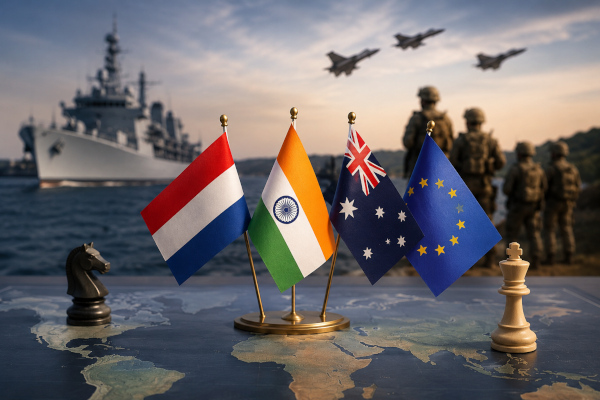
India used the IISS Shangri-La Dialogue in Singapore as a high-value defence diplomacy platform, holding separate discussions with the Netherlands, Australia and the European Union. Defence Secretary Rajesh Kumar Singh led these engagements on the sidelines of the summit, signalling India’s growing focus on building practical security partnerships across the Indo-Pacific and Europe. The 2026 Shangri-La Dialogue is being held in Singapore from 29 to 31 May 2026, with participation from 44 countries, 54 ministerial-level delegates, and more than 42 Chief of Defence Forces-level delegates and senior defence officials.
In the meeting with the Netherlands, Rajesh Kumar Singh held talks with Dutch Defence Minister Dilan Yeşilgöz-Zegerius. The discussion focused on strengthening bilateral defence cooperation, expanding military-to-military engagement and exploring defence industrial collaboration. This is important because the Netherlands is a serious European technology and maritime power, with strengths in naval systems, logistics, shipbuilding, electronics, cyber infrastructure and port security. For India, such cooperation fits naturally into its wider maritime security vision, especially as Indian Ocean security increasingly connects with European Indo-Pacific interests.
The talks with Australia carried strong Indo-Pacific significance. Singh met his Australian counterpart Meghan Quinn, and both sides reviewed progress under the India-Australia Comprehensive Strategic Partnership. The two countries also discussed future high-level engagements and ways to deepen defence cooperation in areas of mutual interest. Australia’s own Defence Ministry had earlier described India and Australia as “top-tier security partners”, with Australian Defence Minister Richard Marles scheduled to travel to India after the Shangri-La Dialogue for the 2nd Australia-India Defence Ministers’ Dialogue.
India’s engagement with the European Union was equally significant. Rajesh Kumar Singh held talks with Belén Martínez Carbonell, Secretary General of the European External Action Service, and Lieutenant General Enrico Barduani, Deputy Chair of the European Union Military Committee. The discussions advanced the India-EU strategic dialogue around shared security interests and deeper defence and strategic cooperation. This gives India a wider institutional channel with Europe beyond individual bilateral partnerships, especially in areas such as maritime security, defence technology, supply chain resilience, cyber security and regional stability.
These meetings also came just after India and Singapore held their 16th Defence Policy Dialogue on 28 May 2026. During that dialogue, India and Singapore discussed defence industry cooperation, cyber security, artificial intelligence, maritime security, unmanned systems and advanced defence technologies. Both sides also reaffirmed support for an open, inclusive and rule-based regional security architecture in the Indo-Pacific. This gives context to India’s wider activity in Singapore: New Delhi is using the summit period to strengthen several defence tracks together — bilateral, minilateral and institutional.
The larger message is clear. India is positioning itself as a serious security actor that can speak to Europe, ASEAN, Australia and other Indo-Pacific partners from a position of strategic confidence. The focus is shifting from ceremonial defence diplomacy to operational and industrial cooperation. Military exchanges, maritime coordination, defence manufacturing, emerging technologies, cyber resilience and interoperability are now becoming the working language of India’s partnerships.
For India, the Netherlands brings European maritime and technology depth, Australia brings Indo-Pacific operational convergence, and the European Union brings institutional weight. Together, these engagements show India’s defence diplomacy moving across three layers at once: trusted bilateral partnerships, regional Indo-Pacific security cooperation and wider engagement with European strategic institutions.
You may also like
-
Sigma Advanced Systems Secures Fresh ₹973 Crore NATO Artillery Ammunition Order
-
India Advances Indigenous Defence and Space Technologies Through Naval Innovation, Drones and Advanced Electronics
-
Thales Seeks Indian Partnerships for Next-Generation Missiles, Radars and Electronic Warfare Systems
-
Indian and Australian Armies Conduct Jungle and Coastal Warfare Drills in AUSTRAHIND 2026
-
Sagar Defence Unveils Autonomous Vessel at SWAVLAMBAN 2026, Expands Manufacturing
