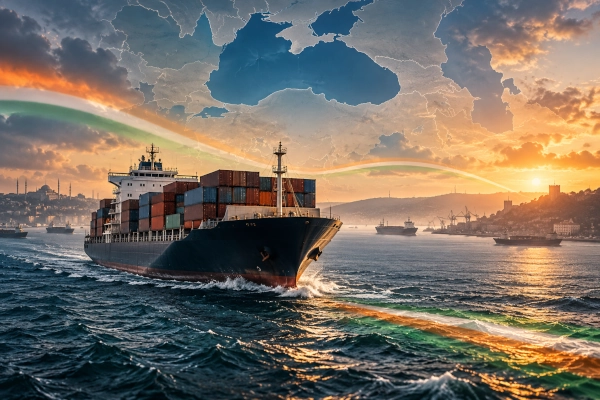
India has emerged in discussions around the security of commercial shipping in the Black Sea as Ukraine steps up diplomatic efforts to restore safer maritime trade routes disrupted by the continuing war with Russia.
The development places New Delhi in an unusual but potentially important diplomatic position. India has not announced any formal mediation role between Russia and Ukraine, but maritime security has now become a distinct part of its engagement with Kyiv. The issue also connects directly with Indian interests because Indian sailors work across the global merchant fleet and India depends heavily on stable maritime trade for energy, fertilisers, food commodities and manufactured goods.
India Raises Civilian Shipping Security With Ukraine
The maritime dimension of India’s engagement became clearer during External Affairs Minister S. Jaishankar’s visit to Kyiv on September 3, 2026, when he met Ukrainian President Volodymyr Zelenskyy.
According to the Ukrainian presidency, the two sides discussed threats to civilian shipping in the Black Sea. Jaishankar referred to the deaths of Indian sailors in attacks on vessels and stressed the importance of maritime safety for India as a major seafaring nation.
This gave India a direct stake in the issue beyond the broader political dimensions of the Russia–Ukraine war. For New Delhi, Black Sea security is not only a European security concern but also a question of seafarer safety, trade continuity and the stability of global commodity flows.
Ukraine Pushes for a Maritime Truce
Ukraine has been seeking wider diplomatic support for restoring safer maritime movement in the Black Sea. During talks with Turkish President Recep Tayyip Erdoğan on September 24, Zelenskyy discussed Black Sea security and the restoration of the maritime export corridor.
Kyiv has indicated that several options are under discussion. Its position is that progress would require Russia to halt attacks on Ukrainian infrastructure, after which Ukraine could reciprocally reduce certain forms of long-range strikes.
Türkiye remains the most important regional player because of its control over access to the Black Sea through the Bosporus and Dardanelles and its earlier role in facilitating the Black Sea Grain Initiative.
India’s position is different. New Delhi is not a Black Sea power, but it maintains working relations with both Moscow and Kyiv and has consistently advocated dialogue and diplomacy.
India Is Not Yet a Formal Mediator
The distinction is important.
There is no official evidence that India is formally mediating negotiations between Russia and Ukraine over a maritime ceasefire. The Ministry of External Affairs has not announced that New Delhi is negotiating a new Black Sea agreement.
What is established is that India has discussed civilian maritime security directly with Ukraine and that Kyiv is trying to engage countries with major commercial, food-security and shipping interests in creating conditions for safer navigation.
India is therefore better described as part of the broader diplomatic environment around Black Sea shipping rather than as a formal intermediary between Russia and Ukraine.
Why the Black Sea Matters to Global Food Security
The Black Sea is one of the world’s most important grain-export regions.
Ukraine is a major supplier of wheat, maize, sunflower oil and other agricultural commodities, while Russia is also one of the world’s largest grain exporters. Disruption to ports and maritime routes can therefore affect food markets far beyond Eastern Europe.
Ukraine has repeatedly argued that attacks on port infrastructure threaten food supplies to countries that depend on imports from the region. During Jaishankar’s Kyiv visit, Zelenskyy also linked maritime security with the wider question of maintaining access to global food markets.
For India, the significance extends beyond domestic imports. New Delhi maintains strong commercial relationships across West Asia, Africa and Asia, where instability in grain and freight markets can affect partner economies and food-security conditions.
Commercial Shipping Risk Has Increased
The maritime security environment in the Black Sea has become more difficult.
London’s Joint War Committee recently widened the area classified as high risk following increased attacks on commercial shipping. Such classifications can raise war-risk insurance premiums and increase operating costs for shipping companies.
The impact is not limited to agricultural cargoes. The Black Sea is also an important route for crude oil, refined petroleum products and other bulk commodities.
Higher insurance costs, rerouting and operational uncertainty can therefore affect freight prices and international trade even when individual cargoes are not directly connected with Russia or Ukraine.
Russia Is Diversifying Its Export Routes
The pressure on Black Sea shipping is also changing Russian logistics.
Russian companies have begun adapting fertiliser and coal terminals in Baltic and Arctic ports to handle more grain exports as disruption affects traditional Black Sea routes.
A large share of Russia’s seaborne grain exports has historically moved through the Black Sea, making alternative routes strategically important for Moscow.
This illustrates how the conflict is changing regional trade patterns rather than merely delaying individual shipments.
India’s Russia Relationship Adds Diplomatic Weight
India’s involvement attracts attention because New Delhi maintains a substantial strategic relationship with Moscow.
Russia remains an important supplier of crude oil and defence equipment to India, while the two countries continue cooperation in energy, nuclear power, space, connectivity and industrial sectors.
At the same time, India has maintained diplomatic engagement with Ukraine and has repeatedly argued that the conflict should be addressed through dialogue and diplomacy.
This gives New Delhi access to both sides, although access should not be confused with direct influence over battlefield or military decisions.
India’s practical value in Black Sea discussions may instead come from its position as a major trading nation that can highlight the interests of commercial shipping, food-importing countries and seafarers.
A Limited Maritime Arrangement May Be More Achievable
A comprehensive settlement of the Russia–Ukraine war remains far more complex than a limited agreement dealing with commercial shipping.
For that reason, Black Sea maritime security could become one of the areas where narrower arrangements are explored even without a broader peace settlement.
Türkiye’s earlier role in the Black Sea Grain Initiative demonstrated that limited functional agreements can sometimes operate even while wider hostilities continue.
Any new arrangement would still have to address difficult issues such as port security, attacks on maritime infrastructure, vessel inspections, sanctions-related concerns and the treatment of military or dual-use cargoes.
India’s Maritime Interest Is Likely to Remain Central
India’s role should therefore be viewed primarily through the lens of maritime security rather than as evidence of a new peace-mediation role.
The safety of Indian seafarers, uninterrupted movement of food and energy commodities, insurance costs and stability of international shipping are all direct Indian interests.
If discussions over a Black Sea maritime truce progress further, India could remain a useful diplomatic participant because it maintains working relations with Russia, Ukraine and many of the countries most affected by disruptions to agricultural and energy trade.
For now, the clearest development is that New Delhi is increasingly treating maritime security as a distinct diplomatic issue within its broader engagement on the Russia–Ukraine conflict.
References
Office of the President of Ukraine — Volodymyr Zelenskyy Discussed Peace Efforts, Security Issues, and Bilateral Cooperation with India’s Minister of External Affairs, September 3, 2026
https://www.president.gov.ua/en/news/volodimir-zelenskij-obgovoriv-iz-ministrom-zakordonnih-sprav-106241
Office of the President of Ukraine — Presidents of Ukraine and Türkiye Discussed Black Sea Security, Restoration of Food Exports, and a Potential Drone Deal, September 24, 2026
https://www.president.gov.ua/en/news/prezidenti-ukrayini-j-turechchini-obgovorili-bezpeku-v-chorn-106553
Office of the President of Ukraine — Meeting on Challenges Facing Food Exports and Maritime Transportation, September 15, 2026
https://www.president.gov.ua/en/news/prezident-proviv-naradu-z-uryadovcyami-j-predstavnikami-agra-106405
Reuters — London’s Marine Insurers Widen Black Sea High-Risk Zone as Shipping Attacks Surge, September 18, 2026
Reuters — Russia Adapts Baltic and Arctic Terminals to Export Grain Amid Black Sea Disruption, September 21, 2026
You may also like
-
Drupada’s Priest at Hastinapura: The Mahabharata’s First Formal Diplomatic Attempt to Prevent the Kurukshetra War
-
India and Finland Expand Technology Dialogue as New Delhi Deepens European Partnerships
-
India and Slovenia Explore Manufacturing, Energy and Digital Opportunities Around India-EU Trade Expansion
-
India-Pacific Islands Cooperation Gets Fresh Push at Second FIPIC Foreign Ministers’ Meeting
-
India and Netherlands Deepen Water Partnership With Two MoUs for Gujarat’s Kalpasar Project
