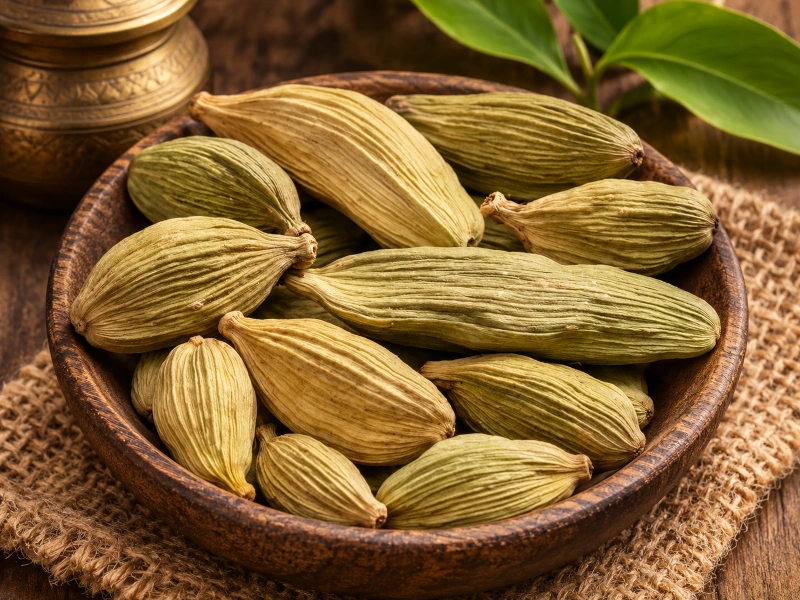
In the mist-covered mountains of Sikkim, where the Eastern Himalayas rise above deep river valleys and dense temperate forests, grows one of India’s most distinctive aromatic spices. Sikkim Large Cardamom, renowned for its dark capsules, powerful fragrance and characteristic smoky flavour, represents an agricultural tradition closely associated with the mountain communities of the Himalayan region. Cultivated beneath forest canopies and nourished by mountain streams, this valuable spice has sustained generations of farmers while contributing to Sikkim’s reputation as an important centre of organic agriculture.
Obtained from the dried fruit capsules of Amomum subulatum Roxb., Sikkim Large Cardamom is botanically distinct from the small green cardamom cultivated in southern India. Its relatively large capsules, dark reddish-brown appearance, concentrated essential oils and distinctive aromatic profile make it particularly valued in savoury cooking, traditional spice mixtures and regional culinary preparations. Unlike green cardamom, which is generally prized for its sweet and floral fragrance, large cardamom develops a deeper, more robust aroma, often enhanced through traditional smoke-curing.
The cultivation of large cardamom is closely associated with Sikkim’s mountain environment, where traditional agroforestry practices combine spice production with tree cover, organic matter management and the careful use of natural water resources. The crop holds considerable economic importance for rural communities, particularly those engaged in smallholder agriculture across the state’s mountainous districts.
Sikkim Large Cardamom received Geographical Indication (GI) registration on 23 March 2015, formally recognising its geographical identity under India’s Geographical Indications of Goods (Registration and Protection) Act, 1999. The registration was obtained by the North Eastern Regional Agricultural Marketing Corporation Limited (NERAMAC), under the Ministry of Development of North Eastern Region. The GI registration protects the identity of a spice whose reputation reflects the relationship between Himalayan ecology, traditional farming knowledge and the agricultural heritage of Sikkim.
Historical Origins and Traditional Heritage of Sikkim Large Cardamom
Large cardamom has a long history of cultivation in the Eastern Himalayan region, particularly in Sikkim and adjoining mountain territories. The plant is adapted to the humid, shaded environments of the Himalayan foothills, where suitable climatic conditions and forest vegetation support its growth. Traditional farming communities developed methods of cultivating the crop within agroforestry systems, establishing a production tradition that continues to influence the region’s agricultural landscape.
Sikkim’s mountainous geography encouraged the development of agricultural systems suited to steep slopes, variable elevations and abundant seasonal rainfall. Large cardamom became an important component of these systems because it could be cultivated beneath suitable tree cover while providing a valuable commercial harvest. The crop gradually developed into one of the state’s principal cash crops, supporting rural households through the sale of dried capsules.
The history of large cardamom is particularly associated with the agricultural traditions of the Lepcha, Bhutia and Nepali-speaking communities of Sikkim. These communities contributed to the development and continuation of regional farming practices, including the management of forest shade, organic matter, planting material and harvesting operations. Their accumulated knowledge reflects the adaptation of agriculture to the environmental conditions of the Eastern Himalayas.
Traditional cultivation also involved the management of local water sources. Mountain streams and natural drainage systems were important for maintaining moisture in cardamom-growing areas, particularly during periods of reduced rainfall. Farmers developed practical methods of directing water towards plantations while avoiding excessive saturation of the soil.
Large cardamom eventually became an important commodity in regional trade, connecting Sikkim’s agricultural villages with markets in adjoining Himalayan territories and the wider Indian subcontinent. Its strong flavour and characteristic aroma contributed to demand from traders supplying spice markets and food-processing enterprises.
The continued cultivation of large cardamom represents the preservation of an agricultural tradition in which geographical conditions, community knowledge and specialised post-harvest practices remain closely connected. Its GI recognition acknowledges this heritage and provides a legal framework for protecting the reputation established by generations of Sikkimese farmers.
Geographical Origin and Cultivation Areas
Sikkim Large Cardamom is associated with the mountainous agricultural landscapes of Sikkim, where suitable elevations, rainfall and forest vegetation create favourable conditions for its cultivation. The Geographical Indications Registry identifies Sikkim as the registered geographical area of the product, establishing its protected regional identity.
Large cardamom cultivation is distributed across several parts of the state, particularly in mountain villages where agroforestry systems remain an important component of the agricultural economy. Areas within the present-day districts of Mangan, Gyalshing, Pakyong, Gangtok, Namchi and Soreng contain landscapes associated with cardamom cultivation, although the suitability of individual locations depends on altitude, moisture availability and environmental conditions.
The Dzongu region of northern Sikkim possesses a particularly important association with traditional large cardamom cultivation. This mountainous area, closely connected with Lepcha cultural heritage, is associated with the indigenous Dzongu Golsey variety, demonstrating the relationship between local agricultural knowledge and the conservation of distinctive planting material.
Western Sikkim also contains important cardamom-growing landscapes. Villages in the Gyalshing region have maintained traditional cultivation practices, while agricultural institutions have introduced programmes supporting improved planting material, nursery development and plantation management.
The Pakyong region forms another important part of Sikkim’s cardamom economy. Government-supported activities have included farmer training, producer organisation development and improvements in cultivation and marketing practices.
Large cardamom can be cultivated across a range of elevations, depending on the variety and local climatic conditions. Different cultivars are adapted to lower, middle and higher mountain environments, allowing farmers to select planting material according to the characteristics of their agricultural land.
The geographical identity of Sikkim Large Cardamom consequently reflects more than the political boundaries of the state. It represents a distinctive Himalayan production system shaped by mountain ecology, traditional varieties, agroforestry practices and the accumulated knowledge of farming communities.
Unique Characteristics of Sikkim Large Cardamom
Sikkim Large Cardamom is produced from Amomum subulatum Roxb., a perennial herbaceous plant belonging to the family Zingiberaceae. The plant develops underground rhizomes and produces clusters of leafy shoots, with flowering structures emerging near the base of the plant.
The commercially valuable portion consists of dried fruit capsules containing numerous small aromatic seeds. These capsules are considerably larger than those of small green cardamom and generally possess an oval to rounded shape with a ribbed or textured exterior.
The colour of traditionally cured large cardamom ranges from reddish-brown to dark brown, sometimes approaching black. The drying process influences the appearance of the capsules, while their natural aromatic compounds contribute to the strong fragrance associated with the spice.
A defining characteristic of Sikkim Large Cardamom is its distinctive smoky, resinous and penetrating aroma. This fragrance is associated with the essential oils naturally present in the seeds and with the traditional curing methods used to prepare the harvested capsules.
The aromatic profile differs considerably from that of small green cardamom. While green cardamom is commonly associated with sweet, floral and fruity notes, large cardamom possesses a stronger and more robust character that makes it particularly suitable for savoury preparations.
The spice also has an established reputation for retaining its flavour during cooking. Whole capsules are frequently incorporated into dishes that require prolonged heating, allowing their aromatic constituents to contribute gradually to the finished preparation.
These physical and sensory characteristics form an important part of the commercial identity of Sikkim Large Cardamom. The combination of its botanical origin, traditional production methods and Himalayan geographical association provides the foundation for its recognition as a Geographical Indication.
Traditional Varieties of Sikkim Large Cardamom
One of the most important features of Sikkim Large Cardamom is the diversity of traditional cultivars maintained by farming communities. The Government of Sikkim’s Agriculture Department identifies six principal indigenous cultivars: Ramsey, Ramla, Sawney, Varlangey, Seremna and Golsey. These varieties differ in plant characteristics, capsule development, elevation requirements and harvesting periods.
Ramsey is particularly suited to higher elevations, generally above 1,500 metres. The plants are robust, with maroon-coloured tillers and comparatively narrow leaves. Flowering generally begins around May, while harvesting takes place during October and November. Its adaptation to steep, high-altitude landscapes makes it important in Sikkim’s traditional mountain agriculture.
Ramla resembles Ramsey in several growth characteristics and is cultivated in selected high-altitude regions of northern Sikkim. The variety produces comparatively broad leaves and dark pinkish capsules, with flowering beginning around May and harvesting generally occurring in October.
Sawney is widely adapted to middle and higher elevations, making it one of the more versatile traditional cultivars. It produces relatively large capsules and is suitable for cultivation across different Himalayan environments. Flowering generally occurs between March and May, while harvesting takes place during September and October, sometimes extending into November.
Varlangey is recognised for its vigorous growth and suitability for middle and higher elevations. Its plants are relatively tall and robust, while the capsules are often bold and contain numerous seeds. At higher elevations, flowering and harvesting may occur later than in lower-altitude varieties.
Seremna is traditionally associated with selected lower-altitude areas of western Sikkim, including the Hee-Gaon region. It is recognised for its productive capacity and distinctive growth characteristics, including drooping leaves and green tillers.
Golsey, particularly the Dzongu Golsey type, is associated with lower-elevation cultivation in northern Sikkim. The plants are generally less tall than some high-altitude varieties but produce comparatively bold capsules. The variety forms an important part of the agricultural heritage of the Dzongu region.
The survival of these cultivars demonstrates the genetic and agricultural diversity of large cardamom cultivation in Sikkim. Each variety reflects adaptations to particular environmental conditions, providing farmers with planting material suited to different elevations and growing seasons.
Traditional Cultivation and Himalayan Agroforestry Practices
Sikkim Large Cardamom is traditionally cultivated beneath suitable forest and plantation shade, forming an important component of the state’s Himalayan agroforestry systems. This method allows farmers to grow a commercially valuable crop while retaining tree cover that moderates sunlight, temperature and soil moisture.
Large cardamom requires a humid growing environment and protection from prolonged exposure to intense sunlight. Farmers therefore maintain shade trees above their plantations, carefully managing vegetation to provide conditions suitable for healthy plant development.
One of the most important traditional shade trees is Alnus nepalensis, commonly known as Himalayan alder or Utis. Other suitable species include Schima wallichii and selected native trees adapted to the region’s mountain environment. These trees contribute to the agroforestry landscape while providing the filtered light required by large cardamom.
The cultivation system also makes extensive use of organic matter. Fallen leaves, plant residues and compost contribute to soil fertility and help maintain moisture in the root zone. The accumulation of natural vegetation beneath shade trees supports the development of soil conditions favourable for perennial crops.
Large cardamom is commonly propagated through healthy suckers obtained from established plants, although seed propagation and improved nursery techniques are also used. Farmers select suitable planting material and establish it in prepared pits or planting sites where adequate drainage and moisture are available.
Planting generally takes place during the monsoon period, particularly between May and July, when rainfall supports the establishment of young plants. The exact timing depends on local weather conditions and the availability of planting material.
Farmers undertake regular plantation maintenance, including the removal of competing weeds, management of old shoots and protection of the developing plants from pests and diseases. These activities require knowledge of the crop’s growth cycle and the environmental conditions of individual plantations.
The integration of shade trees, organic matter management and perennial spice cultivation makes large cardamom an important example of traditional Himalayan agroforestry. Its continued production demonstrates how agricultural systems can be adapted to mountain landscapes while maintaining the ecological conditions required by the crop.
The Role of the Eastern Himalayas and Mountain Climate
The Eastern Himalayas form the ecological foundation of Sikkim Large Cardamom cultivation. The region’s steep slopes, abundant rainfall, forest vegetation and varied elevations create a distinctive environment supporting several specialised agricultural crops.
Large cardamom generally thrives in cool, humid mountain conditions where soil moisture remains available during important stages of plant growth. The crop benefits from suitable shade and well-drained soils, making forested mountain slopes particularly important for traditional cultivation.
The Government of Sikkim’s agricultural guidance identifies well-drained sandy loam soils with a moderately acidic reaction as suitable for large cardamom. Organic matter contributes to soil structure and moisture retention, while appropriate drainage helps protect the underground rhizomes from waterlogging.
Elevation has a significant influence on the crop’s development. Traditional cultivars possess different levels of adaptation to low, middle and high-altitude environments, with some varieties performing particularly well above 1,500 metres.
Scientific research published in Scientific Reports in 2023 examined large cardamom cultivation across 41 sites in Sikkim at elevations ranging from approximately 975 to 2,069 metres. The study identified significant differences in growth and yield-related characteristics among cultivars, demonstrating the importance of matching planting material with suitable environmental conditions.
Mountain water resources are another important component of the traditional production system. Springs, streams and local irrigation channels can help maintain soil moisture during periods when rainfall is insufficient.
The relationship between forest cover, soil moisture and mountain climate gives Sikkim Large Cardamom its distinctive agricultural identity. Protecting these environmental conditions remains important for maintaining productive plantations and preserving the traditional geographical character of the crop.
Traditional Bhatti Curing and the Development of Smoky Aroma
One of the most distinctive aspects of Sikkim Large Cardamom is its traditional post-harvest processing method, commonly associated with the Bhatti system of curing.
Freshly harvested large cardamom capsules contain substantial moisture and must be dried before they can be stored or marketed. Traditionally, farmers place the capsules on a raised drying platform above a controlled fire, allowing heat and smoke to remove moisture from the harvested material.
The conventional Bhatti structure uses locally available construction materials and fuelwood. Heat generated beneath the drying platform passes through the capsules, gradually reducing their moisture content while contributing to the characteristic dark colour and smoky aroma associated with traditionally processed large cardamom.
This curing method has considerable cultural and commercial importance because it forms part of the inherited production knowledge of Himalayan farming communities. The technique has helped establish the distinctive sensory identity of large cardamom in regional spice markets.
However, direct exposure to smoke can also create processing challenges. Excessive temperatures, uncontrolled combustion and prolonged exposure to smoke may lead to uneven drying, deterioration of aromatic quality and contamination by undesirable combustion products.
Scientific research has therefore focused on improving traditional Bhatti technology. The Indian Cardamom Research Institute, through its regional research activities in Sikkim, has developed improved curing systems designed to retain desirable colour and flavour while achieving more controlled drying.
Improved systems can separate smoke from the capsules or regulate the movement of heated air, helping farmers reduce undesirable contamination and produce a more consistent commercial product.
The development of better curing technologies demonstrates how traditional processing knowledge can be combined with scientific improvements. Maintaining the distinctive identity of Sikkim Large Cardamom does not require preserving every limitation of older processing methods; rather, it involves protecting the crop’s geographical heritage while improving quality, safety and commercial value.
Scientific Characteristics and Essential-Oil Composition
The distinctive fragrance of Sikkim Large Cardamom is associated with the volatile essential oils contained within its seeds. These oils comprise several naturally occurring aromatic compounds that contribute to the spice’s powerful and penetrating flavour.
One of the principal constituents is 1,8-cineole, a compound associated with fresh, cooling and eucalyptus-like aromatic notes. Its presence contributes to the characteristic fragrance of large cardamom and helps distinguish its sensory profile from that of small green cardamom.
Other naturally occurring volatile compounds contribute additional woody, resinous and aromatic characteristics. Their relative concentrations vary according to cultivar, environmental conditions, maturity and processing techniques.
Traditional smoke-curing introduces another dimension to the flavour of the spice. Smoke-related aromatic substances may become associated with the dried capsules during processing, contributing to the familiar smoky character of commercial black cardamom.
The quality of large cardamom is influenced by capsule maturity, drying conditions, moisture content and storage practices. Excessive moisture can encourage microbial deterioration, while unsuitable heating and prolonged storage may reduce aromatic quality.
Scientific assessment therefore considers physical characteristics such as capsule size, colour and cleanliness, together with chemical parameters and the presence of undesirable contaminants.
The development of improved processing and analytical methods offers opportunities to maintain the strong aromatic character of Sikkim Large Cardamom while supporting consistent quality standards.
Culinary Importance and Traditional Uses
Sikkim Large Cardamom occupies an important place in the culinary traditions of the Eastern Himalayas and the wider Indian subcontinent. Its robust aroma and smoky flavour make it particularly suitable for savoury dishes, spice blends and preparations requiring prolonged cooking.
In Sikkim and neighbouring Himalayan regions, large cardamom is used in selected meat preparations, curries and regional spice mixtures. Its strong fragrance complements ingredients such as ginger, garlic, chilli and other aromatic spices commonly used in mountain cuisines.
The spice is also widely recognised in North Indian cooking, where whole black cardamom capsules are incorporated into biryani, pulao, rich gravies and slow-cooked meat dishes. The capsules are often added during cooking and may be removed before serving, allowing their aroma to infuse the preparation.
Large cardamom contributes to traditional spice mixtures such as garam masala, where its deep flavour adds complexity to combinations of aromatic ingredients. The quantities used are generally small because its fragrance can become dominant when added excessively.
Its culinary applications differ from those of small green cardamom. Green cardamom is commonly preferred in sweets, desserts and fragrant beverages, while large cardamom is more closely associated with savoury preparations and robust spice blends.
Large cardamom also has a history of use in traditional Indian medicinal systems. It has been employed in preparations associated with digestion and respiratory comfort, although such applications should be distinguished from established culinary uses and evaluated according to appropriate medical evidence.
The continuing demand for large cardamom reflects its distinctive sensory characteristics and versatility in food preparation. Its strong flavour has helped sustain commercial interest in a spice whose cultivation remains closely associated with the Eastern Himalayan agricultural landscape.
Geographical Indication Recognition of Sikkim Large Cardamom
Sikkim Large Cardamom received formal recognition under India’s Geographical Indications of Goods (Registration and Protection) Act, 1999, following an application submitted by the North Eastern Regional Agricultural Marketing Corporation Limited.
The application was filed on 27 January 2012 under Application No. 376, seeking protection for the geographical identity of Sikkim Large Cardamom as an agricultural spice associated with the state of Sikkim.
NERAMAC, a Government of India enterprise under the Ministry of Development of North Eastern Region, undertook the registration process to support the recognition and protection of the region’s traditional agricultural products.
The application documented the geographical origin and established reputation of Sikkim Large Cardamom, together with the agricultural characteristics and production traditions associated with the crop.
The Geographical Indications Registry examined the application through its statutory procedures, including the assessment of supporting documentation and publication of the proposed geographical indication.
The application appeared in Geographical Indications Journal No. 61, which the official registry records as available on 21 November 2014.
Following completion of the registration procedure, the registry issued Certificate No. 222 on 23 March 2015, formally registering Sikkim Large Cardamom under Class 30.
The registered geographical area is Sikkim, and NERAMAC is identified as the registered proprietor. The registration establishes a legal framework for protecting the geographical indication and supporting its use by eligible authorised producers.
Official registry records show that renewal documentation was processed in January 2023. The current registration remains valid until 26 January 2032, subject to further renewal under the applicable legislation.
The GI recognition formally acknowledges the distinctive agricultural identity of Sikkim Large Cardamom and its association with the ecological conditions and traditional farming practices of the Eastern Himalayas.
GI Tag Journey of Sikkim Large Cardamom
The recognition of Sikkim Large Cardamom as a Geographical Indication represents the formal protection of an agricultural tradition developed over generations in the Eastern Himalayas. Its journey combines traditional cultivation, institutional support, scientific research and modern initiatives designed to strengthen the livelihoods of spice-growing communities.
| Period / Date | Milestone |
|---|---|
| Traditional agricultural period | Himalayan farming communities developed large cardamom cultivation beneath suitable forest shade in Sikkim’s mountain landscapes. |
| Expansion of commercial cultivation | Large cardamom became one of Sikkim’s important cash crops, supporting rural households and regional spice trading networks. |
| 2004 | The Indian Cardamom Research Institute released improved large cardamom varieties ICRI Sikkim 1 and ICRI Sikkim 2. |
| 27 January 2012 | NERAMAC filed GI Application No. 376 for Sikkim Large Cardamom. |
| 21 November 2014 | The application was made available in Geographical Indications Journal No. 61. |
| 23 March 2015 | Sikkim Large Cardamom received GI Certificate No. 222. |
| 2020 | Government-supported biotechnology programmes highlighted the development of improved micropropagation methods for healthy large cardamom planting material. |
| January 2023 | The Geographical Indications Registry processed renewal documentation for the registered product. |
| 22 May 2025 | The Spices Board conducted a large cardamom nursery-development and farmer-support programme at Dentam in Gyalshing district. |
| 22 February 2026 | The Government of India announced a weather-based crop insurance pilot for large cardamom growers in Sikkim. |
| 24 February 2026 | Scheduled launch date of the Large Cardamom Weather-Based Crop Insurance Scheme, initially covering Pakyong, Gyalshing and Mangan. |
| 31 July 2026 | The Spices Board organised a growers’ training programme in Pakyong involving approximately 50–60 farmers from six Farmer Producer Organisations. |
| 26 January 2032 | The current GI registration remains valid until this date, subject to further renewal. |
The registration and development timeline demonstrates the importance of combining geographical protection with practical agricultural support. Scientific research, nursery development, farmer training and financial-risk management can strengthen the production system while preserving the geographical identity recognised by the GI registration.
GI Details at a Glance
| Particular | Details |
|---|---|
| Geographical Indication | Sikkim Large Cardamom |
| State | Sikkim |
| Botanical Name | Amomum subulatum Roxb. |
| Botanical Family | Zingiberaceae |
| Product Category | Agricultural |
| GI Class | 30 |
| Application Number | 376 |
| Date of Filing | 27 January 2012 |
| Registered Proprietor | North Eastern Regional Agricultural Marketing Corporation Limited (NERAMAC) |
| Registered Proprietor’s Address | 9 Rajbari Path, Ganeshguri, G.S. Road, Guwahati, Assam – 781005 |
| GI Journal | No. 61 |
| GI Journal Availability Date | 21 November 2014 |
| Certificate Number | 222 |
| GI Certificate Date | 23 March 2015 |
| Registered Geographical Area | Sikkim |
| Traditional Cultivars | Ramsey, Ramla, Sawney, Varlangey, Seremna and Golsey |
| Improved Varieties | ICRI Sikkim 1 and ICRI Sikkim 2 |
| Traditional Processing | Bhatti curing |
| Characteristic Appearance | Dark reddish-brown to nearly black capsules |
| Characteristic Aroma | Strong, penetrating and smoky |
| Cultivation System | Shaded Himalayan agroforestry |
| Current GI Status | Registered |
| Registration Valid Until | 26 January 2032 |
Farmer Participation and Traditional Agricultural Knowledge
The cultivation of Sikkim Large Cardamom depends substantially on smallholder farmers whose livelihoods are connected with mountain agriculture. The crop provides an important source of agricultural income in villages where steep terrain and environmental conditions limit the range of commercially suitable crops.
Traditional knowledge contributes to nearly every stage of production. Farmers select suitable planting material, maintain shade trees, manage soil moisture and determine appropriate harvesting periods according to local conditions.
The diversity of traditional cultivars reflects generations of adaptation to different elevations and climatic environments. Knowledge of the suitability of Ramsey, Sawney, Golsey and other varieties helps farmers choose planting material appropriate for their agricultural land.
Family labour and community participation remain important in harvesting and post-harvest processing. The collection of mature capsules and their preparation for drying require care, while curing operations demand practical experience in managing temperature and moisture.
The involvement of Farmer Producer Organisations offers opportunities for collective action in cultivation, processing and marketing. Organised groups can improve access to technical training, agricultural inputs and institutional support while strengthening connections with commercial buyers.
The Spices Board has increasingly emphasised producer participation in its agricultural development activities. The July 2026 training programme in Pakyong involved approximately 50–60 farmers from six Farmer Producer Organisations, demonstrating the importance of collective capacity-building in the state’s spice sector.
These initiatives complement the GI framework by connecting the protection of geographical identity with the practical needs of the communities responsible for producing the crop.
Scientific Research and Improved Planting Material
Scientific research has become increasingly important for strengthening large cardamom cultivation in Sikkim. The Indian Cardamom Research Institute, operating under the Spices Board, has undertaken extensive work on crop improvement, genetic resources, disease management and post-harvest technologies.
One of its important achievements was the development of ICRI Sikkim 1 and ICRI Sikkim 2, improved varieties selected from the Sawney cultivar. These varieties were released in 2004 and were developed to provide better production potential under suitable growing conditions.
The Spices Board reports that the improved varieties possess a yield potential of approximately 800 kilograms per hectare under appropriate management conditions. This figure represents research-based potential rather than a guaranteed yield for every agricultural holding.
The institute has also established germplasm conservation facilities at Pangthang and Kabi, where different large cardamom accessions are maintained for research and crop improvement.
Such conservation is important because traditional cultivars possess different characteristics relating to altitude adaptation, flowering, capsule development and environmental tolerance. Maintaining this diversity provides valuable genetic resources for future breeding programmes.
Research has also addressed important viral diseases affecting large cardamom. Chirke and Foorkey are among the major disease problems identified by the Spices Board, and scientific programmes have examined their transmission, prevention and management.
Healthy planting material is therefore an important priority. Biotechnology-supported initiatives have investigated micropropagation methods intended to produce disease-free plants and improve the availability of suitable planting material for farmers.
The Government of India’s biotechnology programmes have supported efforts to improve the production of healthy large cardamom plants through tissue-culture techniques. These technologies provide opportunities to complement conventional propagation and strengthen plantation renewal.
The integration of traditional cultivars with scientific crop improvement helps preserve the agricultural heritage of Sikkim while supporting more productive and resilient cultivation systems.
Sikkim’s Organic Agricultural Identity
Sikkim Large Cardamom occupies a distinctive place within the state’s wider commitment to organic agriculture. Sikkim became internationally recognised for its transition to fully organic farming, with the state formally declared India’s first fully organic state in 2016.
The cultivation of large cardamom is well suited to traditional agroforestry practices that make use of organic matter, forest shade and natural soil-management methods. Farmers have historically relied on leaf litter, compost and locally available organic inputs to maintain plantation conditions.
The retention of suitable tree cover contributes to the environmental character of cardamom-growing landscapes. Trees moderate sunlight, influence soil moisture and help maintain conditions favourable for the crop, while their fallen leaves contribute organic material to the soil.
The Government of India has highlighted Sikkim Large Cardamom as an important example of the relationship between geographical indications and traditional organic agricultural practices. Official GI promotional material published in 2021 identified its distinctive aroma and quality in connection with the agroclimatic conditions of Sikkim and the organic methods used in cultivation.
Organic farming practices can support the marketing of Sikkim Large Cardamom in specialised agricultural markets. However, the geographical indication and organic certification serve different purposes. GI registration protects geographical identity, while organic certification concerns compliance with prescribed production standards.
The combination of Sikkim’s organic agricultural reputation and the protected geographical identity of large cardamom provides opportunities to communicate the distinctive heritage of the crop to domestic and international consumers.
Economic Importance and Sikkim’s Spice Economy
Large cardamom is one of Sikkim’s most important traditional cash crops, contributing to the livelihoods of rural households and supporting commercial activity associated with spice trading and processing.
The Spices Board’s Annual Report 2024–25 records approximately 23,312 hectares under large cardamom cultivation in Sikkim, including 17,550 hectares of yielding area. Production was estimated at 5,429 metric tonnes, with productivity of approximately 309 kilograms per yielding hectare.
These figures demonstrate the importance of large cardamom within Sikkim’s agricultural economy. The state accounted for a substantial share of India’s reported large cardamom production, reflecting its long-established position as a major cultivation centre.
The figures describe the state’s overall large cardamom production and should not be interpreted as the volume of cardamom sold specifically under GI-authorised certification.
The commercial value of large cardamom depends on capsule quality, aroma, moisture content, processing methods and market demand. Well-processed capsules can command greater commercial interest, particularly when buyers require consistent product characteristics and reliable sourcing.
Domestic demand is supported by the extensive use of black cardamom in Indian cuisine, while international markets provide opportunities for exports of whole spices and value-added products.
The GI registration creates an additional basis for commercial differentiation by allowing qualifying Sikkim Large Cardamom to be identified through its protected geographical origin.
Improved processing facilities, organised producer participation and stronger market connections can help farming communities obtain greater value from the crop while preserving the reputation associated with Sikkim’s traditional agricultural heritage.
Weather-Based Crop Insurance and Farmer Protection
The economic importance of Sikkim Large Cardamom has encouraged new measures to support farmers facing environmental and agricultural risks.
On 22 February 2026, the Ministry of Commerce and Industry announced that the Spices Board, in collaboration with the Agriculture Insurance Company of India Limited, was preparing to introduce a Large Cardamom Weather-Based Crop Insurance Scheme in Sikkim.
The scheme was scheduled for launch on 24 February 2026 and designed initially as a pilot programme covering Pakyong, Gyalshing and Mangan. These districts contain important cardamom-growing areas where farmers are exposed to weather-related production uncertainties.
The initiative was intended to provide financial protection against specified climatic risks affecting large cardamom cultivation. Weather-based insurance uses defined meteorological parameters and insurance conditions to determine compensation, potentially reducing the financial impact of adverse growing seasons.
The pilot approach was designed to allow operational evaluation and feedback from participating farmers before considering further expansion.
The programme reflects a growing emphasis on strengthening the economic resilience of traditional spice cultivation. By combining crop insurance with agricultural research, farmer training and improved market access, government institutions are developing a broader support framework for Sikkim’s large cardamom sector.
Protecting Authenticity and Product Quality
The GI registration of Sikkim Large Cardamom establishes a legal framework for protecting the geographical identity of the product. Maintaining the value of this recognition requires appropriate production records, quality management and participation by eligible producers.
The registered proprietor, NERAMAC, plays an institutional role in the geographical indication system, while producers seeking authorised-user status must satisfy the applicable legal requirements.
The integrity of the registered product depends on its connection with the recognised geographical area and the agricultural practices associated with its identity.
Quality assurance begins with the selection of suitable planting material and continues through cultivation, harvesting, curing and storage. Each stage influences the physical and aromatic characteristics of the final spice.
Harvesting at an appropriate stage of maturity helps maintain capsule quality. Controlled drying reduces moisture and supports safe storage, while suitable packaging protects the product from deterioration during transport and commercial handling.
Improved curing technologies are particularly valuable because excessive smoke exposure and unsuitable drying conditions can affect product quality. The use of scientifically managed processing systems can help preserve desirable aromatic characteristics while reducing unwanted contamination.
Traceability provides another important means of protecting geographical authenticity. Records identifying the origin of harvested material, processing activities and commercial transactions can help distinguish eligible regional products from those originating outside the registered area.
The combination of GI protection, scientific quality management and transparent marketing can strengthen the commercial reputation of Sikkim Large Cardamom while supporting consumer confidence in its geographical identity.
Sikkim Large Cardamom and India’s GI Agricultural Heritage
India’s geographical indication system recognises agricultural products whose distinctive characteristics, reputation or quality are associated with particular regional environments and production traditions.
Sikkim Large Cardamom occupies a distinctive position within this heritage because its identity is rooted in the ecological conditions of the Eastern Himalayas rather than the tropical plantation landscapes more commonly associated with the spice trade of southern India.
The distinction between large and small cardamom is particularly significant. Sikkim Large Cardamom is derived from Amomum subulatum, while Alleppey Green Cardamom and Coorg Green Cardamom are produced from Elettaria cardamomum. These products belong to the same botanical family but represent different species with distinct agricultural and commercial characteristics.
The cultivation of large cardamom also highlights the importance of indigenous varieties. The preservation of Ramsey, Sawney, Golsey and other traditional cultivars reflects the relationship between mountain communities and the agricultural environments in which they have developed specialised farming knowledge.
Its association with agroforestry further distinguishes the product. Large cardamom is cultivated beneath tree cover, making its production closely connected with the management of forest vegetation, soil organic matter and mountain water resources.
The GI registration recognises these relationships and places Sikkim Large Cardamom within India’s wider framework for protecting traditional agricultural products.
It also demonstrates the importance of northeastern India in the country’s agricultural heritage. The region possesses distinctive crops, growing environments and cultivation practices that contribute substantially to India’s botanical and cultural diversity.
Future Prospects for Sikkim Large Cardamom
The future development of Sikkim Large Cardamom is closely connected with the conservation of suitable Himalayan growing environments, the preservation of indigenous cultivars and the continued advancement of scientific agricultural practices.
Research into disease-resistant planting material, improved propagation techniques and cultivar adaptation can help farmers maintain productive plantations. The conservation of traditional genetic resources remains particularly important because different varieties possess characteristics suited to specific elevations and environmental conditions.
Improved irrigation and water management provide further opportunities to strengthen cultivation. The availability of suitable soil moisture during critical growth periods can influence flowering and capsule development, making efficient water use an important component of plantation management.
The continued development of improved Bhatti curing systems and other controlled drying technologies can support better product quality. Processing improvements that preserve aroma while reducing contamination can strengthen the commercial position of Sikkim Large Cardamom in markets where food safety and product consistency are increasingly important.
Organised producer participation also offers opportunities for value addition. Farmer Producer Organisations can improve access to technical guidance, processing facilities, financial support and commercial markets, allowing smallholder farmers to participate more effectively in the agricultural value chain.
The weather-based crop insurance initiative announced in 2026 represents another component of this development. Financial-risk protection can complement agricultural research and market support by helping growers manage the uncertainties associated with mountain farming.
Sikkim’s established reputation for organic agriculture provides a further opportunity to develop specialised markets for authenticated large cardamom. Appropriate certification, traceability and quality management can help communicate the product’s geographical and agricultural identity.
The preservation of traditional farming knowledge remains central to these efforts. The experience of Himalayan communities in managing shade, selecting suitable varieties, maintaining soil fertility and harvesting cardamom represents an agricultural resource that cannot be replaced by technology alone.
Sikkim Large Cardamom embodies a distinctive combination of Himalayan ecology, traditional agroforestry, indigenous crop diversity and specialised processing knowledge. Its powerful aroma, characteristic dark capsules and established commercial reputation reflect the environmental conditions of the Eastern Himalayas and the agricultural experience of communities that have cultivated the crop for generations.
The Geographical Indication registration granted in March 2015 formally recognised this heritage, while ongoing scientific research and government-supported agricultural programmes continue to strengthen the production system.
From the shaded mountain plantations of Dzongu to the cardamom-growing villages of Gyalshing, Pakyong and Mangan, Sikkim Large Cardamom remains a living expression of India’s Himalayan agricultural heritage, indigenous farming knowledge and the enduring economic importance of one of the country’s most distinctive aromatic spices.
References
1. Geographical Indications Registry, Government of India — Sikkim Large Cardamom, Application No. 376.
Official registration record confirming the filing date, registered proprietor, geographical area, GI Journal publication, Certificate No. 222, registration date and validity until 26 January 2032.
https://search.ipindia.gov.in/GIRPublicSearch/Application/Details/376
2. Agricultural and Processed Food Products Export Development Authority (APEDA) — Geographical Indications of Sikkim.
Official government compilation identifying Sikkim Large Cardamom as a registered geographical indication.
https://apeda.gov.in/Sikkim
3. Government of Sikkim — Agriculture Department: Large Cardamom Cultivation and Varieties.
Official agricultural guidance describing the traditional cultivars Ramsey, Ramla, Sawney, Varlangey, Seremna and Golsey, together with their characteristics, elevation requirements and harvesting periods.
https://agri.sikkim.gov.in/Department/AgriSubMenuDetails?ContID=28&SubContID=120
4. Spices Board India, Ministry of Commerce and Industry — Research Highlights: Large Cardamom.
Official research documentation covering improved varieties, genetic resources, disease management, pollination studies and improved Bhatti curing technology.
https://indianspices.com/research-highlights-0
5. Spices Board India — Annual Report 2024–25.
Official statistical information on large cardamom cultivation, yielding area, production and productivity in Sikkim and other producing states.
https://www.indianspices.com/sites/default/files/Spices%20Annual%20Report%202024-25%20final%20%282%29%20%281%29.pdf
6. Press Information Bureau, Ministry of Commerce and Industry — Spices Board to Launch Large Cardamom Weather-Based Crop Insurance Scheme in Sikkim, 22 February 2026.
Official government announcement of the pilot insurance initiative covering Pakyong, Gyalshing and Mangan.
https://www.pib.gov.in/PressReleasePage.aspx?PRID=2231420
7. Press Information Bureau, Ministry of Commerce and Industry — Spices Board Organises Growers Training Programme for Large Cardamom Farmers in Pakyong District, 31 July 2026.
Official documentation of farmer training, producer organisation participation, cultivation guidance and market-development activities.
https://www.pib.gov.in/PressReleasePage.aspx?PRID=2292422
8. Press Information Bureau, Ministry of Commerce and Industry — Spices Clinic and Input Distribution Programme at Dentam, Gyalshing District, 22 May 2025.
Official report describing nursery development, agricultural inputs, scientific guidance and institutional support for large cardamom growers.
https://www.pib.gov.in/PressReleasePage.aspx?PRID=2130462
9. Department of Biotechnology, Government of India — Sikkim Science and Technology Programme Compendium, 2020.
Government documentation concerning biotechnology-based micropropagation of large cardamom and improved cultivation practices.
https://static.pib.gov.in/WriteReadData/userfiles/SSTP_Compendium_2020.pdf
10. ICAR — KIRAN: Large Cardamom Cultivation in Sikkim.
Government agricultural knowledge resource documenting soil requirements, shade management, propagation, traditional varieties and disease-control practices.
https://www.kiran.nic.in/sikkim_pride.html
11. Scientific Reports — Elevation Determines the Productivity of Large Cardamom (Amomum subulatum Roxb.) Cultivars in Sikkim Himalaya, 2023.
Peer-reviewed scientific research examining cultivar variation, elevation requirements and yield-related characteristics across 41 cultivation sites in Sikkim.
https://www.nature.com/articles/s41598-023-47847-6
12. Press Information Bureau — Geographical Indication Products of Northeastern India, November 2021.
Government publication describing the distinctive aroma, quality, organic production practices and agricultural importance of Sikkim Large Cardamom.
https://static.pib.gov.in/WriteReadData/specificdocs/documents/2021/nov/doc2021112441.pdf
You may also like
-
Indian HealthTech Startup EkaCare Selected to Build Multilingual AI Medical Documentation System for NHA
-
Ashoka Buildcon Secures $58.9 Million Contract to Develop 120 MW Solar Power Plant in Bhutan
-
Tata Power to Begin Construction of 10 GW Solar Ingot and Wafer Manufacturing Plant in Odisha
-
Cabinet Extends MUDRA Credit Guarantee Scheme Until 2031 with ₹5,000 Crore Corpus
-
Philippines Seeks Customised BrahMos Missile Systems as India Negotiates Potential $800 Million Defence Deal
