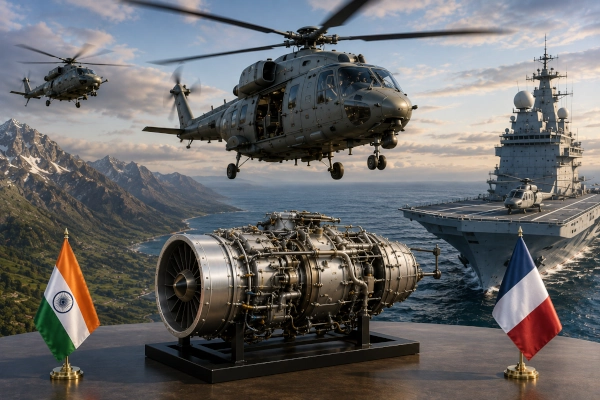
Hindustan Aeronautics Limited and Safran Helicopter Engines have taken a major step toward creating an indigenous high-power helicopter propulsion capability, signing the final contract with their joint venture SAFHAL Helicopter Engines Pvt. Ltd. for the Aravalli engine. The agreement covers the design, development, manufacture, supply and lifecycle support of the new 3,500–4,000 shaft horsepower turboshaft engine.
Aravalli has been selected to power HAL’s planned 13-tonne Indian Multi-Role Helicopter (IMRH) and its naval derivative, the Deck-Based Multi-Role Helicopter (DBMRH). These platforms are being developed to provide the Indian Armed Forces with a new generation of medium-lift helicopters capable of performing troop transport, air assault, logistics, search-and-rescue and other demanding missions. The naval DBMRH is intended to extend the concept to shipborne operations for the Indian Navy.
The programme will be executed through SAFHAL, the joint venture established by HAL and France’s Safran Helicopter Engines. Rather than simply manufacturing an existing foreign engine under licence, the partnership is structured around joint design and development of a new propulsion system tailored to the requirements of future Indian rotorcraft. Safran has described Aravalli as its first co-development effort in an engine of this power class.
Development will include advanced engineering and design methods, modern manufacturing processes, extensive testing and the creation of long-term product-support capabilities. The engine is being designed for high performance, reliability, maintainability and operation in demanding environments, requirements that will be particularly important for helicopters expected to serve across India’s varied terrain and climatic conditions.
The Aravalli programme also represents a significant progression in the long-standing HAL-Safran partnership. Their cooperation began with the Artouste engines used on the Cheetah and Chetak fleets and later expanded through the Shakti engine family, which powers the Advanced Light Helicopter, Light Combat Helicopter and Light Utility Helicopter. Aravalli moves this relationship into the joint development of a substantially more powerful propulsion system for the next generation of Indian medium-lift helicopters.
Beyond the engine itself, the programme is expected to strengthen India’s aerospace engineering, manufacturing and maintenance, repair and overhaul ecosystem. Establishing domestic expertise across the engine lifecycle could reduce dependence on overseas support while creating a foundation for future propulsion programmes and export opportunities. HAL and Safran have also indicated potential longer-term civil applications in areas such as offshore transport, utility missions and VVIP helicopter operations.
With the final contract now in place, Aravalli moves from programme selection into full-scale development and industrialisation. Its progress will be closely tied to the IMRH and DBMRH programmes, making the engine one of the most important indigenous aerospace propulsion projects currently being undertaken in India.
You may also like
-
IndigoTex Raises ₹5 Crore to Scale Indigenous Advanced Textile Technologies
-
Sunfox Technologies Raises $7 Million to Take India-Built Spandan ECG Platform Global
-
DRDO Opens Actuators, Infrared Seeker, Lightweight Torpedo and Armour Technologies to Indian Industry
-
Indian Army to Add 225 Indigenous FPV Drones; Aerodrone Says Systems Were Tested Up to 17,500 Feet
-
India Helps Build a Machine Hotter Than the Sun: INOX India’s Cryogenic Role in ITER
