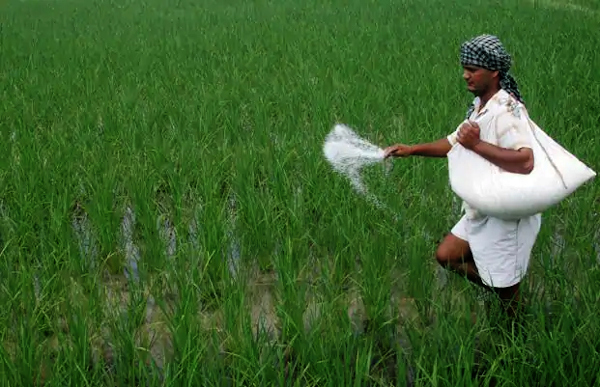
India has strengthened its fertilizer preparedness ahead of the Kharif 2026 season, with the government stating that the country currently has 199.65 lakh metric tonnes of fertilizer stock available, covering more than 51 percent of the projected seasonal requirement. The Department of Agriculture and Farmers Welfare has assessed the total fertilizer requirement for the upcoming Kharif season at 390.54 lakh metric tonnes.
According to the Department of Fertilizers, the present stock level is significantly higher than the usual buffer of around 33 percent, indicating improved advance planning, stocking and logistics management. The government has also assured farmers that there is no change in the Maximum Retail Price of major fertilizers, providing relief at a time when input costs and seasonal farm preparations remain crucial for the agricultural economy.
The government said India’s fertilizer availability has improved sharply after a recent crisis period, with around 97 lakh metric tonnes added through domestic production and imports. Domestic production alone contributed 76.78 lakh metric tonnes, while imports that reached Indian ports added another 19.94 lakh metric tonnes. This combined supply build-up has helped the country create a comfortable buffer before peak agricultural demand begins.
Product-wise, domestic production after the crisis included 46.28 lakh tonnes of urea, 6.20 lakh tonnes of DAP, 15.57 lakh tonnes of NPKs and 8.73 lakh tonnes of SSP. Imports reaching Indian ports included 12.51 lakh tonnes of urea, 0.76 lakh tonnes of DAP, 3.79 lakh tonnes of NPKs and 2.88 lakh tonnes of MOP. Together, these numbers show that both domestic manufacturing and overseas sourcing are being used to maintain fertilizer security for the farming sector.
To prevent any shortage during the peak season, Indian fertilizer companies have also initiated aggregated global tenders for 19 lakh metric tonnes of fertilizers. This includes 12 lakh tonnes of DAP, 4 lakh tonnes of TSP and 3 lakh tonnes of ammonium sulphate. In addition, tenders for raw materials such as 5.36 lakh tonnes of ammonia and 5.94 lakh tonnes of sulphur are also in progress.
The government has further confirmed that around 7 lakh tonnes of NPKs secured from stock on hand are expected to arrive at Indian ports during May and June. This will add another layer of supply support before sowing activity intensifies across the country.
The Department of Fertilizers is continuing regular reviews of input availability for urea and phosphatic and potassic fertilizer production. It is also clearing subsidy bills on a weekly basis to maintain liquidity across the supply chain. The Empowered Group of Secretaries has held eight meetings so far to address availability-related challenges and ensure that farmers receive fertilizers at affordable rates without disruption.
The latest update therefore signals that India is entering the Kharif 2026 season with a strong fertilizer buffer, stable prices and active import planning. For farmers, the most important takeaway is that the government has assured adequate availability of major fertilizers and no hike in MRP. For the agriculture sector, this preparedness is crucial because timely fertilizer supply directly affects sowing, crop health and overall farm productivity during one of India’s most important agricultural seasons.
Reference: PIB
You may also like
-
India’s Economic Warfare Challenge: Strategic Autonomy, Energy Security and the Rise of a Global Power
-
India-US Trade Deal Stalemate: Why Washington’s Tariff Pressure Has Failed to Secure an Agreement
-
US Double Standards in Foreign Policy: 16 Recent Cases Involving India, Russia, China and Global Trade
-
India’s Arctic Energy Ambitions: Russian Oil, LNG and a New Sea Route to Indian Ports
-
India and Russia Explore Joint Icebreaker Construction as Maritime Industrial Cooperation Expands
