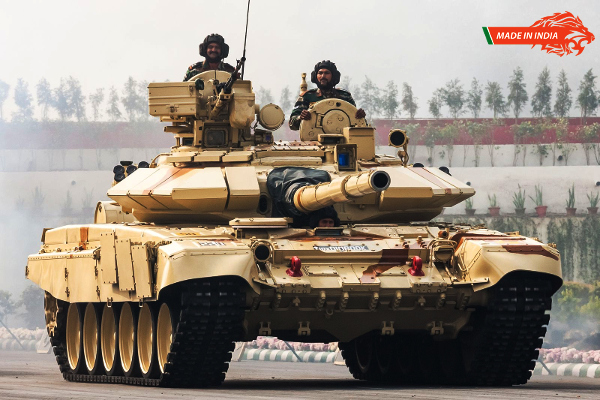
India is significantly expanding its capacity to maintain and modernise its frontline armoured fleet with the establishment of a new ₹472-crore T-Series Tank Overhaul Project at Vehicle Factory Jabalpur, designed to overhaul as many as 80 T-72 and T-90 tanks every year.
Raksha Mantri Rajnath Singh and Madhya Pradesh Chief Minister Dr Mohan Yadav performed the Bhoomi Pujan for the project on 27 August 2026 at Vehicle Factory Jabalpur, a unit of the Mini Ratna Defence Public Sector Undertaking Armoured Vehicles Nigam Limited (AVNL).
The new facility addresses an important maintenance requirement of the Indian Army. The Army requires approximately 230 tanks to undergo overhaul every year, while the Heavy Vehicles Factory at Avadi currently possesses capacity for about 150 tanks annually. Once the Jabalpur facility reaches its planned capacity of 80 tanks per year, the combined overhaul capability of the two facilities would effectively match the Army’s stated annual requirement.
Beyond increasing maintenance capacity, the project represents a broader effort to build an indigenous ecosystem capable of sustaining India’s large armoured fleet without excessive dependence on overseas supply chains. It will bring together tank overhaul, component manufacturing, modernisation, technical expertise and an expanded network of domestic suppliers.
Filling a Critical Tank Overhaul Capacity Gap
Modern battle tanks are complex machines that require extensive maintenance throughout their operational lives. An overhaul is considerably more comprehensive than routine servicing and generally involves inspection, repair, refurbishment or replacement of major mechanical, electrical, hydraulic and electronic systems before a tank is returned to operational service.
The Indian Army operates substantial fleets of T-72 and T-90 series main battle tanks, making dependable overhaul capacity essential for maintaining high levels of fleet availability.
Until now, the Heavy Vehicles Factory at Avadi has carried much of this responsibility. Its existing annual overhaul capacity of approximately 150 tanks, however, falls short of the Army’s requirement of around 230 tanks per year.
The planned 80-tank annual capacity at Jabalpur precisely addresses this gap. By creating a second substantial overhaul centre, India will also distribute maintenance capability across more than one major industrial location, reducing concentration and improving the resilience of the armoured vehicle support network.
For the Army, the central benefit will be the timely return of refurbished tanks to operational formations, improving availability and ensuring that ageing platforms remain combat-effective through their designated service lives.
T-72 and T-90 Remain Central to India’s Armoured Forces
The establishment of a dedicated T-Series overhaul facility is especially significant because the T-72 and T-90 continue to constitute a major component of India’s armoured strength.
The T-72 has served the Indian Army for decades and remains operational in substantial numbers. The newer T-90 family provides a more advanced armoured capability and has become another important pillar of India’s mechanised formations.
Even as future armoured systems emerge, these existing fleets will continue to require maintenance, refurbishment and technological upgrades.
The new Jabalpur facility therefore represents an investment not merely in sustaining old equipment but in maintaining combat capability while progressively incorporating modern technologies into established platforms.
Tanks Are Evolving, Not Disappearing
Rajnath Singh used the occasion to address a wider debate surrounding the future of tanks in modern warfare.
The rapid proliferation of drones, precision-guided weapons, missiles, satellites, artificial intelligence, electronic warfare and cyber capabilities has dramatically changed the battlefield. Recent conflicts have demonstrated that armoured vehicles operating without adequate surveillance, air defence, electronic protection and infantry support can be highly vulnerable.
This does not necessarily make tanks obsolete. Instead, it changes how they must operate.
Modern armoured warfare increasingly requires tanks to function as part of a connected combat network involving infantry, artillery, unmanned aircraft, air power, sensors, electronic warfare and precision-strike systems.
The Defence Minister emphasised precisely this approach, arguing that future battlefield effectiveness will depend on integrated capabilities rather than reliance upon any single weapons platform.
From Tank Formation to Integrated Combat System
The Indian Army’s evolving operational concepts increasingly seek to integrate traditionally separate combat arms into formations capable of responding rapidly and operating as combined fighting systems.
Rajnath Singh referred to the Army’s Integrated Battle Group concept, under which tanks, infantry, artillery, drones, surveillance systems, air support and precision weapons can be brought together in a coordinated operational structure.
Within such a system, a tank is no longer simply a heavily protected gun platform operating independently. It becomes one node within a broader network of sensors, communications systems and strike capabilities.
This transformation also changes the importance of tank modernisation.
Improved sensors can enhance situational awareness. Better communications can allow armoured formations to exchange information rapidly with drones and reconnaissance assets. Electronic warfare protection can improve survivability in contested environments, while modern fire-control and targeting equipment can reduce the time between detecting and engaging a threat.
An overhaul facility can consequently become much more than a repair centre if it is progressively equipped to support technological upgrades alongside mechanical refurbishment.
Jabalpur Could Become an Important Armoured Modernisation Hub
Vehicle Factory Jabalpur’s expanded responsibilities could strengthen the city’s longstanding place within India’s defence-manufacturing geography.
Jabalpur already possesses an established defence-industrial base. The addition of a major T-72 and T-90 overhaul capability will deepen expertise in armoured vehicle maintenance, engineering, component replacement, testing and modernisation.
AVNL brings considerable institutional experience to the project. According to the Defence Ministry, the organisation has approximately 25 years of experience in overhauling T-72 and T-90 variants.
This accumulated expertise is important because the effective overhaul of a battle tank requires far more than physical infrastructure. Technicians need detailed knowledge of propulsion, transmission, weapon, electrical, hydraulic, sighting and fire-control systems as well as the ability to identify structural deterioration after years of demanding service.
Building another major centre around these capabilities also creates a pool of specialised engineering skills that could support future armoured programmes.
Heavy Vehicles Factory Avadi Has Supplied Around 4,400 Tanks
India’s domestic armoured vehicle manufacturing infrastructure has already accumulated considerable experience.
Rajnath Singh noted that the Heavy Vehicles Factory at Avadi has supplied around 4,400 tanks to the Indian Army during the past four decades.
The figure illustrates the scale of India’s armoured manufacturing and support requirement. Large fleets require an equally large industrial infrastructure behind them, because tanks must remain operational for decades after they leave the production line.
Manufacturing is therefore only one stage of a much longer defence-industrial cycle.
Maintenance, availability of spare parts, depot-level repair, upgrades, component replacement and periodic overhaul can determine whether a platform remains militarily useful throughout its intended lifespan.
The Jabalpur project strengthens this often less visible but strategically important component of military preparedness.
₹472-Crore Project Could Create a Large MSME Supply Chain
The economic impact of the facility is expected to extend beyond AVNL itself.
Overhauling T-Series tanks will generate recurring requirements for mechanical, electrical, electronic and hydraulic components, assemblies and subsystems. A substantial portion of these requirements can potentially be sourced from Indian manufacturers and smaller specialist suppliers.
This creates an opportunity for micro, small and medium enterprises to become integrated into the armoured vehicle maintenance supply chain.
Unlike a one-time infrastructure construction project, tank overhaul creates recurring demand. Components wear out, electronics become obsolete, hydraulic systems require refurbishment and mechanical parts need replacement. Each cycle can generate orders for specialised manufacturers.
As domestic suppliers acquire experience and meet military quality standards, the same industrial capabilities can potentially support other armoured vehicles and defence programmes.
The project could therefore act as an industrial multiplier, encouraging a larger ecosystem of specialised engineering companies around Jabalpur and elsewhere in Madhya Pradesh.
Defence Readiness Depends on Industrial Resilience
The project also highlights a lesson emerging from recent prolonged conflicts around the world: military strength depends not only on the number of platforms available at the beginning of a conflict but on the ability of the industrial system to repair, replace and sustain them over time.
A modern military can rapidly consume ammunition, components, spare parts and replacement systems during prolonged high-intensity operations. Countries dependent on distant overseas suppliers may encounter difficulties if transport routes are disrupted, exports are restricted or foreign production cannot keep pace with demand.
Rajnath Singh therefore placed particular emphasis on advanced technologies, resilient supply chains, industrial capacity and innovation as essential elements of national military power.
For India, indigenous overhaul capability directly supports this objective.
A tank damaged through operational use or requiring deep maintenance can be restored domestically. Components can increasingly be sourced locally. Upgrades can be incorporated without sending platforms overseas, while engineering knowledge remains within the national industrial ecosystem.
This is the practical military dimension of defence self-reliance.
India’s Objective Goes Beyond Domestic Assembly
The Defence Minister outlined a wider objective in which India would manufacture defence equipment domestically, conduct its repair and maintenance within the country, modernise existing systems with contemporary technologies and develop future capabilities through indigenous research and industry.
This approach is more ambitious than simply replacing imported finished weapons with locally assembled equivalents.
A genuinely self-sustaining defence ecosystem requires capability across the entire life cycle of a platform — design, manufacture, testing, maintenance, overhaul, upgrades, spare parts and eventual replacement.
The Jabalpur facility fits directly into this life-cycle model.
By retaining overhaul capability within India, the country gains greater control over the availability of its armoured fleet while simultaneously developing industrial skills that can be transferred to future programmes.
Defence Production Reaches Around ₹1.80 Lakh Crore
The project comes amid a major expansion in India’s domestic defence-manufacturing sector.
According to figures highlighted during the event, India’s defence production reached approximately ₹1.80 lakh crore during Financial Year 2025-26, compared with around ₹46,000 crore in 2014.
Defence exports were stated to have reached an all-time high of approximately ₹39,000 crore, rising from less than ₹1,000 crore roughly a decade earlier.
The increase reflects the combined expansion of Defence Public Sector Undertakings, private manufacturers, startups, MSMEs and a broader localisation of components and subsystems.
Sustainment infrastructure such as the Jabalpur overhaul facility complements these production figures because a defence-industrial system ultimately needs to support equipment long after manufacture.
Madhya Pradesh Seeks Larger Defence Manufacturing Role
The new project could also accelerate Madhya Pradesh’s emergence as a defence and aerospace manufacturing destination.
Rajnath Singh highlighted plans involving approximately 3,073 hectares in the Gwalior-Chambal region for defence manufacturing, along with proposed investments exceeding ₹16,960 crore.
He also referred to the state’s investment initiatives, including the Global Investors Summit 2025 and Invest MP 3.0, as part of efforts to attract industrial projects.
Jabalpur already offers an established defence ecosystem and skilled industrial workforce. A major tank overhaul programme can deepen this base by attracting component suppliers, engineering companies, maintenance contractors and ancillary industries.
Chief Minister Mohan Yadav similarly emphasised that the investment would expand the state’s defence ecosystem while creating opportunities for MSMEs.
Employment Beyond the Factory Gates
The economic importance of the project is consequently expected to spread beyond direct employment inside Vehicle Factory Jabalpur.
A large overhaul centre requires engineers, technicians, machine operators, quality-control personnel, logistics specialists and skilled trades. Supporting companies require their own workforce for fabrication, electronics, machining, hydraulics, transportation and servicing.
Local businesses can benefit from the movement of personnel, material and services associated with a large industrial facility.
The Defence Minister said the project could generate opportunities for workers, young people, small entrepreneurs and communities in Jabalpur and surrounding areas.
The larger significance comes from the creation of specialised industrial skills. Defence manufacturing demands strict standards in metallurgy, precision engineering, electronics, reliability and quality control. Once developed, many of these skills can also be applied to other advanced manufacturing sectors.
Sustaining India’s Armoured Fleet for the Future
The ₹472-crore T-Series Tanks Overhaul Project is therefore more significant than the construction of another defence factory facility.
Its planned capacity of 80 T-72 and T-90 tanks annually, combined with the existing 150-tank capacity at Heavy Vehicles Factory Avadi, would bring India’s overhaul capability in line with the Indian Army’s stated annual requirement of approximately 230 tanks.
That represents a direct operational benefit: more tanks can be refurbished and returned to formations on time.
But the strategic value extends further. The project strengthens indigenous maintenance capability, distributes critical industrial capacity across multiple locations, provides new opportunities for MSMEs and creates an infrastructure base that could support future upgrades to India’s armoured fleet.
As warfare becomes increasingly dominated by networks linking tanks, infantry, drones, artillery, surveillance systems, electronic warfare and precision weapons, the survival of the battle tank will depend on its ability to evolve as part of that larger combat system.
Jabalpur’s new overhaul facility is intended to help India sustain that evolution — ensuring that its large T-72 and T-90 fleet remains maintained, modernised and operationally available while the country builds an increasingly self-reliant defence-industrial ecosystem.
You may also like
-
Bengaluru Startup Paar Autonomy Develops AI-Powered Drone Systems for GPS-Denied Environments
-
Adani Green Energy Expands Battery Storage to 6.63 GWh at Khavda, Strengthening India’s Renewable Power Infrastructure
-
Sigma Advanced Systems Secures Fresh ₹973 Crore NATO Artillery Ammunition Order
-
India Advances Indigenous Defence and Space Technologies Through Naval Innovation, Drones and Advanced Electronics
-
Thales Seeks Indian Partnerships for Next-Generation Missiles, Radars and Electronic Warfare Systems
