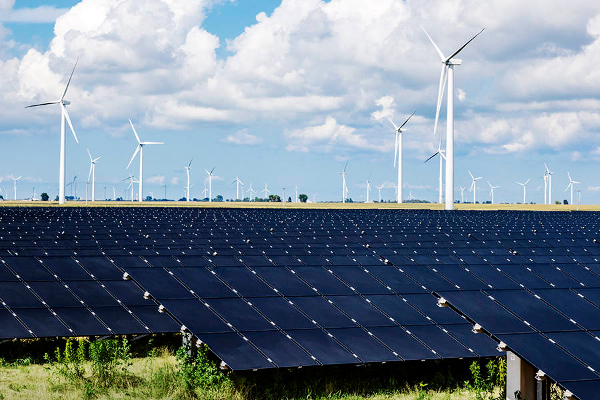
India has emerged as the third-largest country in the world in installed renewable energy capacity, marking another major milestone in the country’s clean energy transition. According to a report cited by News On Air, Morgan Stanley has said that India’s renewable energy expansion could significantly reduce the country’s external energy dependence, provided it is supported by stronger domestic manufacturing in critical supply-chain segments such as solar cells, wafers and polysilicon.
The progress comes at a time when India is rapidly expanding its solar and wind energy base. Data from the Ministry of New and Renewable Energy shows that India’s domestic solar module manufacturing capacity has nearly doubled within a year, rising from 38 gigawatts in March 2024 to 74 gigawatts in March 2025. Solar cell capacity has also grown sharply, increasing from 9 gigawatts to 25 gigawatts during the same period.
However, the report also underlines a key challenge for India’s renewable energy ambitions. Despite the rise in domestic manufacturing, the country continues to depend on imports for several upstream solar components. In financial year 2025, India imported around 35 million solar modules worth nearly 1.6 billion US dollars, with an estimated 60 to 80 percent of these imports sourced from China.
India’s broader energy mix is also undergoing a visible transformation. The country’s non-fossil fuel capacity has crossed 50 percent of total installed power capacity, reaching 262.7 gigawatts. Solar and wind power have contributed the largest share of recent capacity additions, reinforcing India’s position as one of the fastest-growing clean energy markets in the world.
The development is significant not only for India’s climate and energy goals, but also for its industrial strategy. A deeper domestic renewable manufacturing ecosystem could help India reduce import dependence, secure its energy supply chains, create jobs and position the country as a global clean technology hub. The next major test will be how quickly India can move beyond module assembly and build stronger capacity in the higher-value parts of the solar supply chain.
You may also like
-
PM Dhan-Dhaanya Krishi Yojana Completes One Year: Gaya, Nagaur and Umaria Emerge as Best-Performing Districts
-
Political Protests in India: Economic Losses, Export Disruptions and the Impact on Investor Confidence
-
Jeeraphool Rice of Chhattisgarh — Surguja’s Fragrant Cumin-Shaped Heritage Grain
-
India’s E-Commerce Platforms Record ₹24,000 Crore Festive Sales in Two Days as Meesho Reports 75% Surge in Orders
-
India’s Economic Warfare Challenge: Strategic Autonomy, Energy Security and the Rise of a Global Power
