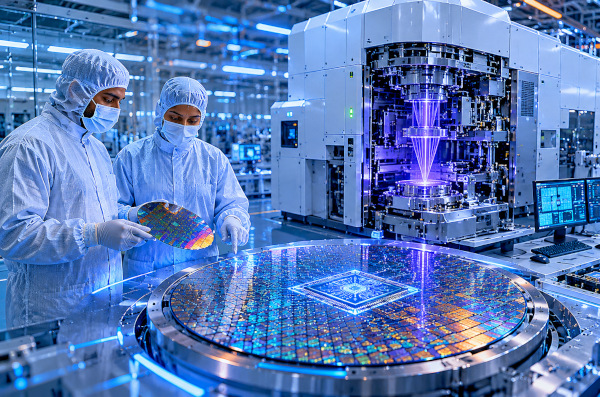
The Government of India has approved 12 new electronics manufacturing projects involving proposed investments of ₹7,503 crore under the Electronics Components Manufacturing Scheme (ECMS), strengthening the country’s efforts to develop an integrated domestic electronics manufacturing ecosystem. The newly approved projects are expected to generate production worth ₹39,045 crore and create 7,127 direct employment opportunities across seven states.
Union Minister for Electronics and Information Technology Ashwini Vaishnaw announced the approvals in New Delhi on Friday while launching the Semicon 2.0 Web Application Portal under the India Semiconductor Programme. The announcements mark an important expansion of India’s electronics and semiconductor manufacturing strategy, with increasing emphasis on producing essential components, specialised materials, industrial equipment and advanced technologies within the country.
Twelve Projects to Strengthen Domestic Electronics Manufacturing
The newly approved projects cover ten targeted product segments spanning electronic components, industrial supply-chain materials and capital equipment. The manufacturing proposals are distributed across Gujarat, Karnataka, Madhya Pradesh, Maharashtra, Punjab, Tamil Nadu and Uttar Pradesh, broadening the geographical reach of India’s electronics manufacturing industry.
Four approvals involve the manufacture of essential electronic components, including multilayer printed circuit boards, relays, heat sinks and speciality ceramics. These products support a wide range of applications in consumer electronics, telecommunications, automotive systems, industrial automation and advanced electronic equipment.
NeST ICELR Private Limited has received approval for manufacturing multilayer printed circuit boards, while TDConnex (Chennai) Private Limited will manufacture relays. Modern Automotives Limited has been approved for heat sink production, and Voltix Semicon Private Limited will manufacture speciality ceramics.
The inclusion of these products reflects the government’s emphasis on developing manufacturing capabilities beyond the final assembly of electronic devices. Domestic production of such components can strengthen supply-chain reliability, increase local value addition and support Indian manufacturers producing increasingly sophisticated electronic systems.
Investment in Battery Materials and Critical Industrial Components
Five approved proposals focus on manufacturing products required across electronics and advanced energy-storage supply chains. These include copper foil, lithium-ion battery anode materials, cathode active materials, polypropylene films and camera rims.
Indo Asia Copper Limited has received approval for copper foil manufacturing, an important input for copper-clad laminates used in printed circuit boards and for lithium-ion battery cells. TACC Limited will manufacture anode materials for lithium-ion batteries, while Vidyuta Materials Private Limited has been approved for producing cathode active materials.
Enerfolie LLP will manufacture polypropylene films used as dielectric materials in capacitors, and Surface Modification Technologies Private Limited has received approval for camera rim production.
The approvals for copper foil, cathode active materials and speciality ceramics represent the first approvals for these product categories under the Electronics Components Manufacturing Scheme. Their inclusion expands the range of specialised industrial materials that India intends to manufacture domestically.
Developing domestic capacity in battery materials is particularly relevant to India’s growing electric mobility, renewable energy storage and advanced electronics industries. These sectors require reliable supplies of specialised materials, making their local production an important component of industrial development and supply-chain security.
Advanced Manufacturing Equipment and Factory Automation
The latest approvals also extend to capital equipment and industrial technologies used in electronics manufacturing. TDConnex (Chennai) Private Limited has received approval for precision moulds and tooling, while Rockwell Automation India Private Limited will manufacture power and control systems for capital equipment.
Wipro Pari Robotics Private Limited has been approved for manufacturing equipment used in factory automation and system integration. These technologies are essential for establishing modern production facilities capable of maintaining high levels of precision, consistency and manufacturing efficiency.
The inclusion of automation and industrial equipment within the scheme highlights an important dimension of India’s manufacturing strategy. Building a domestic electronics industry requires not only the ability to manufacture finished products and components but also access to the machinery, production systems and technical infrastructure needed to operate advanced factories.
Expanding indigenous capabilities in these areas can support electronics manufacturers, automotive component producers and other precision engineering industries while creating opportunities for domestic suppliers of industrial technologies.
Electronics Components Manufacturing Scheme Reaches ₹77,051 Crore in Investments
With the latest approvals, the total number of applications approved under the Electronics Components Manufacturing Scheme has increased to 118, covering 34 products across 16 states.
According to the Ministry of Electronics and Information Technology, these projects collectively represent proposed investments of ₹77,051 crore, with projected production worth ₹5,73,146 crore and an estimated 81,755 direct employment opportunities.
Before the latest announcement, the government had approved 106 applications involving proposed investments of ₹69,548 crore. The addition of another 12 projects demonstrates the continued expansion of the scheme into specialised manufacturing segments.
The Electronics Components Manufacturing Scheme is designed to strengthen domestic production capabilities across the electronics value chain, including components, materials and industrial equipment. It also supports the development of a broader manufacturing ecosystem in which domestic suppliers can participate in national and international production networks.
The government has placed particular emphasis on increasing opportunities for micro, small and medium enterprises. Speaking at the event, Vaishnaw highlighted that nearly half of the units approved under the scheme belong to the MSME sector, reflecting the importance of smaller manufacturers in building diversified domestic supply chains.
Semicon 2.0 Portal Opens Applications for Semiconductor Manufacturing Expansion
Alongside the electronics manufacturing approvals, the government launched the Semicon 2.0 Web Application Portal, enabling companies to submit proposals under three strategic areas of the programme.
The portal is now accepting applications under Pillar 2, which focuses on semiconductor manufacturing machinery and materials; Pillar 3, which supports the establishment of additional semiconductor fabrication facilities; and Pillar 4, which aims to strengthen the Assembly, Testing, Marking and Packaging (ATMP) and Outsourced Semiconductor Assembly and Test (OSAT) industries.
The Union Cabinet has approved a fiscal outlay of ₹1,27,500 crore for Semicon 2.0 under the India Semiconductor Mission. The programme is structured around six strategic pillars covering chip design, machinery and materials, semiconductor fabrication, advanced packaging, research and development, and talent development.
The initiative is intended to deepen India’s semiconductor manufacturing ecosystem by encouraging investment across the complete production chain. Semiconductor manufacturing requires specialised equipment, high-purity materials, chemicals, gases, precision engineering and advanced testing capabilities, making the development of supporting industries essential for a competitive domestic semiconductor sector.
Vaishnaw indicated that Semicon 2.0 would place particular emphasis on attracting manufacturers of semiconductor equipment, materials, chemicals and gases. The government is targeting the establishment of at least three major equipment manufacturers and five companies specialising in chemicals and gases within India’s semiconductor ecosystem.
India’s Semiconductor Industry Expands into Commercial Production
The latest announcements build upon progress achieved under the first phase of the Semicon India Programme. According to the government, 12 semiconductor projects have been approved across six states, involving cumulative investments exceeding ₹1.64 lakh crore.
As of October 2026, five of these projects had commenced commercial production, reflecting the gradual transition from investment approvals and factory construction to operational semiconductor manufacturing capabilities.
The India Semiconductor Mission has also supported the development of domestic chip-design capabilities. A total of 105 startups have received access to Electronic Design Automation tools, while 24 startups have received funding support and 15 have attracted venture capital investment.
The Chips to Startup programme has extended access to electronic design tools to 332 institutions, with approximately 70,000 students trained so far. These initiatives are intended to develop the technical workforce and research capabilities required to sustain India’s growing semiconductor industry.
The development of semiconductor fabrication, packaging, electronic component manufacturing and chip design within the country represents a broader effort to strengthen technological self-reliance. These industries support critical applications ranging from consumer electronics and telecommunications to automobiles, industrial equipment, aerospace and defence systems.
Strengthening India’s Electronics Manufacturing Value Chain
Addressing the gathering, Vaishnaw emphasised that India’s electronics manufacturing industry is moving beyond device assembly towards the development of a more comprehensive domestic production ecosystem. He highlighted the country’s expanding capabilities in battery cells, copper foils, copper-clad laminates and advanced printed circuit boards as examples of this industrial transition.
The government’s strategy increasingly focuses on strengthening the interconnected industries required for electronics manufacturing. By encouraging production of materials, components, machinery and sophisticated industrial systems, India is seeking to retain a greater share of manufacturing value within the domestic economy.
The approval of 12 additional electronics manufacturing projects and the opening of applications under Semicon 2.0 represent complementary developments in this strategy. Together, they expand opportunities for Indian companies to participate in electronics supply chains while supporting the establishment of advanced semiconductor manufacturing capabilities.
With ₹77,051 crore in proposed investments now approved under the Electronics Components Manufacturing Scheme and more than ₹1.64 lakh crore associated with approved semiconductor projects, India is building an increasingly diversified industrial foundation for electronics manufacturing, advanced technologies and technological self-reliance.
You may also like
-
CFF Fluid Control and Germany’s TKMS Partner for Anti-Submarine Warfare Manufacturing
-
India’s Free Trade Agreement Network Could Cover 75% of Merchandise Exports, Expanding Access to US$329 Billion in Trade
-
NMDC Iron Ore Production Rises 22% to 32.32 Million Tonnes in April–October 2026
-
Martin-Baker Plans ₹380 Crore Ejection Seat Manufacturing Facility in Karnataka
-
Cabinet Approves ₹14,500 Crore Scheme to Develop 92 GWh Energy Storage Capacity, Targets ₹97,600 Crore Investment
