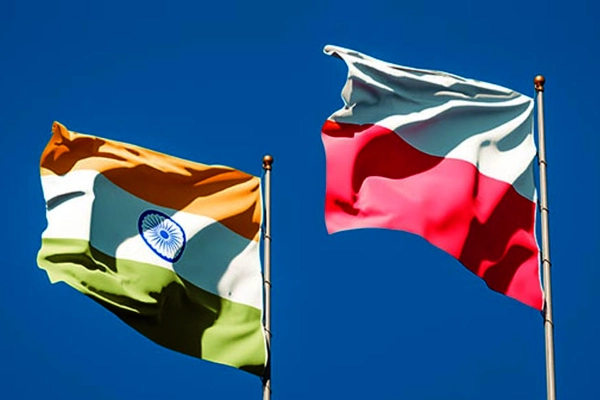
India and Poland are preparing a new set of agreements covering cyber security, space cooperation, critical minerals, clean-coal technologies and the protection of classified information, signalling a significant expansion of a bilateral relationship that was elevated to a Strategic Partnership only two years ago.
External Affairs Minister S. Jaishankar disclosed the emerging agreements on September 4 following talks in Warsaw with Polish Deputy Prime Minister and Foreign Minister Radosław Sikorski. The two ministers reviewed implementation of the Action Plan adopted during Prime Minister Narendra Modi’s landmark visit to Poland in 2024 and assessed progress across trade, investment, defence, energy and technology.
Jaishankar said the review showed a noticeable increase in trade and investment, deeper defence cooperation and expansion in established sectors such as mining and energy. At the same time, entirely new opportunities are opening in space, digital technologies, artificial intelligence and innovation, broadening the relationship beyond its traditional commercial foundations.
The planned agreements are particularly significant because several involve technologies directly linked to economic and national security. A framework on cyber security could strengthen cooperation against cyber attacks, improve institutional exchanges and create channels for sharing expertise on protecting digital and critical infrastructure.
This is not a completely new direction. The India-Poland Action Plan for 2024–2028 already commits the two governments to closer interaction on cyber security, including cooperation on cyber-attack prevention and response, regulation, law enforcement, research, awareness and business exchanges. The latest Warsaw discussions indicate that both sides are now working to give parts of that cooperation a more formal institutional basis.
Space is another area moving toward a formal framework. The 2024 Action Plan called for an agreement promoting the safe, sustainable and secure use of space, alongside cooperation between commercial space ecosystems and collaboration in human and robotic exploration. Jaishankar’s latest confirmation that a space agreement is under preparation suggests that this commitment is advancing toward implementation.
Cooperation on critical minerals could prove equally important. India is seeking more resilient supplies of minerals essential to batteries, electronics, renewable energy, aerospace and advanced defence manufacturing, while Poland possesses a significant mining and industrial base. The existing Strategic Partnership framework already calls for cooperation in advanced mining systems, high-technology machinery, safety standards and mineral-related industries.
The inclusion of clean-coal technologies reflects another area where the economic structures of the two countries overlap. India and Poland both have long histories of relying on coal for energy security. Their Action Plan specifically calls for cooperation on cleaner coal technologies that can reduce environmental impact while allowing energy systems to transition gradually.
Potential cooperation on the exchange and protection of classified information may have even wider strategic implications. Such agreements commonly provide the legal and security framework needed for governments and defence industries to exchange sensitive information. While no detailed scope has yet been published, progress in this area could support the expanding defence and technology relationship between India and Poland.
Defence was itself a significant part of the Warsaw discussions. The Polish Foreign Ministry said the talks covered implementation of the Strategic Partnership as well as cooperation in defence, space and shipbuilding. India and Poland have also activated a bilateral defence working mechanism as military and industrial contacts increase.
Shipbuilding presents an interesting opportunity because India is rapidly expanding both naval construction and its commercial shipbuilding industry, while Poland maintains established shipyards and maritime-engineering capabilities. Cooperation could potentially extend from commercial vessels and repair infrastructure to specialised maritime technologies, although no specific joint project was announced during the September 4 talks.
The latest meeting also comes against the backdrop of stronger economic engagement. India and Poland held the seventh session of their Joint Commission for Economic Cooperation in New Delhi in July 2026, where both sides examined ways to expand trade, investment and business partnerships.
India’s wider relationship with the European Union is creating another opportunity. Jaishankar highlighted the recently concluded India-EU Free Trade Agreement as a major element of the expanding relationship with Europe and said it could generate new opportunities for both India and Poland.
The breadth of the agenda now under discussion shows how quickly India-Poland relations are changing. What was once a relationship concentrated largely around trade, mining and traditional industrial cooperation is developing strategic dimensions involving cyber resilience, secure information, space, critical-resource supply chains, defence technology and maritime industry.
The next important milestones will be the actual conclusion of the agreements now under negotiation and the emergence of specific projects from the defence, space and shipbuilding discussions. If those frameworks translate into industrial partnerships and technology programmes, Poland could develop into a considerably more important Central European strategic and technological partner for India.
You may also like
-
India and Uzbekistan Strengthen Counter-Terrorism Cooperation, Focus on Terror Financing and Regional Security
-
India and Poland Target Doubling Bilateral Trade by 2030, Expand Defence and Technology Cooperation
-
India Calls for Legally Binding International Treaty to Prevent Weaponisation of Outer Space
-
India and New Zealand Strengthen Trade Ties with Electronic Origin Data Exchange Agreement Under FTA
-
Polish Prime Minister Donald Tusk Arrives in India to Strengthen Strategic Partnership in Defence, Trade and Technology
