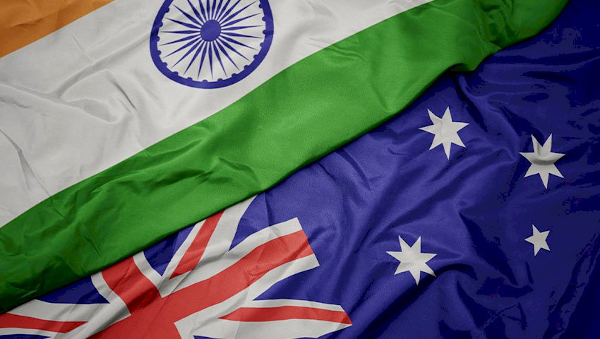
India and Australia are steadily transforming their defence relationship into one of the most important security partnerships in the Indo-Pacific. The relationship has moved beyond ceremonial visits and diplomatic language into a practical framework built around maritime cooperation, interoperability, joint exercises, defence industry engagement and shared concern over the changing balance of power across the Indian Ocean and Pacific region.
The momentum was visible during the 10th India-Australia Defence Policy Talks held in New Delhi in May 2026. The dialogue reaffirmed the India-Australia Comprehensive Strategic Partnership and gave both sides a platform to review the next stage of defence cooperation. The Indian delegation was led by Joint Secretary Amitabh Prasad, while the Australian side was headed by Bernard Philip, First Assistant Secretary, International Policy. The meeting reflected the growing trust between the two countries and the increasing seriousness with which both sides are approaching regional security.
The Indo-Pacific has become the central theatre of 21st-century geopolitics. Sea lanes, chokepoints, underwater cables, island chains, naval bases, energy routes and maritime trade corridors now shape national security as much as land borders. For India, the Indian Ocean is a natural strategic space. For Australia, the eastern Indian Ocean and Pacific approaches are vital to national defence. This geography brings both countries into a shared security frame.
China’s expanding naval activity, assertive behaviour in maritime disputes and growing presence across the Indo-Pacific have accelerated this convergence. India and Australia are not building a rigid military alliance. Their approach is more flexible, more practical and more suited to the realities of the region. The aim is to create dependable habits of cooperation that can be scaled during crises, exercises, humanitarian operations and maritime security missions.
A major pillar of the partnership is interoperability. Modern defence cooperation depends on the ability of two armed forces to communicate, coordinate, deploy and operate together. India and Australia are now working to deepen this across all domains — sea, land, air, cyber and emerging technology. This matters because future crises in the Indo-Pacific may demand quick coordination between navies, air forces, surveillance networks, logistics chains and command structures.
Maritime cooperation sits at the heart of the relationship. The Indian Navy and the Royal Australian Navy have increased their operational engagement through exercises, port calls, fleet reviews and multilateral drills. Exercises such as AUSINDEX, Malabar, Milan and Kakadu have helped both sides improve coordination in anti-submarine warfare, maritime surveillance, air defence, communication procedures and complex naval manoeuvres. These drills are important because they convert diplomatic intent into operational familiarity.
The importance of anti-submarine warfare is especially clear. The Indian Ocean is seeing greater underwater activity, including submarine deployments, seabed mapping and long-range naval movements by extra-regional powers. India and Australia both understand that control of the surface is only one part of maritime security. The underwater domain is now central to deterrence, intelligence and sea-lane protection. Cooperation in this area gives both sides a sharper view of the maritime battlespace.
The logistics support agreement between India and Australia has also become a crucial enabler. Reciprocal access to facilities allows ships and aircraft to refuel, repair, replenish and sustain longer deployments. For a navy, logistics is strategy in physical form. A warship’s reach depends not only on its weapons, but also on the ports, fuel, spares and maintenance networks available to it. By improving logistics coordination, India and Australia are creating the foundation for sustained presence across wider maritime spaces.
The two countries are also working toward a Joint Maritime Security Collaboration Roadmap. Such a roadmap can give structure to naval coordination, information-sharing, maritime domain awareness and cooperation with regional partners. In practical terms, this means better tracking of vessels, faster understanding of suspicious maritime activity and stronger cooperation during contingencies. In a region where grey-zone activity, illegal fishing, coercive patrols and sudden military deployments are becoming common, maritime awareness is a strategic necessity.
Defence industry cooperation is another major area of growth. India’s defence manufacturing sector is expanding under the Make in India and Aatmanirbhar Bharat frameworks, while Australia brings strengths in undersea technology, surveillance, advanced materials, autonomous systems and niche defence engineering. The first India-Australia Defence Industry Roundtable in Sydney in 2025, Australia’s defence trade mission to India and the defence industry discussions at Raisina Dialogue in 2026 show that both sides are trying to connect military strategy with industrial capability.
This industrial link is important because modern defence partnerships increasingly depend on supply-chain trust. Critical components, sensors, drones, electronic warfare systems, underwater platforms and secure communications all require dependable manufacturing ecosystems. India and Australia can reduce strategic vulnerabilities by building trusted defence industry channels and encouraging joint development in select technologies.
Army-to-army engagement is also gaining weight. The visit of Indian Army Chief General Upendra Dwivedi to Australia earlier in 2026 helped widen the relationship beyond the naval domain. Professional military education, officer exchanges, joint planning, training conversations and doctrinal engagement give both armies a better understanding of each other’s operational thinking. This is especially useful in multi-domain warfare, where land forces, air assets, cyber networks, space-based systems and maritime platforms increasingly operate as one integrated force.
Training exchanges such as the General Bipin Rawat Memorial Young Officers Exchange Programme and interactions between the Indian Military Academy and the Royal Military College, Duntroon, add a human foundation to the partnership. Military trust is built not only through documents, but through officers who train together, understand each other’s systems and carry those relationships into future commands. These exchanges create the next generation of defence familiarity between the two countries.
The partnership also fits into the wider Quad framework involving India, Australia, Japan and the United States. The Quad’s focus on a free, open and stable Indo-Pacific strengthens the broader environment in which India-Australia defence ties are developing. Maritime domain awareness, energy security, critical minerals, humanitarian assistance, disaster relief and resilient supply chains all form part of this larger strategic picture. India and Australia bring different strengths to this framework, but their interests increasingly overlap.
For India, Australia is a valuable partner because of its geography, advanced military systems, Indo-Pacific orientation and growing willingness to engage in the Indian Ocean. For Australia, India is essential because of its scale, naval reach, strategic autonomy, defence industrial expansion and central position in the Indian Ocean Region. The relationship works because both countries bring complementary advantages.
The defence partnership also sends a wider message to the region. Stability in the Indo-Pacific will depend on countries that can cooperate without creating dependency, support rules without seeking dominance and build capacity without forcing smaller nations into binary choices. India and Australia are positioning their partnership around this practical logic. The focus is on resilience, presence, preparedness and regional confidence.
The future of India-Australia defence ties will likely be shaped by three areas: maritime domain awareness, defence technology and regular military exercises. Better surveillance will help both countries understand the movement of ships, submarines and grey-zone actors. Better technology cooperation will strengthen industrial resilience. More complex exercises will improve operational readiness. Together, these steps can make the partnership more useful during real-world contingencies.
The strategic direction is now clear. India and Australia are building a defence relationship that is operationally meaningful, politically stable and regionally relevant. It is a partnership shaped by geography, sharpened by maritime realities and strengthened by shared concern over coercive behaviour in the Indo-Pacific. As the region enters a more contested era, this cooperation can become
You may also like
-
Exercise Tarang Shakti 2026 Concludes in Jodhpur, Showcasing India’s Air Power, Indigenous Defence Technology
-
Indian Navy Vice Chief Inspects Japan’s Mogami-Class Stealth Frigate as India-Japan Shipbuilding Cooperation Expands
-
Philippine Marine Wargames Reportedly Show BrahMos Can Penetrate Chinese Destroyer Air Defences
-
Safran Signs 18 Agreements with Indian Aerospace Suppliers, Expanding Make in India Manufacturing Partnerships
-
Indian Army’s Vajra Corps Certifies First Batch of Drone Operators, Strengthens Battlefield Surveillance
