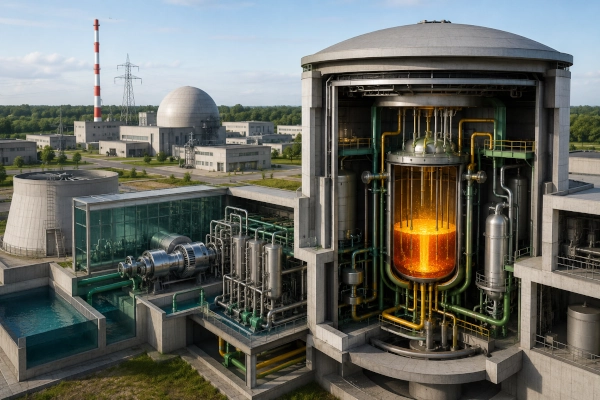
India is accelerating research on an indigenous molten salt reactor designed to use the country’s thorium resources and support the third stage of its long-term nuclear energy programme.
The Department of Atomic Energy has confirmed that the Bhabha Atomic Research Centre is developing a small demonstration molten salt reactor to validate the materials, fuel chemistry, components and operating systems required for the efficient use of thorium.
The project remains at the research and technology-demonstration stage. Commercial deployment of a higher-powered reactor would be considered only after the demonstration system operates successfully and the technology’s safety, reliability and economic viability are established.
What Is a Molten Salt Reactor?
A molten salt reactor is an advanced nuclear reactor in which heated liquid salt performs a central role in carrying fuel, transferring heat or both.
In India’s proposed Indian Molten Salt Breeder Reactor, or IMSBR, the nuclear fuel would be dissolved in a continuously circulating mixture of molten fluoride salts.
The hot liquid fuel would flow through the reactor core, where nuclear fission releases heat. It would then pass through heat exchangers that transfer this energy to a separate power-conversion system.
Unlike conventional nuclear reactors, which generally use solid fuel rods, the Indian design proposes a liquid-fuel system. This creates the possibility of continuously monitoring and processing the fuel while the reactor is operating.
Designed Around India’s Thorium Resources
The principal objective of the Indian molten salt programme is to develop a self-sustaining nuclear fuel cycle based on thorium-232 and uranium-233.
Thorium-232 is fertile rather than directly fissile. This means it cannot normally sustain a nuclear chain reaction on its own. When thorium absorbs a neutron, however, it undergoes a series of nuclear transformations that eventually produce uranium-233, which can be used as reactor fuel.
In the proposed IMSBR, thorium dissolved in the circulating salt would absorb neutrons and produce protactinium-233. The liquid-fuel system could allow this material to be extracted and permitted to decay into uranium-233 outside the reactor core.
The resulting uranium-233 could then be returned to the reactor as fuel, potentially allowing the system to breed new fissile material while generating energy.
BARC says this process could enable the reactor to operate through a self-sustaining uranium-233–thorium fuel cycle. Because the proposed IMSBR is based on a thermal-neutron spectrum, it may also require less initial uranium-233 than a fast-spectrum reactor, improving its potential for wider future deployment.
Part of India’s Three-Stage Nuclear Programme
India’s nuclear energy strategy was developed to make the best use of the country’s comparatively limited uranium reserves and extensive thorium resources.
The first stage is centred on pressurised heavy-water reactors using natural uranium. These reactors generate electricity while producing plutonium in their spent fuel.
The second stage uses this plutonium in fast breeder reactors. These reactors are designed to produce additional fissile material, including plutonium-239 from uranium-238.
The third stage is intended to make large-scale use of thorium by converting it into uranium-233 and using the resulting material as nuclear fuel.
India’s 500 MWe Prototype Fast Breeder Reactor at Kalpakkam achieved first criticality on April 6, 2026. Fast breeder technology is expected to provide the fissile inventory needed to support the later introduction of thorium-based systems, including molten salt reactors.
Five-Megawatt Thermal Development Facility Planned
BARC is designing a Molten Salt Breeder Reactor Developmental Facility to demonstrate the principal systems required for a 5 MWth Indian Molten Salt Breeder Reactor.
The proposed facility is intended to validate reactor components and technologies at a meaningful engineering scale before the development of larger power-producing systems.
A capacity of 5 MWth refers to thermal energy generated by the reactor rather than electricity supplied to the grid. The initial facility would primarily serve as a technology demonstrator and research platform.
The government has separately described its immediate goal as the development of a low-power or small demonstration reactor. A commercial, higher-capacity version would be pursued only after the demonstration project establishes that the technology can operate successfully.
Electricity Through a Supercritical Carbon-Dioxide Cycle
The proposed Indian reactor is being designed to transfer heat to a supercritical carbon-dioxide Brayton cycle.
In this system, carbon dioxide is maintained under conditions where it behaves neither entirely as a conventional gas nor as a liquid. It can then be circulated through compact turbines and heat exchangers to generate electricity.
BARC expects this technology to offer a higher energy-conversion efficiency than some conventional steam-based power cycles.
The use of supercritical carbon dioxide could also reduce the physical size of certain power-conversion components. However, the system requires advanced turbines, compressors, seals, heat exchangers and materials capable of operating reliably at high temperatures and pressures.
Potential Safety Advantages
Thorium-based molten salt breeder reactors are expected to operate at or near atmospheric pressure.
Most conventional water-cooled reactors must maintain water at high pressure to prevent it from boiling at reactor operating temperatures. Molten salts have much higher boiling points, allowing them to operate at elevated temperatures without requiring the same level of internal pressure.
Lower operating pressure could reduce the risk of certain high-pressure accidents and decrease the mechanical stresses placed on reactor vessels and piping.
Liquid-fuel molten salt reactors can also be designed with passive safety systems that allow fuel salt to drain into subcritical storage tanks if temperatures rise excessively or electrical power is lost.
However, these advantages do not make the technology risk-free. Safe operation depends on controlling radioactive material circulating through the reactor system, maintaining salt chemistry and preventing corrosion or leakage over long periods.
The Department of Atomic Energy has said that the technology is not yet mature and that its economic implications can only be properly assessed after a limited-scale demonstration.
New Materials Required to Resist Corrosion
One of the biggest challenges facing molten salt reactors is the corrosive effect of hot fluoride salts on structural materials.
The reactor vessel, pipes, pumps, valves and heat exchangers must retain their strength while remaining in contact with high-temperature salt and intense radiation for extended periods.
BARC has developed a nickel-molybdenum-chromium-titanium alloy for the proposed reactor vessel. Research is continuing to examine its resistance to corrosion, radiation damage, thermal cycling and long-term mechanical stress.
Other development areas include nuclear-grade graphite, specialised coatings, high-temperature components and systems capable of controlling impurities in the salt.
The International Atomic Energy Agency identifies materials compatibility, corrosion management, salt purity and containment integrity as major challenges shared by molten salt reactor programmes worldwide.
Fuel-Salt Preparation and Purification
India must also master the production, purification and management of nuclear-grade fluoride salts.
Even small quantities of moisture, oxygen or metallic impurities can influence corrosion and affect the physical and chemical behaviour of the fuel salt.
BARC is therefore conducting research on salt preparation, purification, characterisation, thermophysical properties, thermal hydraulics and fuel-salt optimisation.
The programme also requires the development of lithium-7 enrichment technology. Lithium-containing fluoride salts may be used in the reactor, but the proportion of lithium isotopes must be carefully controlled because lithium-6 absorbs neutrons and produces tritium.
BARC has established specialised facilities for handling molten salts under controlled atmospheric conditions and is undertaking research into molten salt reactor fuel chemistry and thermodynamic behaviour.
Online Fuel Processing Presents Opportunities and Challenges
The circulating liquid fuel offers the possibility of removing certain fission products and recovering useful nuclear material without shutting down the reactor for conventional refuelling.
Online processing could improve neutron efficiency and support the breeding of uranium-233 from thorium.
At the same time, it creates a complex engineering and safeguards challenge. The system must handle intensely radioactive fuel salt, separate specific elements and prevent the release or diversion of nuclear material.
Specialised remote-handling equipment, radiation shielding, containment systems, measurement technologies and safeguards procedures would be required before such a system could operate commercially.
These fuel-cycle technologies are among the areas being developed as part of the Indian molten salt reactor programme.
Potential for Reduced Long-Lived Waste
Thorium-based reactors are expected to produce smaller quantities of certain long-lived transuranic elements than conventional uranium-plutonium fuel cycles.
This could reduce the long-term radiological burden of nuclear waste, although molten salt reactors would still generate radioactive fission products, contaminated structural materials and fuel-processing waste requiring secure management.
The potential waste advantage will therefore depend on reactor design, fuel-processing efficiency, operating practices and the waste-management system adopted for future plants.
The government has identified lower production of long-lived nuclear waste as one of the potential benefits of thorium-based power.
Wider High-Temperature Reactor Research
Alongside the liquid-fuel IMSBR, BARC is developing an Innovative High Temperature Reactor cooled by molten fluoride salt.
Unlike the IMSBR, the proposed high-temperature system would use solid TRISO particle fuel formed into pebbles, with molten salt serving mainly as the coolant.
BARC is designing a 20 MWth demonstration version capable of producing temperatures of up to approximately 665 degrees Celsius. The heat could eventually be used for hydrogen production through thermochemical water-splitting processes.
This work complements India’s broader effort to combine advanced nuclear energy with industrial heat and low-carbon hydrogen production.
Long-Term Technology Rather Than Immediate Power Project
India’s molten salt reactor should not yet be viewed as a commercial power station approaching immediate construction.
The programme is presently focused on scientific research, materials qualification, salt chemistry, component development, safety studies and demonstration-scale engineering.
Important questions involving corrosion, fuel processing, reactor regulation, maintenance, waste management and cost must be resolved before a commercial plant can be considered.
Nevertheless, the project could become strategically significant for India. Successful development would provide the country with an indigenous technology capable of using thorium for long-term, low-carbon electricity generation.
By combining thorium resources, liquid-fuel technology, online processing and advanced power conversion, the Indian Molten Salt Breeder Reactor represents one of the country’s most ambitious nuclear research programmes and a possible foundation for the third stage of India’s nuclear energy strategy.
References
Bhabha Atomic Research Centre, Department of Atomic Energy
“BARC Activities for the Indian Nuclear Power Programme — Molten Salt Reactor.”
Press Information Bureau, Government of India
“Parliament Question: Thorium-Based Power Projects.”
Published March 11, 2026.
Press Information Bureau, Government of India
Department of Atomic Energy update on the development of a demonstration molten salt reactor and thorium utilisation.
Department of Atomic Energy, Government of India
“Prototype Fast Breeder Reactor at Kalpakkam Attains First Criticality.”
Published April 7, 2026.
International Atomic Energy Agency
“Current Status of Structural Material Development for Molten Salt Reactors and Related Challenges.”
Workshop held July 20–24, 2026.
You may also like
-
EON Space Labs and Dhruva Space Advance Indian Space Hardware on Transporter-18 Mission
-
SatLeo Labs’ TAPAS-1 Reaches Orbit, Advancing India’s Private Thermal-Imaging Capability
-
TakeMe2Space’s MOI-1A Reaches Space on Falcon 9 Transporter-18 Mission
-
Bank of Baroda Enters Pension Fund Management After PFRDA Appointment
-
SCI and India’s Push for a Larger Indigenous Maritime Fleet
