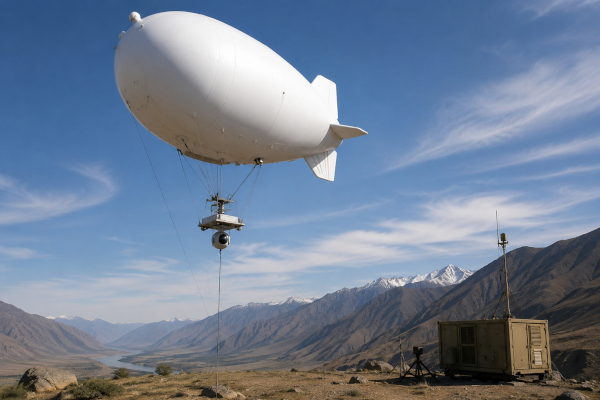
India’s defence technology ecosystem has taken another important step forward with the successful demonstration of an indigenous AI-enabled tactical aerostat surveillance system by IIT Delhi. Developed under a DRDO-supported project in collaboration with deep-tech startups, the system represents a strong example of how academia, defence research and private innovation can come together to build deployable strategic technologies for national security.
A tactical aerostat is a lighter-than-air surveillance platform that remains tethered to the ground while operating at height. Filled with helium, it can stay airborne for long periods and carry cameras, sensors and communication payloads. IIT Delhi’s demonstrated system used a tactical aerostat balloon of about 24 cubic metres and deployed it up to a height of 30 metres, carrying a payload of up to 10 kilograms for applications such as surveillance, security and remote communications.
The significance of this system lies in persistent observation. Border areas, forward posts, critical installations and disaster zones often need continuous monitoring from an elevated position. Ground-based cameras have terrain limitations, while drones need regular battery replacement, piloting and operational rotation. Aerostats provide a stable aerial platform that can remain in position for extended periods, giving security forces a wider field of view and sustained situational awareness. IIT Delhi has also highlighted advantages such as longer endurance, lower operating cost, continuous monitoring, higher payload capacity and enhanced reliability when compared with drones.
The project has a strong indigenous materials foundation. The technology originated from the DRDO Industry Academia-Centre of Excellence funded SITEX-I and SITEX-II research programmes at IIT Delhi. Under the guidance of Prof. Mangala Joshi and Prof. B. S. Butola from the Department of Textile and Fibre Engineering, researchers developed indigenous aerostat hull materials and related engineering technologies. This is important because lighter-than-air systems depend heavily on specialised coated textiles that can retain helium, withstand weather exposure and support payload stability.
The industrialisation of the platform was carried out by GB Texcoat Solution Pvt. Ltd., a FITT-IIT Delhi incubated deep-tech startup. The company developed and fabricated the aerostat system using high-performance coated textile materials designed for helium retention, lightweight construction, durability and all-weather operation. This startup-driven pathway is important for India because successful defence technologies need more than laboratory validation. They require material supply chains, fabrication capability, field repairability and scalable production.
The AI layer gives the system its modern battlefield relevance. During the demonstration, the aerostat carried a high-definition surveillance payload, while CYRAN AI, an IIT Delhi faculty-led deep-tech startup, deployed Edge AI algorithms to analyse live aerial imagery in real time. The system demonstrated intelligent object detection, classification, activity recognition and automated alerts.
This changes the role of the aerostat from a passive camera platform to an intelligent surveillance node. In a border or sensitive-area environment, raw video alone can overload operators. AI-assisted detection can help identify vehicles, movement patterns, suspicious activity and unusual changes in the monitored area. Edge AI is especially valuable because analysis happens near the sensor, reducing the need to transmit every frame to a distant command centre before action is taken.
For India’s defence forces, such a system can support layered surveillance. A tactical aerostat can be deployed near border posts, forward operating bases, ammunition depots, air bases, coastal nodes, training areas and temporary security zones. It can act as a persistent watchtower, feeding live visual intelligence to commanders on the ground. When integrated with ground patrols, UAVs, radar, electro-optical sensors and command networks, it can strengthen the local surveillance picture.
The system also has major value in disaster management and internal security. During floods, landslides, forest fires, large public gatherings or emergency response operations, an aerostat can provide continuous aerial visibility over affected areas. Its ability to carry cameras and communication payloads makes it useful for search, rescue coordination, crowd monitoring, infrastructure inspection and temporary communication support. IIT Delhi has identified applications in disaster response, public safety, critical infrastructure monitoring, agriculture, environmental management and smart-city operations.
Strategically, the project reflects the direction India’s defence innovation model is taking. DRDO-backed academic research has generated the technical foundation. IIT Delhi has provided scientific depth in materials and system design. Startups have helped convert research into deployable hardware and AI capability. This model supports Atmanirbhar Bharat by reducing dependence on imported strategic materials and building domestic competence in lighter-than-air surveillance technologies.
The tactical aerostat also fits India’s operational geography. India has long land borders, difficult terrain, deserts, riverine zones, coastal stretches and high-value strategic infrastructure. Many of these locations require affordable, persistent and rapidly deployable surveillance tools. A compact indigenous aerostat can become a valuable asset for sector-level monitoring, especially in areas where a permanent tower is difficult to build or where temporary surveillance coverage is needed for a specific mission.
The next stage will likely involve higher altitude deployment, longer endurance validation, payload diversification, sensor fusion, secure communications, field ruggedisation and integration with command-and-control systems. For military use, the platform will need reliable operation in wind, heat, dust, rain and field handling conditions. It will also need secure data links and practical deployment procedures for troops.
IIT Delhi’s AI-enabled tactical aerostat is therefore more than a balloon-based camera system. It is a compact surveillance architecture combining indigenous materials, aerospace engineering, startup manufacturing and artificial intelligence. For India, it opens a path toward cost-effective persistent aerial monitoring across defence, border security, disaster response and critical infrastructure protection.
In the modern security environment, the side that sees earlier, understands faster and responds with clarity gains the advantage. This indigenous tactical aerostat gives India another tool to strengthen that advantage from the sky.
You may also like
-
IIT Hyderabad Develops Lung-Derived Bioink for 3D Bioprinting and Regenerative Medicine
-
Indian Scientists Discover Molecular Switch That Can Regulate Cellular Autophagy
-
Scientists Map Earliest Glow of Hydrogen, Opening A New Window to the Universe
-
Indian Researchers Study RAD51 DNA-Repair Gene Variant in Prostate Cancer
-
TDB Backs Multi Nano Sense With ₹37.51 Crore to Build Indigenous Multi-Gas Sensor Platform
