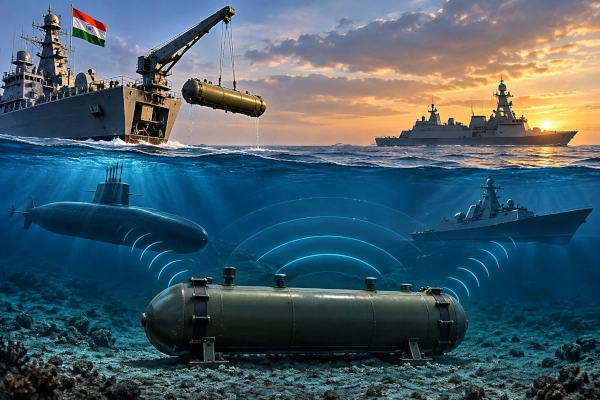
India is moving towards acquiring an indigenous advanced seabed weapon capable of detecting and engaging modern surface ships and submarines, with the Defence Acquisition Council clearing procurement of the Multi-Influence Ground Mine, or MIGM, for the Indian Navy.
The Defence Acquisition Council, chaired by Defence Minister Rajnath Singh, granted Acceptance of Necessity for procurement of MIGM on July 3, 2026. The Ministry of Defence said the weapon would help the Navy deny freedom of manoeuvre to an adversary, formally moving the indigenous underwater mine from successful development and validation towards acquisition.
The clearance follows the successful combat validation of MIGM by DRDO and the Indian Navy in May 2025. During that trial, the system was fired under representative combat conditions using a reduced explosive charge. Following the test, DRDO Chairman Dr Samir V. Kamat said MIGM was ready for induction into the Navy.
Together, these developments give India an indigenous weapon designed for an area of naval warfare that often attracts less attention than missiles, submarines or aircraft but can have a disproportionate effect on an adversary’s freedom to operate at sea.
MIGM Is More Than a Conventional Naval Mine
MIGM stands for Multi-Influence Ground Mine. Unlike the traditional image of a naval mine that explodes after physical contact with a vessel, MIGM is designed to detect the signatures generated by ships and submarines moving through the water.
Bharat Dynamics Limited, one of the production partners for the system, says MIGM incorporates sensors capable of recording acoustic, magnetic, pressure and UEP/ELFE signatures produced by marine vessels. Onboard data-acquisition electronics and processing equipment evaluate those inputs and generate the appropriate command for the mine’s subsequent action.
That multi-sensor approach is particularly relevant against modern naval vessels. Warships and submarines are increasingly designed to suppress individual signatures through quieter machinery, magnetic-signature management and other measures. Reducing one detectable characteristic, however, does not mean that a vessel stops disturbing its surrounding environment.
A multi-influence weapon can therefore examine several physical signatures rather than depending on a single trigger. This gives the system a better basis for recognising and discriminating maritime targets, including vessels engineered to reduce their detectability.
Designed With Stealth Ships and Submarines in Mind
DRDO has specifically said that MIGM was developed to give the Indian Navy an edge against modern stealth ships, while the Ministry of Defence describes the system as enhancing Indian capabilities against both stealth ships and submarines.
This is an important distinction. Modern naval stealth is not limited to reducing radar cross-section above the waterline. Naval designers also attempt to reduce machinery noise, electromagnetic signatures and other characteristics that could make a ship or submarine easier to detect.
Seabed mines designed around several influences can complicate those defensive measures because the target cannot depend on defeating one sensing mechanism alone.
DRDO reporting following the 2025 trial said the exercise demonstrated the integration of the mine’s multiple sensors and its triggering architecture under realistic conditions. The validation represented an important step between technology development and operational induction.
A One-Tonne Seabed Weapon
MIGM is a substantial underwater weapon rather than a small expendable device.
According to Bharat Dynamics, the cylindrical system can weigh up to approximately 1,000 kilograms and measures up to around 3 metres in length with a diameter of 533 millimetres. It has negative buoyancy, allowing it to remain on the seabed, and uses a lithium-thionyl chloride primary battery as its power source.
The 533-mm diameter is also noteworthy because it corresponds broadly with the dimensions associated with standard heavyweight naval underwater weapons, although the Ministry of Defence has not publicly released detailed operational deployment parameters for the production configuration.
DRDO documentation says MIGM has been developed in both exercise and combat versions. The system can operate autonomously as well as through a cable-controlled mode, giving the Navy different configurations for training, evaluation and operational use.
Multiple Deployment Options
DRDO’s public technical documentation states that MIGM can be deployed from ships, submarines and COOPs, providing the Navy with more than one method of placing the weapon.
Submarine compatibility is particularly significant because it potentially allows underwater weapons to be deployed without requiring a surface vessel to remain in the immediate area. Surface ships, meanwhile, provide another means of establishing underwater minefields where operational circumstances permit.
The precise deployment tactics, operational depths, engagement logic and target-selection parameters have not been publicly disclosed and remain appropriately outside the available technical information.
What is clear from DRDO’s published material is that MIGM was designed as a flexible naval mine rather than a single-purpose harbour-defence device.
Why Seabed Mines Remain Relevant
Naval mines are among the oldest forms of underwater warfare, but modern sensor technology has prevented them from becoming obsolete.
A naval mine does not have to chase a ship across the ocean to influence operations. Its military value derives partly from uncertainty. Once an adversary believes that an area may contain advanced mines, operating through that area becomes more complicated and may require reconnaissance, mine-countermeasure assets and additional precautions.
This is why the Ministry of Defence’s description of MIGM is significant. When approving procurement in July 2026, it said explicitly that the system would help deny freedom of manoeuvre to the adversary.
Mine warfare can consequently have an effect greater than the number of weapons actually deployed. The possibility of mines can force an opponent to reconsider routes and devote valuable assets to clearing or avoiding suspected areas.
For a Navy responsible for extensive coastlines, island territories, naval bases and strategically important approaches, an indigenous capability in this category provides another layer within a much broader maritime-denial architecture.
Development Led by DRDO’s Naval Laboratory
MIGM has been designed and developed by the Naval Science & Technological Laboratory in Visakhapatnam, one of DRDO’s principal centres for underwater weapons and naval technologies.
The programme also involved the High Energy Materials Research Laboratory in Pune and the Terminal Ballistics Research Laboratory in Chandigarh. Their involvement reflects the range of disciplines required for an underwater weapon combining sensors, electronics, power systems, structural engineering and an explosive component.
NSTL has previously worked on several important indigenous underwater systems, including torpedo technologies. MIGM extends that expertise into advanced seabed warfare.
The programme also demonstrates how specialised technologies developed across different DRDO laboratories can be integrated into a weapon intended for serial production by Indian industry.
BDL and Apollo Micro Systems Named as Production Partners
The Ministry of Defence has officially identified Bharat Dynamics Limited in Visakhapatnam and Apollo Micro Systems Limited in Hyderabad as production partners for MIGM.
BDL already manufactures a range of Indian missile and underwater weapon systems and publicly lists MIGM among its naval products.
The involvement of an established defence public-sector company alongside a private Indian electronics company is also indicative of the changing structure of India’s defence-industrial ecosystem. Increasingly, DRDO-developed weapons are moving into production through combinations of DPSUs and private-sector partners rather than remaining confined to government laboratories.
For a system such as MIGM, indigenous production also has particular strategic value because underwater weapons involve sensitive sensors, processing electronics and mission software whose external dependence could complicate availability during a crisis.
From Validation in 2025 to Procurement Approval in 2026
MIGM’s development did not begin in 2025. DRDO had publicly discussed the programme years earlier, and by 2020 the system had successfully completed its technology-demonstration phase during technical trials.
The critical development came on May 5, 2025, when DRDO and the Indian Navy conducted the combat firing of the indigenous system with a reduced explosive charge.
The Ministry of Defence described the test as successful, while Rajnath Singh said MIGM would strengthen the Navy’s undersea-warfare capabilities. Dr Samir Kamat subsequently declared that the successful validation had made the system ready for induction.
By the end of 2025, the government was publicly listing MIGM among indigenous naval weapons that had been developed and were ready for induction.
The next major milestone arrived on July 3, 2026, when the Defence Acquisition Council granted Acceptance of Necessity for procurement.
An AoN should not be confused with a completed supply contract. It represents the government’s in-principle administrative approval for an acquisition to proceed through the defence-procurement process. The July decision therefore establishes the Navy’s intention to procure MIGM but does not by itself disclose the number of mines, final contract value, delivery schedule or production quantities.
Adding Another Indigenous Layer to Undersea Warfare
MIGM forms part of a broader Indian effort to build domestic capability across virtually every part of underwater warfare.
India already operates the indigenous Varunastra heavyweight torpedo, while DRDO has developed the Advanced Light Weight Torpedo and the Maareech torpedo-defence system. Indigenous sonar, submarine-related technologies and anti-submarine weapons are also being developed or brought into service. The Ministry of Defence has listed MIGM alongside several of these systems as part of the wider indigenisation of Indian naval warfare capabilities.
The importance of MIGM is therefore not that naval mines themselves are new. It lies in India developing and preparing to procure a domestically designed mine incorporating multiple sensing technologies for use against increasingly sophisticated maritime targets.
A foreign-supplied mine can provide an operational capability, but an indigenous system also gives India greater control over production, software, sensors, maintenance and future upgrades.
That becomes especially important for technologies intended to remain relevant as opposing naval platforms become quieter and harder to detect.
A Quiet Weapon With Strategic Consequences
Modern naval warfare is often associated with aircraft carriers, submarines, long-range missiles and increasingly unmanned systems. Advanced naval mines occupy a much less visible part of that picture, but they can shape how an opponent uses the maritime battlespace.
MIGM represents India’s attempt to bring modern sensing, electronic processing and indigenous underwater-weapons expertise into that role.
The successful combat validation in May 2025 established that the system had progressed beyond laboratory development. The Defence Acquisition Council’s July 2026 approval has now moved it further towards operational procurement.
Important details remain undisclosed, including the number of mines the Navy intends to acquire and the eventual value and schedule of the production order. It is therefore premature to describe MIGM as already inducted in quantity.
It can be stated with confidence is that India has successfully developed and validated an indigenous Multi-Influence Ground Mine designed against modern surface ships and submarines, and the government has formally approved its procurement for the Indian Navy.
For India’s undersea-warfare programme, that represents a significant capability. MIGM gives the Navy the prospect of a domestically produced seabed weapon capable of sensing several characteristics of passing vessels and imposing an additional layer of uncertainty on any adversary attempting to operate in waters defended by the Indian fleet.
You may also like
-
JSW Steel’s Crude Steel Production Rises 5% to 7.27 Million Tonnes in Q2 FY2027
-
Kabra Extrusiontechnik’s GEON Commissions 20 MWh Battery Storage Project in Rajasthan
-
OBSC Perfection Secures ₹8.9 Crore Israeli Defence Order for Precision Fuze Components
-
NTPC Subsidiary NVVN Targets 1,000 MWh Battery Storage Capacity by March 2027
-
India and Russia Explore New Defence Co-Production and Joint Technology Development Opportunities
