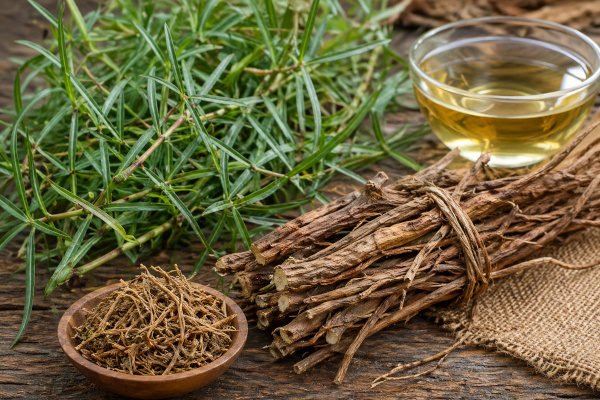
Hemidesmus indicus, better known in Ayurveda as Sariva, Anantamoola, Indian Sarsaparilla, and in South India as Nannari or Naruneendi, is one of those quiet herbs that does not shout like Ashwagandha or Turmeric, but has occupied a respected place in traditional medicine for centuries. It is especially valued as a cooling, aromatic, Pitta-pacifying root used in conditions connected with heat, burning sensation, skin irritation, thirst, urinary discomfort, feverish states and what Ayurveda calls Rakta vikara — disorders of the blood tissue and its expression through the skin.
Botanically, the accepted name is Hemidesmus indicus (L.) R.Br., and modern taxonomy places it in the Apocynaceae family. Kew’s Plants of the World Online lists it as native across India and neighbouring regions including Sri Lanka, Bangladesh, Pakistan, Assam/East Himalaya and parts of Southeast Asia. In older Ayurvedic and pharmacopoeial literature, it is often listed under the older family classification Asclepiadaceae, which is why both names may appear in books and medicine labels. The Ayurvedic Pharmacopoeia of India identifies Shveta Sariva as the root of Hemidesmus indicus and records it as a prostrate or semi-erect shrub found across large parts of India, from the upper Gangetic plains eastwards to Assam and across central, western and southern India up to about 600 m elevation.
In Ayurveda, Sariva is not merely a “cooling herb.” Its deeper identity is that of a Rakta-prasadana and Rakta-shodhaka dravya — a herb that supports the clarity and balance of the blood tissue. When Pitta becomes sharp, hot and inflammatory, it often shows itself through the skin: itching, burning, redness, rashes, boils, acne-like eruptions, excessive heat, sourness, thirst and inflammatory discomfort. Sariva is traditionally chosen in such patterns because it is Madhura in rasa, Guru and Snigdha in guna, Sheeta in virya, and Madhura in vipaka, making it nourishing, cooling and stabilising rather than harsh or drying. The Ayurvedic Pharmacopoeia lists its actions as Raktashodhaka, Vishaghna, Tridoshanashana, Dipana, Amanashana and Jvarahara, and its therapeutic uses include Agnimandya, Aruchi, Atisara, Shvasa, Jvara, Kasa, Kandu, Kushtha and Raktavikara.
The most commonly used medicinal part is the root. Proper Sariva root has a distinctive aromatic, sweetish, slightly acrid smell and taste. The Pharmacopoeia describes the roots as cylindrical pieces, around 30 cm long and 3–8 mm in diameter, hard, somewhat twisted, dark brown externally, sometimes with a violet-grey tinge, yellow and woody at the centre, surrounded by a mealy white cortical layer, with a corky bark marked by transverse cracks and longitudinal fissures. This aromatic root is the same material behind the traditional Nannari sherbet of Tamil Nadu and Kerala — a summer drink that reflects the old Indian idea that food, drink and medicine exist on a connected spectrum.
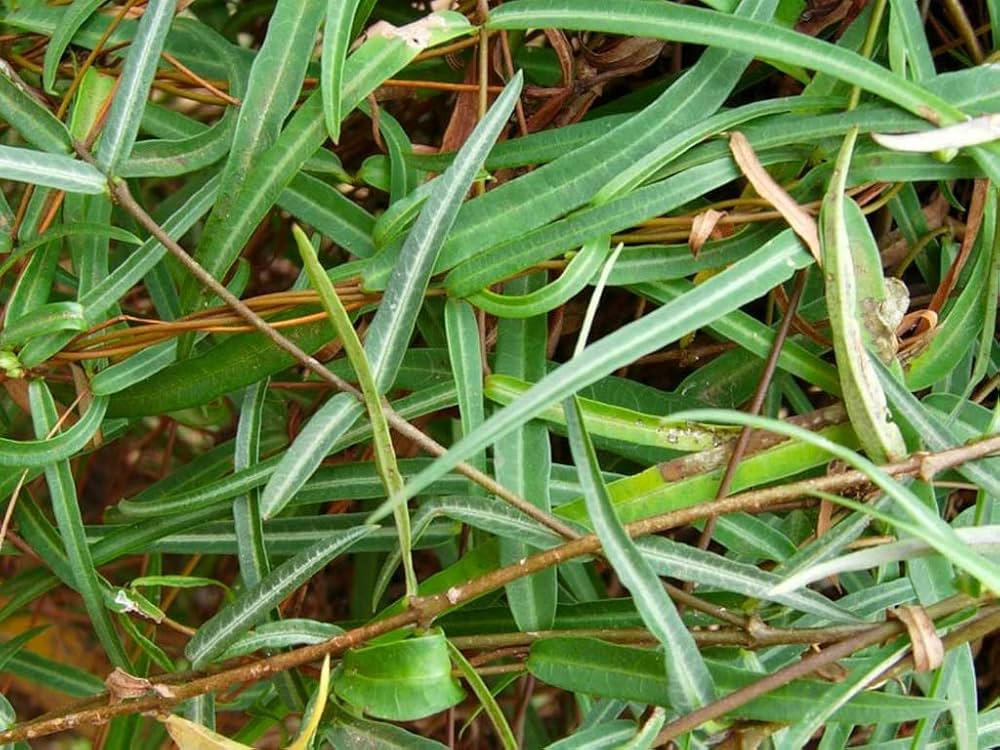
The plant itself is a slender climber or twiner with a woody rootstock. The Kerala State Medicinal Plants Board describes it as having brownish stems, variable opposite or whorled leaves, yellow to brownish flowers in short axillary cymes, cylindrical follicles and white coma on the seeds. Field identification matters because the market often confuses Sariva with other roots sold as “sarsaparilla.” Indian Sariva is Hemidesmus indicus, while many Western “sarsaparilla” products come from Smilax species. They are not the same plant. For Ayurveda, the identity of the root is crucial because the rasa, guna, virya and karma of the drug depend on proper botanical sourcing.
From an Ayurvedic perspective, Sariva’s first major area of importance is skin health. It is traditionally used in Kandu and Kushtha, terms that broadly cover itching and chronic skin disorders in classical language. This does not mean Sariva is a one-herb cure for eczema, psoriasis, acne or fungal problems, but it is often used as part of a larger formula where the underlying pattern is Pitta-Rakta aggravation — heat, redness, burning, itching, inflammatory eruptions and sensitivity. It is gentler than strongly bitter herbs, which makes it useful in people who need cooling and blood-supporting action without excessive depletion.
The second major area is heat and burning sensation. Sariva’s Sheeta virya makes it especially suited to summer complaints, excessive thirst, burning urination, body heat, mild feverishness and Pitta-type restlessness. In Kerala and Tamil Nadu, this logic survives in the simple habit of drinking Nannari water or Nannari sherbet during hot months. The traditional version uses real root extract, water and a sweetener, often with lemon. The modern commercial version, however, may contain artificial flavours and high sugar, so it should not be confused with a therapeutic preparation.
The third area is digestion and Ama correction. At first glance, a sweet and cooling herb may not seem digestive, but Sariva is also listed with Dipana and Amanashana actions in the Ayurvedic Pharmacopoeia. This is important because Ayurveda does not view skin and blood disorders as isolated surface problems. Improper digestion, low Agni, Ama formation and disturbed Pitta can all feed inflammatory patterns. Sariva is therefore used not as a harsh digestive stimulant like Trikatu, but as a gentler herb that supports digestion while cooling the system.
The fourth area is urinary comfort and fluid balance. Traditional practice uses Sariva in burning urination, heat-related urinary irritation and Pitta-dominant urinary discomfort. This is why it appears in cooling combinations with herbs like Usheera, Chandana, Musta, Lodhra or Manjishta depending on the condition. In classical thinking, it helps cool and soothe the channels rather than forcing urination aggressively.
The fifth area is fever, cough and respiratory irritation. The Pharmacopoeia lists Jvara, Kasa and Shvasa among its therapeutic uses. In practical terms, this points to its use in feverish, inflammatory and irritated states where heat, dryness, thirst and tissue sensitivity are present. It is not a replacement for medical care in infection, asthma or persistent fever, but in Ayurveda it can be part of a formulation chosen according to dosha, strength, season and associated symptoms.
Modern phytochemical studies help explain why this root attracted so much traditional attention. The Ayurvedic Pharmacopoeia lists essential oil, saponin, resin, tannins, sterols and glucosides among its constituents. Reviews of Hemidesmus indicus research discuss its ethnobotany, phytochemistry, pharmacology and toxicology, with preclinical studies exploring antioxidant, anti-inflammatory, antimicrobial, hepatoprotective, immunomodulatory and metabolic effects. These findings are promising, but they should be understood correctly: much of the evidence is still laboratory or animal-based, not large human clinical trial evidence. Ayurveda gives Sariva its traditional logic; modern research is still catching up.
One of the most famous classical formulations containing Sariva is Sarivadyasava or Saribadyasavam, which the Ayurvedic Pharmacopoeia lists as an important formulation for Shveta Sariva. It is a fermented Ayurvedic preparation traditionally used in conditions involving skin, blood, Pitta, metabolic heat and inflammatory patterns. Sariva is also used as Sariva kwatha, Sariva phanta, Anantamoola churna, cooling herbal waters, and in regional preparations such as Nannari syrup. The Pharmacopoeia gives a decoction dose of 20–30 g of the drug for decoction, but actual use should depend on constitution, age, disease state and practitioner guidance.
A simple traditional summer preparation is Nannari root water. Clean, authentic dried Nannari root is lightly crushed, soaked or simmered in water, strained and consumed as a cooling drink. Lemon may be added. In household use, this is treated more as a seasonal coolant than as medicine. For those with diabetes, fatty liver, obesity or insulin resistance, the sugary sherbet version is best avoided or modified, because the sugar load can defeat the purpose of the herb.
Sariva also has a place in women’s health in traditional practice, especially where Pitta-Rakta aggravation is linked with heat, excessive bleeding tendencies, burning, irritation or white discharge patterns. However, this is an area where self-medication is unwise. Menstrual irregularity, heavy bleeding, recurrent discharge, pelvic pain or urinary symptoms require proper diagnosis. Sariva may be a supportive herb in the Ayurvedic framework, but it should not be used to mask serious conditions.
Safety-wise, Sariva is generally regarded as a gentle herb when properly identified and used in traditional doses, but “natural” does not automatically mean risk-free. Animal toxicity studies have reported no major acute toxic signs in specific tested extracts and doses, but that does not replace human safety data for all populations. Pregnant women, breastfeeding mothers, children, people on diabetes medication, patients with kidney disease, those with chronic liver conditions, and anyone taking multiple medicines should use it only after medical or Ayurvedic consultation. The biggest practical risks are wrong plant material, adulteration, excessive sugar in commercial Nannari syrups, and overuse without understanding the person’s prakriti and condition.
The best way to understand Hemidesmus indicus is to see it as Ayurveda’s fragrant cooling root for overheated blood, irritated skin and Pitta-aggravated channels. It is not a fashionable miracle herb; it is a classical, grounded, deeply Indian plant whose strength lies in balance. It cools without shocking the system, supports the skin without merely treating the surface, and connects digestion, blood, urinary comfort and summer health into one traditional logic. In that sense, Sariva represents the best of Ayurvedic thinking — medicine that begins in the soil, enters the kitchen, matures in the pharmacy and finally works through the intelligence of balance.
Sources:
https://powo.science.kew.org/taxon/urn:lsid:ipni.org:names:60443873-2
https://www.ayurveda.hu/api/API-Vol-1.pdf
https://smpbkerala.in/herbal-data/hemidesmus-indicus.asp
https://www.sciencedirect.com/science/article/pii/S0378874119309900
https://pubmed.ncbi.nlm.nih.gov/32007632
https://pmc.ncbi.nlm.nih.gov/articles/PMC3331001
You may also like
-
Bharat Biotech’s Nucelion and VeGen Bio Partner to Manufacture Advanced Dual-Target CAR-T Cancer Therapy in India
-
Ayurveda and Anger: How Emotional Excess Affects Physical and Mental Health
-
Ayurveda and Stress: Daily Practices for Mental Balance and Emotional Well-Being
-
Ayurveda and Bowel Routine: Why Regularity Matters for Digestive Health
-
Why Ayurveda Warns Against Suppressing Hunger, Thirst and Sleep
