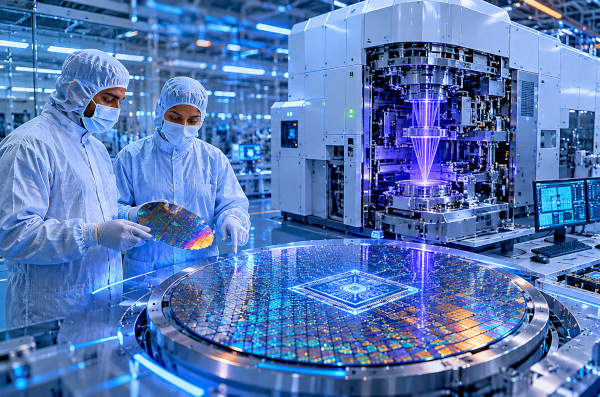
India’s semiconductor mission has received a major boost with Tata Electronics signing a memorandum of understanding with Dutch chip-equipment giant ASML to support the country’s first commercial semiconductor fabrication plant at Dholera in Gujarat. The agreement, announced during Prime Minister Narendra Modi’s visit to the Netherlands, places one of the world’s most important semiconductor equipment companies at the heart of India’s emerging chip-manufacturing ecosystem.
The partnership is significant because lithography is one of the most critical stages in semiconductor manufacturing. In simple terms, lithography is the process through which microscopic circuit patterns are projected and printed layer by layer onto a silicon wafer. ASML’s own technology description says its lithography systems are central to this process, enabling chipmakers to mass-produce patterns on silicon with extreme precision.
Under the MoU, ASML will support the establishment and ramp-up of Tata Electronics’ upcoming 300 mm, or 12-inch, semiconductor fab in Dholera. The collaboration will focus on ASML’s advanced lithography tools and solutions, while also covering local talent training, lithography-intensive skill development, supply-chain resilience and research infrastructure.
The Dholera project is already one of the largest technology manufacturing investments in India. The Government of India earlier said Tata Electronics’ semiconductor fab involves an investment of over ₹91,000 crore and will have a capacity of 50,000 wafer starts per month. It is being developed with support from the India Semiconductor Mission and with technology partnership from Taiwan’s Powerchip Semiconductor Manufacturing Corporation.
The latest ASML agreement therefore fills an essential equipment-and-process layer in the larger Tata semiconductor plan. A chip fab is not simply a factory with machines; it is an ultra-precise ecosystem of cleanrooms, lithography systems, metrology, chemical processes, wafer handling, process control and skilled engineers. Without world-class lithography support, even a well-funded fab cannot move smoothly from construction to production. That is why the involvement of ASML is strategically important for India’s first commercial wafer fabrication push.
The Government has also recently notified the Tata Semiconductor Manufacturing SEZ at Dholera. According to PIB, the SEZ covers 66.166 hectares, is designed for an AI-enabled semiconductor fabrication facility, and is expected to generate around 21,000 direct and indirect jobs.
For India, this agreement is important at three levels. First, it strengthens the operational credibility of the Dholera fab by bringing in a global lithography leader. Second, it supports India’s long-term ambition to move beyond chip design and assembly into wafer fabrication. Third, it deepens India-Netherlands technology cooperation at a time when semiconductors have become central to economic security, AI, defence electronics, automotive systems and telecom infrastructure.
Tata Electronics has already been building a wider semiconductor ecosystem through partnerships in process technology, materials, design, packaging and manufacturing support. The ASML MoU adds one of the most sensitive and high-value technology links in that chain. If executed well, the Dholera fab can become a foundation project for India’s transition from electronics assembly to advanced electronics manufacturing.
The larger message is clear: India’s chip ambitions are now moving from policy announcements to industrial execution. The country still has a long road ahead in semiconductor manufacturing, but the Tata-ASML partnership shows that the ecosystem around India’s first fab is beginning to acquire the global depth needed for serious chip production.
You may also like
-
India’s Economic Warfare Challenge: Strategic Autonomy, Energy Security and the Rise of a Global Power
-
India-US Trade Deal Stalemate: Why Washington’s Tariff Pressure Has Failed to Secure an Agreement
-
US Double Standards in Foreign Policy: 16 Recent Cases Involving India, Russia, China and Global Trade
-
India’s Arctic Energy Ambitions: Russian Oil, LNG and a New Sea Route to Indian Ports
-
India and Russia Explore Joint Icebreaker Construction as Maritime Industrial Cooperation Expands
