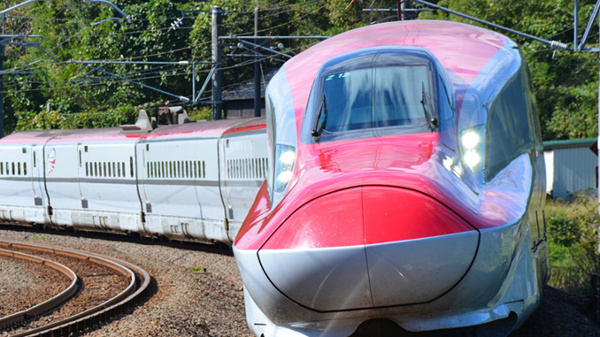
India’s first bullet train corridor is now moving from heavy civil construction into one of its most critical technical phases: track installation. The Mumbai-Ahmedabad High Speed Rail corridor, a 508-km project being executed with Japanese technical and financial assistance, will connect Mumbai, Thane, Virar, Boisar, Vapi, Bilimora, Surat, Bharuch, Vadodara, Anand, Ahmedabad and Sabarmati through 12 stations.
The latest update from the Ministry of Railways says the corridor will use the Japanese J-Slab ballastless track system, based on Shinkansen technology, for the first time in India. Unlike conventional railway tracks that use loose ballast stones, this system uses a reinforced concrete track bed, cement asphalt mortar, pre-cast track slabs, rails and fasteners to create a highly stable track structure suitable for high-speed operations.
According to NHSRCL-linked updates, track work has now gained visible momentum. Reports based on the latest project statement say 185 route km of reinforced concrete track bed has been laid, 188 route km of track slabs have been manufactured, and track slabs have already been laid with cement asphalt mortar injected across 70 route km. The installation process is fully mechanised and uses specialised machinery designed on Japanese construction practices, with most of the equipment manufactured in India.
The project has also seen continued progress on tunnelling and station infrastructure. NHSRCL recently reported that assembly of the second tunnel boring machine started at Sawli on April 11, 2026, for the Mumbai-Ahmedabad bullet train project. Earlier April updates also highlighted progress on the 21-km tunnel package and construction activity linked to the underground BKC bullet train station in Mumbai.
Another important development is the emergence of India’s indigenous high-speed train ambition. Railway Minister Ashwini Vaishnaw has said the Vande Bullet prototype is expected to roll out in 2027, with production planned in the latter half of that year. The announcement was made during the inauguration of BEML’s new high-speed rail manufacturing facility, signalling that India wants to move beyond imported high-speed rail systems and develop domestic capability for future corridors.
The Mumbai-Ahmedabad corridor is designed as India’s first operational high-speed rail line and is expected to run trains at speeds of up to 320 km/h. Beyond reducing travel time between the two major western economic centres, the project is also creating a new industrial ecosystem around precision track systems, high-speed stations, tunnelling, signalling, electrification, rolling stock and specialised construction machinery.
A recent legal development has also cleared one lingering dispute. The Bombay High Court dismissed petitions filed by Godrej & Boyce related to compensation for land acquired at Vikhroli for the bullet train project, with the matter concerning compensation rather than the validity of land acquisition itself.
India’s bullet train project has entered the railway systems phase, where track, tunnel, station, depot and rolling stock decisions will decide the final pace of delivery. With Japanese Shinkansen track technology being installed and an indigenous Vande Bullet prototype now targeted for 2027, India’s high-speed rail programme is beginning to shift from construction milestone to operational readiness.
You may also like
-
ICAR Scientists Develop Indigenous Protective Gloves for Cotton Farmers, Sign Commercial Manufacturing Agreement
-
BHEL–Coal India Joint Venture Begins Construction of ₹25,016 Crore Indigenous Coal Gasification Project in Odisha
-
PM Modi to Inaugurate RBI’s Tier IV Data Centre and Cybersecurity Training Institute in Bhubaneswar
-
India Creates 11 Crore Digital Farmer IDs Five Months Ahead of Target, Strengthening AgriStack Infrastructure
-
Chak-Hao Black Rice of Manipur and Nagaland: The Aromatic Purple Heritage Grain with GI Recognition
