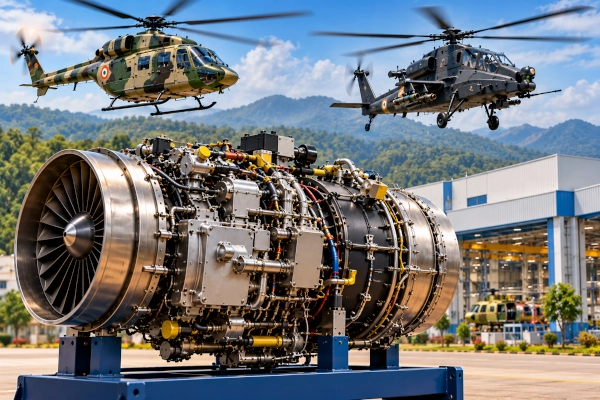
Hindustan Aeronautics Limited’s Koraput Division in Odisha is set to add a second production line for the Shakti helicopter engine as India marks the delivery of the 2,000th aero-engine from the facility.
Defence Minister Rajnath Singh will attend the milestone event at HAL Koraput on October 6, 2026. The Ministry of Defence has confirmed that the new Shakti engine line will involve an investment of ₹218 crore and will expand production capacity for engines used on indigenous helicopter platforms, including the Dhruv Advanced Light Helicopter and Prachand Light Combat Helicopter.
The expansion gives added significance to Koraput’s six-decade evolution from a facility created to manufacture Soviet-origin fighter engines into one of India’s most important aero-engine production and overhaul centres.
Second Shakti Engine Line to Expand Helicopter Propulsion Capacity
The Ministry of Defence says the new production line is being established to meet the growing requirements of India’s indigenous helicopter fleet.
The Shakti engine powers major HAL helicopter platforms, including later variants of the Dhruv and the Light Combat Helicopter Prachand. Increasing production capacity therefore directly supports the expansion and sustainment of these aircraft across the Armed Forces.
The ₹218-crore investment is intended to create additional manufacturing capacity rather than replace the existing Shakti production setup.
The Government has described aero-engine capability as strategically important because propulsion systems are among the most technologically complex parts of an aircraft and are critical to long-term defence self-reliance.
Shakti Was Co-Developed by HAL and Safran
The Shakti is the Indian designation of the Safran Ardiden 1H1 turboshaft engine, developed through cooperation between HAL and Safran Helicopter Engines.
Safran describes the Ardiden 1H1 as a 1,400–2,000 shaft horsepower engine family equipped with dual-channel Full Authority Digital Engine Control. The engine was specifically designed for demanding helicopter operations and is capable of sustained performance in hot-and-high conditions.
Its compact modular architecture is intended to reduce maintenance requirements and operating costs while supporting military missions in difficult environments.
For India, these characteristics are especially important because Army and Air Force helicopters frequently operate from high-altitude bases and forward areas where reduced air density places greater demands on engine performance.
Dhruv Depends on Shakti for High-Altitude Operations
HAL’s own specifications identify the Shakti as the powerplant for the Dhruv Mk III and Mk IV variants.
Compared with the earlier TM333 engine fitted to the first generations of Dhruv, HAL says the Shakti provides higher power and incorporates features such as a dual centrifugal compressor assembly, single-crystal turbine blades and dual-channel FADEC.
The Dhruv Mk III serves in utility roles across the Armed Forces and is designed for high-altitude operations. The Mk IV is the weaponised version, equipped for attack and close-air-support missions.
More than 340 Dhruv helicopters have been produced by HAL across different variants, making sustained Shakti engine production important not only for new helicopters but also for long-term fleet support.
Prachand Adds Further Demand for Shakti Engines
The same engine family also powers the Prachand Light Combat Helicopter, designed by HAL specifically for operations in demanding terrain and high-altitude environments.
The Prachand was developed around India’s requirement for a light attack helicopter capable of operating in conditions where heavier rotorcraft face performance limitations.
As production of the helicopter expands, the requirement for Shakti engines will grow alongside it. The second Koraput line therefore strengthens the propulsion supply chain supporting one of India’s principal indigenous combat-helicopter programmes.
Unlike an isolated component expansion, the investment connects directly with rising demand across multiple HAL rotorcraft fleets.
Koraput Reaches 2,000 Aero-Engine Milestone
The October 6 event will also mark the delivery of the 2,000th aero-engine manufactured at HAL’s Koraput Division.
The Ministry of Defence says the milestone represents nearly six decades of contribution to India’s aerospace manufacturing capability and to the operational readiness of the Armed Forces.
Koraput’s importance lies in the range of propulsion systems it has handled over that period. The Engine Division was established in April 1964 to manufacture the R11-F2/F2S turbojet engine for the MiG-21FL.
It later took up production of the R25 series for the MiG-21 Bis and the R29B for the MiG-27M. Manufacturing of RD-33 Series 3 engines for the MiG-29 began from 2007-08.
The facility also developed extensive overhaul capability for these engines, giving HAL experience across both manufacturing and through-life support.
Koraput Has Built an Extensive Engine Manufacturing Ecosystem
HAL established a forge and foundry unit at Koraput in 1967 to support aero-engine manufacturing from the raw-material stage.
This capability became important because aero-engines contain specialised components exposed to extreme temperatures, pressures and rotational speeds. Producing such components requires precision forging, casting, machining and inspection processes that differ significantly from ordinary industrial manufacturing.
HAL states that the Koraput division has manufactured more than 1,300 engines and overhauled thousands of aero-engines over its history. The 2,000-engine milestone now reflects the wider contribution of the Koraput complex across different production programmes.
Its role has continued to expand as India has sought to increase the indigenous content of propulsion systems used by the Armed Forces.
Su-30MKI Engine Programme Gives Koraput Another Major Workload
Koraput is also central to the Indian Air Force’s Su-30MKI engine programme.
In September 2024, the Ministry of Defence signed a contract with HAL worth more than ₹26,000 crore for 240 AL-31FP aero-engines for the Su-30MKI fleet.
These engines are being manufactured at HAL Koraput, with a planned supply rate of 30 engines annually over eight years.
The programme is designed to increase indigenous content progressively, reaching up to 63 per cent by the end of the delivery schedule and averaging more than 54 per cent across the contract.
That contract gives Koraput a large fixed-wing combat-aircraft propulsion workload at the same time that the Shakti expansion increases its role in helicopter engines.
RD-33 Production Adds Another Fighter Engine Programme
The Koraput facility is also responsible for the RD-33 engine programme supporting the Indian Air Force’s MiG-29 fleet.
The Ministry of Defence signed a ₹5,249.72-crore contract with HAL in 2024 for RD-33 aero-engines to sustain the MiG-29 fleet through its remaining service life.
These engines are being produced under transfer of technology from the Russian original equipment manufacturer, with a focus on increasing indigenisation of high-value components.
The programme further demonstrates the concentration of fighter-engine manufacturing and overhaul expertise at Koraput.
Why Aero-Engine Manufacturing Remains Strategically Important
Aircraft engines remain one of the most difficult technologies to master in aerospace.
They must operate reliably under extreme thermal and mechanical loads while maintaining low weight, high efficiency and precise control. Materials, turbine-blade technology, combustion systems, compressors, digital controls and manufacturing tolerances all impose demanding engineering requirements.
India has made substantial progress in aircraft structures, avionics, weapons and helicopter design, but propulsion remains an area where foreign technology continues to play an important role.
Building greater manufacturing depth around programmes such as Shakti, AL-31FP and RD-33 therefore strengthens domestic capability even where the original engine technology has foreign origins.
The Koraput expansion also preserves specialised manufacturing skills and infrastructure that can contribute to future Indian engine programmes.
Shakti Programme Represents a Different Model of Technology Partnership
The Shakti programme differs from simple engine import because it was co-developed by HAL and Safran.
Safran says the engine has been produced in India under the Shakti designation and has accumulated a substantial operational fleet across Indian military helicopters.
HAL and Safran have also expanded their cooperation into engine maintenance, repair and overhaul through joint facilities supporting the Shakti and earlier TM333 engines.
This long-term industrial relationship has created Indian production, support and maintenance capabilities around an engine family used extensively by HAL-built helicopters.
The new Koraput line deepens that manufacturing relationship while expanding India’s ability to meet domestic requirements from within the country.
Koraput Is Moving From Legacy Support to Future Production
HAL Koraput’s development reflects the changing structure of Indian military aviation.
The division began as a manufacturing base for engines fitted to Soviet-origin fighters. It subsequently expanded into overhaul, component manufacturing and production of engines for newer combat aircraft.
Today, the same complex supports both legacy fleets and increasingly important indigenous platforms.
The second Shakti production line is particularly significant because it is tied directly to Indian-designed helicopters rather than solely to licensed fighter-aircraft programmes.
That makes the ₹218-crore investment part of a broader transition from sustaining imported aircraft designs towards building domestic aerospace systems around Indian production infrastructure.
2,000th Engine Marks a Transition Point for HAL Koraput
The delivery of the 2,000th aero-engine and the establishment of the second Shakti production line bring two different phases of HAL Koraput’s history together.
The milestone reflects nearly six decades of accumulated experience in manufacturing and overhauling complex military propulsion systems. The new line directs part of that capability towards the growing fleet of Indian-designed helicopters.
At the same time, Koraput continues to manufacture engines for frontline fighter aircraft through the Su-30MKI and MiG-29 programmes.
The combination gives the facility a wider strategic role in India’s defence aviation ecosystem. With additional Shakti capacity, major fighter-engine contracts and decades of specialised manufacturing expertise already in place, HAL Koraput is becoming an increasingly important foundation for India’s long-term effort to strengthen domestic aero-engine capability.
References
Press Information Bureau, Ministry of Defence — Raksha Mantri to mark delivery of 2,000th aero-engine at HAL Koraput tomorrow, October 5, 2026.
https://www.pib.gov.in/PressReleseDetailm.aspx?PRID=2319187&lang=1®=3
Hindustan Aeronautics Limited — Engine Division Koraput.
https://hal-india.co.in/production-unit-details/engine-division-koraput
Hindustan Aeronautics Limited — Dhruv Advanced Light Helicopter.
https://hal-india.co.in/product/dhruv
Press Information Bureau, Ministry of Defence — Aatmanirbharta in defence: MoD signs ₹26,000 crore contract with HAL for 240 AL-31FP Aero Engines for Su-30MKI aircraft, September 9, 2024.
https://www.pib.gov.in/PressReleasePage.aspx?PRID=2053088
Press Information Bureau, Ministry of Defence — Official information on procurement of RD-33 aero-engines for the MiG-29 fleet, March 2024.
https://www.pib.gov.in/PressReleasePage.aspx?PRID=2010528
Safran Helicopter Engines — Ardiden 1H1 Shakti, the engine of the Indian Dhruv helicopter.
https://www.safran-group.com/products-services/ardiden-1h1-shakti-engine-indian-dhruv-helicopter
Safran — HAL and Safran sign strategic MoU during groundbreaking ceremony of HE-MRO at Goa, March 14, 2022.
https://www.safran-group.com/pressroom/hal-and-safran-sign-strategic-mou-during-groundbreaking-ceremony-he-mro-goa-2022-03-14
You may also like
-
ICAR Scientists Develop Indigenous Protective Gloves for Cotton Farmers, Sign Commercial Manufacturing Agreement
-
India Moves Towards Five-Year Assured Orders for Defence Startups Under New Procurement Reforms
-
BHEL–Coal India Joint Venture Begins Construction of ₹25,016 Crore Indigenous Coal Gasification Project in Odisha
-
Zen Technologies Introduces Indigenous Hyper-Strike Falcon AI-Guided Counter-Drone Interceptor
-
L&T and Germany’s SCHOTTEL Expand Partnership for Controllable Pitch Propeller Systems in Indian Shipbuilding
