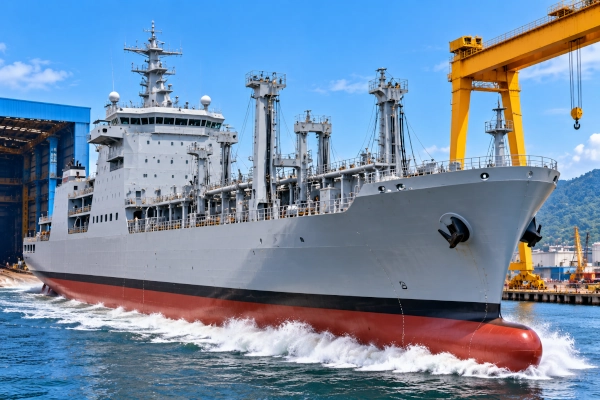
India is preparing to launch the first of five new Fleet Support Ships for the Indian Navy as Hindustan Shipyard Limited in Visakhapatnam simultaneously expands its capacity to construct larger and more complex naval vessels.
Defence Minister Rajnath Singh will launch Fleet Support Ship-1, or FSS-1, on October 6, 2026, while also laying the keel of the fifth ship in the programme and inaugurating an upgraded shipbuilding slipway and a new 300-tonne Goliath crane at the state-owned shipyard.
The Ministry of Defence says the combined milestones demonstrate the growing capacity of India’s indigenous shipbuilding ecosystem and will strengthen the Indian Navy’s ability to sustain warships for extended periods across the Indian Ocean Region.
FSS-1 to Enter Water Just 18 Months After Steel Cutting
FSS-1 is the first vessel in a programme to construct five Fleet Support Ships for the Indian Navy at Hindustan Shipyard Limited.
According to the Ministry of Defence, the vessel will enter the waters of the Bay of Bengal only 18 months after its steel-cutting ceremony, marking rapid progress in the construction programme.
The ships will have a displacement of approximately 43,500 tonnes, placing them among the largest vessels being constructed domestically for the Indian Navy.
Unlike frontline destroyers or frigates, Fleet Support Ships are designed primarily to sustain other naval vessels during extended deployments.
Fleet Support Ships Will Replenish Warships at Sea
The central role of the new ships will be replenishment at sea.
A Fleet Support Ship can transfer fuel, ammunition, provisions, spare parts and other supplies to naval vessels without requiring them to return to harbour. This allows carrier groups, destroyers, frigates and other warships to remain deployed for longer periods.
Such vessels therefore act as floating logistics hubs for naval forces operating far from their home bases.
For the Indian Navy, the five-ship programme will strengthen the ability to maintain sustained deployments across the Indian Ocean Region, where ships may operate thousands of kilometres from the Indian coastline.
Greater Endurance Across the Indian Ocean
The Ministry of Defence has specifically linked the Fleet Support Ship programme with extending the Navy’s endurance and operational reach across the Indian Ocean Region.
Modern naval operations depend not only on combat ships but also on the logistics network that allows those ships to remain at sea. Without replenishment vessels, warships must periodically leave operational areas to refuel and resupply.
A larger fleet of support ships gives commanders greater flexibility to maintain persistent naval presence over wider areas.
This capability is increasingly important as the Indian Navy conducts missions ranging from maritime surveillance and carrier operations to anti-piracy patrols, evacuation missions and humanitarian assistance.
Keel of Fifth Fleet Support Ship to Be Laid
The October 6 event will also mark the keel laying of FSS-5, the final vessel in the five-ship programme.
Keel laying is a major milestone in ship construction and traditionally marks the formal beginning of a vessel’s structural assembly.
The fact that the fifth ship is entering this stage while the first vessel is being launched demonstrates the transition of the programme towards continuous, series production.
Building several ships of the same design in sequence can improve productivity by allowing shipyards and suppliers to retain trained personnel, repeat established manufacturing processes and optimise production schedules.
Five-Ship Programme Worth Nearly ₹19,000 Crore
The Ministry of Defence signed the contract with Hindustan Shipyard Limited in August 2023 for the construction of five Fleet Support Ships at an overall value of approximately ₹19,000 crore.
The programme was approved as an indigenous shipbuilding project and is expected to generate substantial employment while creating business for Indian companies supplying equipment, systems and materials.
At the time of the contract, the Ministry estimated that construction of the five ships would generate nearly 168.8 lakh man-days of employment over eight years.
The programme also involves participation from micro, small and medium enterprises, reinforcing the wider industrial supply chain surrounding Indian naval shipbuilding.
Upgraded Slipway-4 Expands Hindustan Shipyard’s Capacity
Alongside the FSS milestones, Rajnath Singh will inaugurate the upgraded Slipway-4 at Hindustan Shipyard Limited.
The slipway has been extended and its load-bearing capability increased, enabling HSL to undertake substantially larger shipbuilding projects.
Together with the new Goliath crane, the upgraded facility will allow the shipyard to construct and launch vessels of up to 45,000 deadweight tonnes.
This represents a significant expansion in HSL’s physical shipbuilding capability and brings the yard closer to the scale required for increasingly large naval and commercial vessels.
New 300-Tonne Goliath Crane Supports Heavy Ship Construction
A 300-tonne Goliath crane forms a central part of the upgraded infrastructure.
Large shipbuilding increasingly relies on modular construction, in which substantial sections of a vessel are fabricated separately and then moved into position for assembly.
Heavy-lift cranes make it possible to handle larger ship blocks, reducing the number of smaller assembly operations required during construction.
This approach can shorten construction cycles, improve dimensional accuracy and make more efficient use of shipyard space.
The combination of the upgraded slipway and Goliath crane therefore improves both the size of vessels HSL can build and the industrial methods available for constructing them.
Hindustan Shipyard Gains a Larger Naval Role
Hindustan Shipyard Limited has a long history of shipbuilding and ship repair at Visakhapatnam, one of India’s principal maritime industrial centres.
Its expanding role in the Fleet Support Ship programme gives the yard responsibility for a strategically important class of large naval auxiliary vessels.
The project also adds to India’s broader effort to distribute major naval construction across several domestic shipyards instead of concentrating production at a small number of facilities.
Mazagon Dock Shipbuilders, Garden Reach Shipbuilders and Engineers, Goa Shipyard, Cochin Shipyard and Hindustan Shipyard now collectively support a wide range of naval programmes spanning submarines, destroyers, frigates, survey vessels, patrol ships and support platforms.
Fleet Support Ships Strengthen More Than Logistics
Although classified as auxiliary vessels, Fleet Support Ships have a direct influence on combat effectiveness.
A modern destroyer or frigate may possess advanced weapons and sensors, but its endurance ultimately depends on supplies such as fuel, food, aviation fuel and ammunition.
At-sea replenishment reduces the frequency with which frontline ships must return to port and allows a naval task force to maintain its operational position.
For aircraft carrier formations, this capability is particularly important because carrier operations consume large quantities of fuel and aviation supplies.
Fleet Support Ships therefore multiply the practical endurance of the combat fleet rather than functioning simply as transport vessels.
Indigenous Construction Builds Domestic Industrial Capability
Building the vessels at Hindustan Shipyard also creates opportunities to deepen Indian shipbuilding expertise.
Large support ships require extensive integration of propulsion systems, electrical networks, cargo handling equipment, accommodation, communications systems and replenishment machinery.
The programme consequently supports skills extending from steel fabrication and heavy engineering to electronics, systems integration and specialised marine equipment.
Repeat construction across five vessels can also help domestic suppliers achieve production scale and increase localisation as the programme progresses.
Visakhapatnam Emerges as a Wider Defence Maritime Hub
The new investment at Hindustan Shipyard adds to Visakhapatnam’s wider importance within India’s maritime defence infrastructure.
The city hosts the headquarters of the Indian Navy’s Eastern Naval Command and a substantial concentration of naval facilities, repair infrastructure and defence industries.
Expanding HSL’s shipbuilding capacity strengthens this ecosystem by adding the ability to handle vessels approaching 45,000 tonnes.
The new facilities can also support future projects after completion of the current Fleet Support Ship programme, leaving India with permanent heavy shipbuilding capacity on the eastern coast.
FSS Programme Strengthens India’s Blue-Water Capability
The launch of FSS-1 represents more than the construction of another naval vessel.
India’s ability to maintain a sustained naval presence across the Indian Ocean depends on logistics ships capable of accompanying task forces over long distances. Five large Fleet Support Ships will substantially expand this support network as they progressively enter service.
At the same time, the upgraded Slipway-4 and 300-tonne Goliath crane create industrial capacity that can serve naval programmes well beyond the current order.
The October 6 milestones therefore bring together two parts of India’s maritime strategy: strengthening the Navy’s endurance at sea while expanding the domestic shipbuilding infrastructure needed to support a larger and more capable fleet.
References
Press Information Bureau, Ministry of Defence — Raksha Mantri Shri Rajnath Singh to Launch First Fleet Support Ship (FSS-1), Lay Keel of FSS-5 and Inaugurate Upgraded Slipway-4 & 300-Tonne Goliath Crane at Visakhapatnam, October 5, 2026.
https://www.pib.gov.in/https://www.hslvizag.in/
Press Information Bureau, Ministry of Defence — MoD signs contract with Hindustan Shipyard Limited for acquisition of five Fleet Support Ships for Indian Navy, August 25, 2023.
https://www.pib.gov.in/
Hindustan Shipyard Limited — Official information on shipbuilding and ship repair capabilities.
https://www.hslvizag.in/
You may also like
-
ICAR Scientists Develop Indigenous Protective Gloves for Cotton Farmers, Sign Commercial Manufacturing Agreement
-
India Moves Towards Five-Year Assured Orders for Defence Startups Under New Procurement Reforms
-
BHEL–Coal India Joint Venture Begins Construction of ₹25,016 Crore Indigenous Coal Gasification Project in Odisha
-
Zen Technologies Introduces Indigenous Hyper-Strike Falcon AI-Guided Counter-Drone Interceptor
-
L&T and Germany’s SCHOTTEL Expand Partnership for Controllable Pitch Propeller Systems in Indian Shipbuilding
