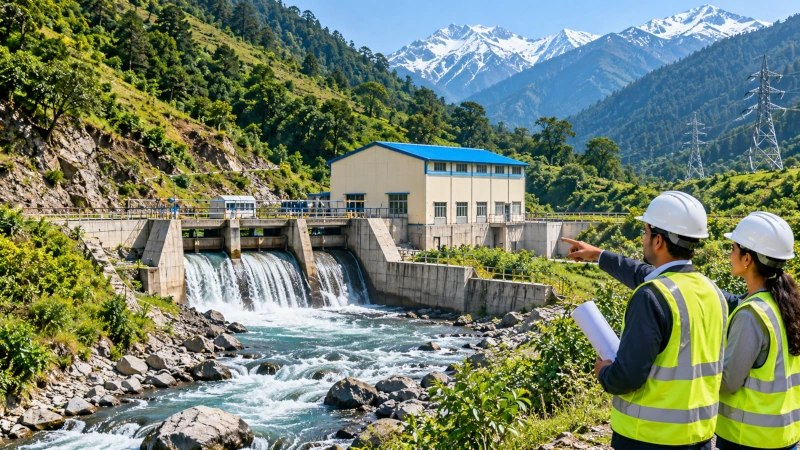
The Government of India has highlighted its ₹2,584.60 crore Small Hydro Power Development Scheme, which aims to add approximately 1,500 megawatts (MW) of renewable electricity generation capacity across the country. The Ministry of New and Renewable Energy (MNRE) outlined the programme’s financial assistance, investment opportunities and employment potential in a Press Information Bureau backgrounder published on 22 November 2026.
Approved by the Union Cabinet in March 2026, the scheme covers the financial years 2026–27 to 2030–31 and focuses on accelerating the development of small hydropower projects, particularly in hilly regions, northeastern states and districts along India’s international borders. The initiative is expected to attract approximately ₹15,000 crore in investment while encouraging the use of domestically manufactured hydropower equipment.
Expanding India’s Small Hydropower Capacity
India possesses considerable untapped potential for generating electricity through small hydropower projects, which use flowing water to produce renewable energy. Unlike larger hydropower installations, these facilities generally require smaller generating infrastructure and can be developed closer to the communities and industries they serve.
According to the Ministry of New and Renewable Energy, India’s estimated small hydropower potential stands at approximately 21,134 MW across 7,133 identified sites. As of 30 September 2026, around 5,182 MW of this potential had been harnessed, representing approximately one-fourth of the country’s estimated capacity. The remaining potential of nearly 15,952 MW provides substantial opportunities for further development.
The new scheme seeks to accelerate the utilisation of these resources by supporting projects with generating capacities between 1 MW and 25 MW. Particular emphasis has been placed on regions where decentralised electricity generation can improve energy access, strengthen local infrastructure and support economic development.
Financial Assistance for Small Hydropower Projects
The ₹2,584.60 crore programme includes a structured financial assistance mechanism intended to improve the economic viability of small hydropower projects. The government has recognised that difficult terrain, infrastructure requirements and financing constraints can discourage investment, particularly in remote and mountainous regions.
For projects located in northeastern states and districts along international borders, the scheme provides financial assistance of ₹3.6 crore per MW or 30% of the project cost, whichever is lower. The maximum assistance available under this category is ₹30 crore per project.
Projects in other eligible locations can receive financial assistance at rates ranging from ₹1.78 crore to ₹2.4 crore per MW, depending on project capacity and location, subject to prescribed conditions. The assistance is limited to 20% of project cost, with an overall ceiling of ₹20 crore per project.
These provisions are designed to reduce the financial burden on project developers and encourage investment in regions where commercially viable hydropower development may otherwise be difficult.
₹15,000 Crore Investment Potential and Employment Generation
The government expects the Small Hydro Power Development Scheme to attract approximately ₹15,000 crore in investment over its implementation period. This investment could support the construction of new power generation facilities, associated civil infrastructure, electrical equipment installations and transmission connectivity.
The programme is also projected to generate approximately 51 lakh person-days of employment during the construction phase. Additional employment opportunities are expected to emerge through the operation, maintenance and servicing of small hydropower installations.
For rural and mountainous communities, these projects could create economic opportunities extending beyond electricity generation. Construction activities, equipment transportation, engineering services and supporting infrastructure development can generate demand for local businesses and skilled workers.
The decentralised nature of small hydropower generation could also benefit communities located far from major electricity generation centres by supporting locally available renewable power.
Supporting Indigenous Hydropower Equipment Manufacturing
A significant component of the scheme is its emphasis on promoting the use of indigenous plant and machinery in small hydropower projects. The government intends to strengthen domestic manufacturing capabilities while expanding renewable electricity generation.
The development of new projects could create additional demand for Indian manufacturers of turbines, generators, control systems, electrical equipment and associated engineering components. Domestic suppliers involved in fabrication, installation, automation and maintenance may also benefit from a larger pipeline of small hydropower installations.
By encouraging indigenous equipment utilisation, the programme aligns with India’s Make in India and Atmanirbhar Bharat initiatives. The expansion of domestic manufacturing and technical capabilities could help strengthen India’s renewable energy supply chains while supporting the development of specialised engineering expertise.
Preparing Detailed Project Reports for Future Development
The government has also incorporated provisions to strengthen the pipeline of future small hydropower projects. An allocation of ₹30 crore has been earmarked to support the preparation of Detailed Project Reports (DPRs) for at least 200 projects.
These reports are essential for evaluating the technical feasibility, economic viability and environmental requirements of proposed installations. They generally examine available water resources, expected electricity generation, infrastructure requirements, project costs and other implementation considerations.
Support for project preparation is particularly important in regions where the absence of detailed technical studies can delay investment decisions. By assisting central and state agencies with feasibility assessments and project documentation, the government intends to create a more structured pipeline of investment-ready hydropower projects.
The initiative could also improve coordination between state authorities, project developers, engineering organisations and financial institutions involved in renewable energy infrastructure.
Opportunities for India’s Public-Sector Energy Ecosystem
The expansion of small hydropower capacity offers potential opportunities for India’s public-sector energy organisations, renewable energy financing institutions and domestic engineering companies.
Organisations such as NHPC Limited, which possesses extensive experience in hydropower development, and the Indian Renewable Energy Development Agency (IREDA), which finances renewable energy projects, operate in sectors relevant to the objectives of the scheme.
However, the government’s 22 November backgrounder does not announce any new project allocation, contract award or financing mandate for these public-sector enterprises. Their participation in individual projects would depend on subsequent project development decisions, eligibility requirements and financing arrangements.
The programme could nevertheless contribute to a broader ecosystem of hydropower developers, equipment manufacturers, engineering consultants and financial institutions working to expand India’s renewable electricity infrastructure.
Strengthening Energy Security and Regional Development
Small hydropower has an important role in India’s renewable energy strategy because it can provide relatively consistent electricity generation where suitable water resources are available. It can complement solar and wind power, although actual electricity output depends on seasonal water availability and local hydrological conditions.
The scheme’s emphasis on hilly regions, northeastern states and border districts reflects the potential benefits of developing decentralised electricity infrastructure in geographically challenging areas. Smaller power stations can utilise local water resources and, where feasible, existing irrigation canals, barrages and other water infrastructure.
Responsible project development will remain important to ensure that hydropower expansion considers river ecology, downstream water requirements and local community interests. Appropriate project assessment and environmental safeguards can help balance renewable electricity generation with the sustainable management of water resources.
The programme also has broader implications for regional economic development. Improved electricity infrastructure can support local enterprises, agricultural processing, tourism services and other productive activities in remote communities.
Advancing India’s Renewable Energy and Manufacturing Ambitions
The Small Hydro Power Development Scheme represents an important component of India’s efforts to diversify renewable electricity generation and unlock underutilised domestic energy resources. With an approved outlay of ₹2,584.60 crore, a target of approximately 1,500 MW of additional capacity and expected investment of around ₹15,000 crore, the programme combines energy infrastructure development with industrial and employment objectives.
Its emphasis on indigenous equipment manufacturing, project preparation and financial assistance could strengthen the foundations of India’s small hydropower industry. Successful implementation will depend on effective project selection, financing, environmental compliance and coordination between government agencies and developers.
By promoting locally generated renewable electricity while expanding opportunities for Indian engineering companies and regional communities, the initiative can contribute to India’s long-term energy security, manufacturing self-reliance and sustainable economic development.
You may also like
-
Indian Army and ITBP Source Essential Supplies from Arunachal Border Villages to Strengthen Rural Economy
-
Mizo Chilli: Mizoram’s Fiery Bird’s Eye Chilli and Its Geographical Indication Heritage
-
Singer India to Commence Manufacturing at New Bhiwadi Facility
-
Bihar Plans Two Nuclear Power Plants With ₹1.4 Lakh Crore Investment
-
NSE Becomes World’s Fifth-Largest Listed Exchange Operator by Market Capitalisation
