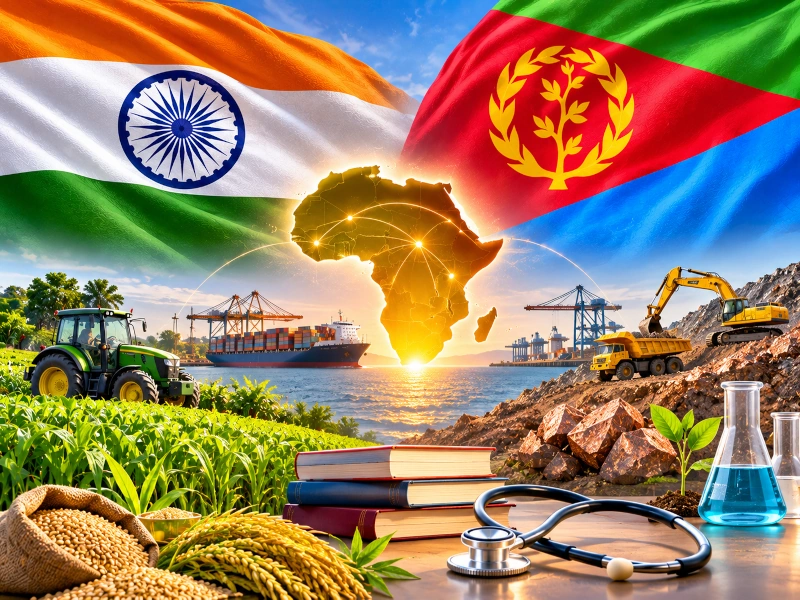
India and Eritrea have discussed opportunities to strengthen bilateral cooperation across trade, investment, agriculture, mining and education, highlighting the expanding scope of India’s diplomatic and economic engagement with African countries. The discussions reflect the shared interest of both nations in developing stronger commercial relationships, strengthening institutional partnerships and identifying opportunities for cooperation in sectors important to their economic development.
According to DD News, Sripriya Ranganathan, Secretary (Consular, Passport, Visa and Overseas Indian Affairs) in the Ministry of External Affairs, held meetings with Eritrean leaders during her visit to Asmara. The discussions reportedly covered bilateral relations and opportunities for expanding cooperation in trade, investment, education, agriculture and mining. Ranganathan also interacted with members of the Indian community in Eritrea and discussed matters concerning their welfare, underscoring the importance of people-to-people connections in strengthening diplomatic relationships.
India and Eritrea Strengthen Bilateral Diplomatic Engagement
India and Eritrea share historical connections extending to ancient maritime trade between the Indian subcontinent and the Red Sea region. According to the Ministry of External Affairs, the ancient Eritrean port of Adulis formed part of an important trading network connecting southern India with the Roman Empire. These early commercial connections provide historical context for the modern relationship between the two countries, which has gradually expanded to include diplomatic engagement, development cooperation, education and technical assistance.
India formally recognised Eritrea following its independence from Ethiopia in May 1993, establishing the foundation for contemporary diplomatic relations. Bilateral engagement subsequently developed through official visits, institutional exchanges and cooperation in areas such as agriculture, healthcare and education. India strengthened its diplomatic presence by establishing a resident mission in Asmara in August 2019, creating additional opportunities for sustained engagement with Eritrean government institutions and the Indian community.
The two countries have also developed a formal mechanism for reviewing their relationship through Foreign Office Consultations. The third round of consultations took place in Asmara on 5 December 2025, when officials examined cooperation in political, economic, educational, healthcare, renewable energy and people-to-people sectors. The latest reported meetings provide an opportunity to build upon these established mechanisms and explore additional areas where bilateral cooperation could deliver practical economic and developmental benefits.
Mining and Mineral Resources Present Opportunities for Economic Cooperation
Mining has emerged as an area of potential economic cooperation between India and Eritrea, particularly because of Eritrea’s mineral resources and India’s growing demand for industrial raw materials. According to the Ministry of External Affairs, Eritrea possesses mineral deposits that include potash and copper, creating potential opportunities for investment, mineral processing and technical collaboration. The development of these resources could support Eritrea’s industrial sector while creating opportunities for international commercial partnerships, subject to regulatory requirements and project feasibility.
Potash is an important component of fertiliser production, making it relevant to agricultural productivity and food security. Copper is extensively used in electrical equipment, telecommunications infrastructure, renewable energy systems and industrial manufacturing. India’s expanding infrastructure, electronics manufacturing and clean-energy sectors have increased the strategic importance of reliable mineral supply chains, making cooperation with mineral-producing countries an area of growing economic interest.
Closer commercial engagement could create opportunities for Indian companies to explore mineral development, processing technologies and associated infrastructure in Eritrea. However, the discussions reported during Ranganathan’s visit do not establish that any new mining agreement, investment commitment or mineral supply arrangement has been finalised. The significance of the engagement lies in the identification of potential areas for future cooperation rather than the announcement of a completed commercial project.
Bilateral Trade Provides Considerable Scope for Expansion
Trade between India and Eritrea remains relatively modest, although commercial exchanges have developed across several sectors. According to the Ministry of External Affairs’ bilateral brief dated 13 April 2026, India’s exports to Eritrea increased from approximately US$10.05 million in 2023–24 to US$19 million in 2024–25. This represents an increase of approximately 89%, indicating growth in Indian exports despite the relatively limited overall scale of bilateral commercial engagement.
India’s principal exports to Eritrea include sugar, pharmaceutical products, rubber, rice and textile-related products. These commodities reflect India’s established manufacturing and agricultural capabilities while providing essential consumer, healthcare and industrial products to the Eritrean market. India has also extended unilateral Duty-Free Tariff Preferential market access to Eritrea, providing eligible Eritrean products with preferential access to the Indian market under the applicable framework.
The expansion of bilateral trade could provide opportunities for Indian pharmaceutical manufacturers, agricultural exporters, engineering companies and other businesses seeking to strengthen their presence in African markets. Eritrea’s economic development priorities and mineral resources could also create opportunities for investment and technical cooperation. Strengthening commercial contacts, improving business connectivity and encouraging institutional engagement would help both countries identify practical opportunities for developing a more diversified trading relationship.
Agricultural Cooperation Remains a Key Component of Bilateral Relations
Agriculture has been an important component of India–Eritrea cooperation for several decades, with both countries recognising the role of agricultural productivity in supporting food security and rural development. In October 1995, Eritrea signed an agreement with the International Crops Research Institute for the Semi-Arid Tropics (ICRISAT), establishing a framework for cooperation in agricultural research. The relationship subsequently expanded through educational exchanges, institutional engagement and development assistance intended to strengthen agricultural capabilities.
In July 2009, the Government of India extended a US$20 million Line of Credit to Eritrea, with US$10 million allocated to agricultural projects and another US$10 million to educational projects. This financial commitment demonstrated India’s support for Eritrea’s agricultural and human resource development priorities. Cooperation in agricultural research and capacity building has continued to provide a foundation for bilateral engagement, particularly in areas where technical expertise and improved farming practices can support productivity.
India’s experience in dryland agriculture, crop research, irrigation technologies and agricultural extension services provides potential opportunities for cooperation with Eritrean institutions. Technical exchanges involving agricultural education, improved farming methods and sustainable resource management could contribute to rural development and food security. The latest discussions on agricultural cooperation therefore build upon an existing relationship rather than representing an entirely new area of bilateral engagement.
India Supports Education and Technical Capacity Building in Eritrea
Education and professional training represent important pillars of India’s development partnership with Eritrea, with Indian institutions providing opportunities for Eritrean students, officials and professionals to develop specialised skills. The Indian Technical and Economic Cooperation Programme, commonly known as ITEC, has played a significant role in this engagement by providing training in public administration, technology, management and other professional disciplines. According to the Ministry of External Affairs, more than 240 Eritrean nationals had participated in ITEC training programmes between 2007–08 and the preparation of the April 2026 bilateral brief.
India allocated 60 ITEC training slots to Eritrea for the financial year 2026–27, continuing its commitment to professional capacity building and institutional development. These programmes enable participants to acquire technical expertise and professional experience through training opportunities offered by Indian institutions. The initiative also strengthens connections between government agencies, educational establishments and professional communities in both countries, contributing to the long-term development of bilateral relations.
Educational cooperation extends to university scholarships administered through the Indian Council for Cultural Relations. For the academic year 2025–26, Eritrea received 12 scholarship allocations under the India–Africa Maitri Scholarship Scheme, providing opportunities for students to pursue higher education in India. India has also supported specialised training in areas including cybersecurity, diplomatic practice and entrepreneurship, reflecting the growing diversity of educational and technical cooperation between the two countries.
Healthcare and Digital Connectivity Strengthen Development Cooperation
Healthcare represents another important area of cooperation between India and Eritrea, particularly in medical education, professional training and institutional exchanges. India has developed considerable capabilities in pharmaceutical manufacturing, affordable healthcare and medical education, creating opportunities for collaboration with countries seeking to strengthen their healthcare systems. Engagement between Indian healthcare institutions and Eritrean authorities has included discussions on medical training, specialised services and potential institutional partnerships.
In October 2025, a delegation from Artemis Hospital visited Eritrea and held discussions with officials from the country’s Ministry of Health. According to the Ministry of External Affairs, the engagement explored opportunities for Indian medical specialists to provide services in Eritrea and examined the possibility of an institutional agreement. These discussions demonstrated interest in expanding healthcare cooperation, although they did not by themselves establish that a new medical services agreement had been concluded.
Digital education and telemedicine provide additional opportunities for bilateral cooperation through India’s e-VidyaBharati and e-ArogyaBharati initiative. Eritrea became a partner country in November 2019, joining a programme designed to expand access to Indian educational and healthcare expertise through digital connectivity. Such initiatives can help strengthen institutional capabilities and improve access to specialised knowledge, particularly where geographical distance or limited local resources create barriers to conventional training and healthcare services.
Indian Community Contributes to Stronger People-to-People Relations
The Indian community in Eritrea forms an important connection between the two countries, contributing to education, professional services and cultural exchanges. According to the Ministry of External Affairs, approximately 200 Indian nationals reside in Eritrea, including schoolteachers, university lecturers, skilled workers and other professionals. Members of the community are located in cities and towns including Asmara, Keren and Adi Keyih, where their professional activities contribute to institutional and social connections.
Indian teachers and academic professionals have played a role in Eritrea’s educational institutions, helping strengthen people-to-people engagement through the exchange of knowledge and professional expertise. Their presence complements government-level development cooperation by creating direct relationships between Indian professionals and Eritrean communities. Such connections contribute to mutual understanding and help sustain bilateral relations beyond formal diplomatic exchanges.
During her reported visit, Sripriya Ranganathan interacted with members of the Indian community and discussed issues concerning their welfare. As Secretary responsible for consular affairs, passports, visas and overseas Indian affairs, engagement with Indian nationals abroad forms an important component of her responsibilities. These interactions provide opportunities for the Ministry of External Affairs to understand community concerns, review consular requirements and maintain communication with Indians living and working overseas.
Historical Connections Provide a Foundation for Modern Relations
India and Eritrea share historical links extending beyond contemporary diplomatic engagement, including ancient commercial exchanges and military connections during the twentieth century. Maritime trade between the Indian subcontinent and the Red Sea region connected merchants and trading centres across the Indian Ocean for centuries. These historical networks contributed to the movement of goods and the development of commercial relationships between distant regions, providing an early foundation for connections between the societies.
The two countries also share historical connections arising from the Second World War, when Indian soldiers participated in military operations in Eritrea. Indian personnel who lost their lives during these campaigns are commemorated at memorials and cemeteries in Keren and Asmara. These memorials form part of the shared historical record and reflect the contribution of Indian military personnel to operations undertaken in the region.
India subsequently participated in international peacekeeping efforts through the United Nations Mission in Ethiopia and Eritrea. More than 1,500 Indian military personnel served under the mission, contributing to security-related responsibilities and humanitarian assistance. This participation added another dimension to India’s engagement with Eritrea and demonstrated the country’s role in supporting international peacekeeping efforts in Africa.
India Expands Economic and Development Partnerships Across Africa
India’s engagement with Eritrea forms part of its broader approach towards strengthening diplomatic, economic and development partnerships with African countries. Cooperation in education, agriculture, healthcare, technology and professional training has been an important component of India’s relations with the continent. These partnerships generally focus on developing institutional capabilities, expanding economic opportunities and supporting programmes aligned with the development priorities of individual countries.
Africa’s mineral resources, agricultural potential, expanding markets and infrastructure requirements offer opportunities for cooperation with Indian enterprises and institutions. India’s capabilities in affordable healthcare, pharmaceutical manufacturing, agricultural research, digital technologies and technical education provide a foundation for mutually beneficial engagement. Stronger relationships with African countries can also support the diversification of India’s commercial partnerships and create additional opportunities for international industrial cooperation.
For Eritrea, closer cooperation with India could provide opportunities for technical assistance, educational exchanges, healthcare development and commercial partnerships. For India, engagement with Eritrea supports stronger diplomatic relations in the Horn of Africa and creates possibilities for expanding economic ties in sectors where both countries have complementary interests. Sustained consultations and institutional cooperation will remain important in translating these opportunities into practical outcomes.
Strengthening a Partnership Based on Mutual Development
The latest reported discussions between India and Eritrea highlight opportunities to expand bilateral cooperation while reinforcing existing partnerships in education, agriculture, healthcare and technical capacity building. Trade, investment and mineral resources provide additional areas for engagement, although future commercial agreements and project commitments will require separate negotiations and formal confirmation. The existing framework of diplomatic consultations, educational scholarships and technical training programmes offers a foundation upon which both countries can pursue further collaboration.
As India continues to strengthen its relationships across Africa, sustained engagement with Eritrea can support economic diversification, skills development and greater institutional cooperation. By combining established development partnerships with opportunities in emerging economic sectors, the two countries can work towards a more diversified and mutually beneficial relationship. The engagement reflects India’s continuing commitment to building constructive partnerships based on knowledge sharing, economic cooperation and long-term development.
You may also like
-
Netherlands Foreign Minister Visits India to Advance Strategic Partnership and Technology Cooperation
-
Israel’s 11 Defence Companies Engage Indian Army and Industry on Advanced Battlefield Technologies
-
The Economics of Warfare: Treasury, Revenue and Military Sustainability in Kauṭilya’s Statecraft
-
Bharata at Citrakūṭa: A Constitutional Crisis Resolved Through Dialogue and Dharma
-
India Reaffirms Its Position on Indus Waters Treaty Amid Pakistani Minister’s Visit
