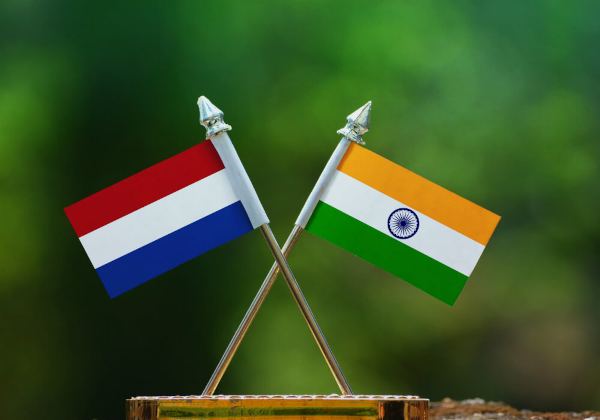
Netherlands Foreign Minister Tom Berendsen is scheduled to begin a two-day official visit to India on Sunday, with high-level discussions planned to strengthen bilateral cooperation in political, economic, commercial and technological sectors. The visit comes as India and the Netherlands seek to advance their strategic partnership and deepen collaboration in areas of mutual economic and technological interest.
According to Akashvani News, the Dutch Foreign Minister is scheduled to hold discussions with External Affairs Minister Dr S. Jaishankar and Union Minister for Electronics and Information Technology and Information and Broadcasting Ashwini Vaishnaw. His meeting with Vaishnaw is scheduled for 23 November.
The diplomatic engagement follows a series of high-level exchanges between the two countries, including Prime Minister Narendra Modi’s visit to the Netherlands in May 2026, during which both governments agreed on a roadmap for their strategic partnership covering the period from 2026 to 2030.
India and Netherlands Strengthen Diplomatic Engagement
India and the Netherlands established diplomatic relations in 1947 and have developed a partnership encompassing trade, investment, technology, agriculture, water management and healthcare. The relationship has expanded through regular high-level exchanges, institutional cooperation and growing business engagement.
The Netherlands is an important economic partner for India within Europe, while India’s expanding manufacturing capabilities, technology ecosystem and large domestic market offer opportunities for Dutch companies and research institutions.
The forthcoming discussions between Berendsen and Jaishankar are expected to provide an opportunity to review bilateral relations and identify areas where cooperation can be strengthened.
Both countries have maintained regular diplomatic engagement on regional and international issues, including developments affecting Europe, the Indo-Pacific and the broader international economic environment.
The visit also provides an opportunity to build on earlier political consultations and strengthen coordination across sectors identified under the bilateral strategic partnership.
Technology and Semiconductor Cooperation Gain Importance
Technology cooperation has become an increasingly important component of India-Netherlands relations, particularly as India expands domestic electronics manufacturing and seeks to strengthen its semiconductor industry.
The Netherlands occupies an important position in the global semiconductor ecosystem through its advanced equipment manufacturers, precision engineering capabilities and research institutions.
India, meanwhile, is developing semiconductor manufacturing and packaging capabilities through government-supported programmes intended to strengthen domestic electronics production and reduce dependence on imported components.
A significant development occurred during Prime Minister Modi’s visit to the Netherlands in May 2026, when an agreement involving Dutch semiconductor equipment manufacturer ASML and Tata Electronics was announced.
The agreement marked an important step in strengthening industrial cooperation between the two countries in the semiconductor sector.
Such partnerships are relevant to India’s efforts to develop a competitive electronics manufacturing ecosystem supported by advanced equipment, specialised technology and international industrial collaboration.
The scheduled meeting between Berendsen and Ashwini Vaishnaw is therefore particularly significant in the context of existing technological cooperation, although specific agreements or announcements arising from the forthcoming discussions have not yet been confirmed.
Building on the India-Netherlands Strategic Partnership Roadmap
During Prime Minister Modi’s visit to the Netherlands in May 2026, the two governments established a strategic partnership roadmap for 2026–2030.
The roadmap provides an institutional framework for expanding bilateral engagement across priority sectors and strengthening cooperation between government agencies, industries and research institutions.
India and the Netherlands have traditionally identified water management, agriculture and healthcare as important areas of bilateral cooperation. Technology and innovation have increasingly become additional priorities.
The Netherlands has considerable experience in water management, including flood protection, water infrastructure and sustainable management of water resources. These capabilities are relevant to India’s urban development, climate resilience and agricultural water-management requirements.
Agricultural cooperation offers opportunities for collaboration in horticulture, food processing, efficient irrigation, agricultural research and advanced farming technologies.
Healthcare and biotechnology also provide scope for research collaboration, scientific exchanges and the development of innovative medical technologies.
The strategic partnership framework offers opportunities to connect these traditional areas of cooperation with emerging industries and advanced technological applications.
Expanding Trade, Investment and Industrial Partnerships
Economic and commercial relations form an important foundation of India-Netherlands cooperation.
The Netherlands serves as a major European trading and logistics centre, supported by extensive port infrastructure, international transport networks and established commercial connections.
Its position within European supply chains provides opportunities for Indian exporters, manufacturers and technology companies seeking greater access to international markets.
India’s expanding industrial base also offers opportunities for Dutch investment in manufacturing, logistics, renewable energy, food processing and technology-intensive industries.
Indian companies have established a presence in the Netherlands across several sectors, while Dutch businesses have participated in India’s industrial, infrastructure and technology development.
Strengthening commercial engagement could support the development of more diversified supply chains, encourage investment in advanced manufacturing and create opportunities for collaboration between enterprises in both countries.
The planned ministerial discussions take place against this broader background of increasing economic interdependence and efforts to strengthen India-Europe commercial relations.
Agriculture, Water Management and Sustainable Development
Agriculture and water management remain important pillars of the bilateral relationship.
The Netherlands has developed internationally recognised capabilities in agricultural productivity, greenhouse cultivation, water conservation and food-processing technologies.
India’s large agricultural sector provides considerable opportunities for cooperation in efficient resource utilisation, crop productivity, agricultural infrastructure and value addition.
Collaborative research and technology exchanges can support the adoption of advanced farming techniques suited to India’s diverse geographical and climatic conditions.
Water management is another area where Dutch expertise has relevance to Indian infrastructure development. Cooperation in flood management, wastewater treatment, irrigation and sustainable urban water systems can contribute to long-term environmental and economic resilience.
The two countries also have opportunities to strengthen cooperation in renewable energy and sustainable industrial development, particularly as businesses seek technologies that improve energy efficiency and reduce environmental impacts.
These sectors provide a foundation for practical cooperation extending beyond diplomatic consultations.
A Growing Partnership Between India and Europe
The Netherlands occupies an important position in India’s engagement with the European Union.
As a major European trading and logistics economy, the country provides connections between Indian businesses and wider European commercial networks.
The relationship also benefits from shared interests in technological innovation, international trade and the development of resilient supply chains.
Regular high-level political consultations help both countries address emerging economic opportunities while maintaining dialogue on international developments.
The scheduled visit of Foreign Minister Berendsen follows the strengthening of bilateral engagement earlier in 2026 and offers another opportunity to advance the strategic partnership established by the two governments.
Strengthening India’s Global Technology and Economic Partnerships
The visit reflects the growing importance of technology, industrial cooperation and economic resilience in India’s diplomatic engagement with European partners.
For India, cooperation with the Netherlands offers opportunities to access specialised expertise, strengthen advanced manufacturing capabilities and expand international research and industrial partnerships.
For the Netherlands, India’s expanding economy, skilled workforce and growing technological ecosystem present opportunities for long-term commercial and scientific cooperation.
The planned discussions between the two governments could help translate the existing strategic partnership framework into further practical collaboration across technology, trade, investment and sustainable development.
As India advances its manufacturing and innovation ambitions, closer cooperation with established technology partners such as the Netherlands can contribute to building stronger industrial capabilities and expanding the country’s participation in global value chains.
You may also like
-
Israel’s 11 Defence Companies Engage Indian Army and Industry on Advanced Battlefield Technologies
-
The Economics of Warfare: Treasury, Revenue and Military Sustainability in Kauṭilya’s Statecraft
-
Bharata at Citrakūṭa: A Constitutional Crisis Resolved Through Dialogue and Dharma
-
India Reaffirms Its Position on Indus Waters Treaty Amid Pakistani Minister’s Visit
-
India and Portugal Commit to Five-Year Strategic Roadmap for Bilateral Cooperation, 2027–2032
