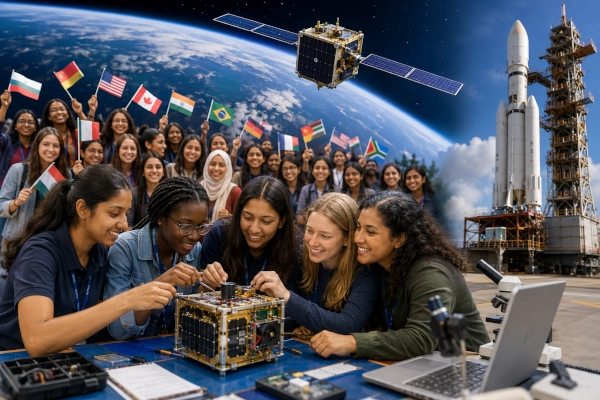
India has become the meeting ground for one of the most ambitious student space-education initiatives attempted on an international scale, with girl students and mentors associated with 108 countries gathering at Gautam Buddha University in Greater Noida for Mission ShakthiSAT.
Led by Chennai-based aerospace organisation Space Kidz India, the programme is bringing participants beyond online lessons and introductory space education into the practical world of satellite engineering, payload development, spacecraft integration and mission planning. The current on-campus phase began on 23 August 2026 and is scheduled to continue through 31 August, transforming the Greater Noida university campus into an international space-technology classroom.
Around 200 girl students, delegates and international representatives were reported at the opening of the programme, while the much larger ShakthiSAT initiative aims to involve approximately 12,000 girls from 108 countries through its training and outreach network. The mission seeks to give schoolgirls direct exposure to real satellite projects rather than limiting their experience of space science to textbooks and classroom theory.
The initiative is being directed by Dr. Srimathy Kesan, founder and chief executive of Space Kidz India, whose organisation has spent more than a decade involving school and college students in satellite development, balloon experiments, space education and small-spacecraft missions.
From 12,000 Students to a Hands-On Spacecraft Team
Mission ShakthiSAT has been designed as a layered programme rather than a one-time satellite workshop.
Its wider network encompasses about 12,000 girls across 108 nations, providing participants with exposure to satellite technology, space science, STEM subjects, mission design and international collaboration. The current Greater Noida programme represents the crucial practical stage in which selected participants move from structured learning towards actual spacecraft-related activities.
Gautam Buddha University says 20 girl students from 17 Indian states were selected for intensive participation in the programme alongside international participants. The university describes the training as covering satellite technology, payload development and space science, with participants receiving practical exposure to the process through which spacecraft are designed and developed.
This distinction is important. The project does not mean that all 12,000 students are physically assembling a satellite at Greater Noida. Instead, the global education programme has created a much larger network from which selected students and national representatives are participating directly in the India phase.
The model attempts to combine scale with practical experience: thousands can be introduced to space technology, while smaller working teams receive deeper exposure to the engineering processes required to turn an idea into flight hardware.
Two Spacecraft Ambitions Emerge from the India Meet
Space Kidz India has said that the India gathering is intended to work towards two spacecraft.
The first is a Low Earth Orbit satellite, which the organisation currently hopes to launch around 11 October 2026, coinciding with the International Day of the Girl Child. The second is described by Space Kidz India as a lunar spacecraft, representing the longer-term exploration component of Mission ShakthiSAT.
Gautam Buddha University has similarly stated that two satellites are expected to emerge from the programme and has linked the project with a future launch from the Satish Dhawan Space Centre at Sriharikota.
Space Kidz India’s current events calendar lists Mission ShakthiSAT for 11 October 2026 at Sriharikota. That date should, however, be treated at present as the mission organiser’s announced target. An accompanying ISRO launch mission identifying ShakthiSAT has not yet been publicly detailed on ISRO’s mission pages.
This distinction is important for accurately describing a space mission. Satellite development, launch integration and the final launch schedule remain separate stages, and launch dates can change as spacecraft qualification, launch vehicle availability and regulatory processes progress.
A Larger Lunar Ambition
The long-term vision for ShakthiSAT goes substantially beyond placing a student satellite into Low Earth Orbit.
Space Kidz India describes the broader programme as an all-girls mission associated with lunar surface mapping, resource identification and study of the lunar environment. Among the potential scientific interests identified by the organisation is the detection or mapping of resources such as water ice, which is considered important for future sustained lunar exploration.
The proposed lunar spacecraft therefore gives the education programme a mission objective around which multiple engineering disciplines can be taught.
A lunar spacecraft must eventually bring together structures, power generation, onboard computing, thermal management, communications, navigation, attitude control, payload systems and mission operations. Even when school students work on selected subsystems rather than independently engineering every element of a spacecraft, exposure to this systems-engineering approach can provide a very different understanding of science from conventional classroom instruction.
The detailed technical configuration of the proposed ShakthiSAT lunar spacecraft—including its mass, spacecraft bus, scientific payloads, intended lunar orbit, communications architecture and launch arrangement—has not yet been publicly released in sufficient detail to describe these parameters as final.
The project’s present significance therefore lies both in its educational scale and in the effort to move participants progressively towards real spacecraft engineering.
What Building a Satellite Actually Teaches
A student satellite programme differs fundamentally from a conventional science competition because individual experiments must ultimately operate as parts of a single engineering system.
Spacecraft designers must consider how much electrical power is available, how much heat electronics generate, whether radio links can communicate with the ground, whether the satellite remains properly oriented and whether every subsystem can survive vibration during launch and the thermal conditions encountered in orbit.
Payload developers cannot design an experiment in isolation. Its mass, dimensions, electrical consumption, data requirements and operational sequence must fit within the limits of the spacecraft.
Students therefore encounter one of engineering’s most important principles: almost every design decision involves a compromise.
Adding a more powerful payload might increase electricity demand. Increasing battery capacity can increase spacecraft mass. A larger antenna may improve communications while complicating deployment. More sensors produce more data, which in turn requires additional onboard storage and communications capacity.
Learning how these systems interact is one of the most valuable aspects of a genuine satellite-building programme.
From Classroom STEM to Systems Engineering
ShakthiSAT is also significant because it introduces school students to systems engineering, a discipline normally encountered much later in technical education.
Successful spacecraft projects require mechanical engineers, electronics engineers, programmers, communications specialists, physicists, mission planners and payload scientists to work towards one common configuration.
Students consequently learn that space technology is not a single subject.
Programming controls onboard computers. Electronics regulate power. Radio-frequency engineering connects the spacecraft with Earth. Mechanical engineering determines the structure. Physics helps predict the orbital and thermal environment. Mathematics supports navigation and data analysis.
The spacecraft becomes a practical platform through which multiple STEM disciplines converge.
This interdisciplinary character can be particularly effective for young students because abstract scientific principles acquire an immediate engineering purpose.
India as the Meeting Point for 108 Countries
The international scale gives ShakthiSAT another unusual dimension.
Rather than restricting the programme to Indian students, Space Kidz India has built partnerships and participation networks spanning 108 countries, turning the spacecraft into a common project around which students with very different national, cultural and educational backgrounds can collaborate.
The organisation says it deliberately selected the number 108 as a symbolic element of the mission, linking it with the approximate astronomical relationship between the apparent sizes and distances of the Sun and Moon as viewed from Earth. More importantly for the programme itself, the number now represents its ambition to create a broad international STEM network centred in India.
The presence of international delegations at Gautam Buddha University consequently turns the programme into something broader than a conventional satellite workshop. It combines space education with international scientific collaboration and leadership development.
Participants are learning that major space missions increasingly depend on teams extending across institutions and national borders.
Gautam Buddha University Becomes a Temporary International Space Campus
The choice of Gautam Buddha University has given the mission a substantial university environment in which to conduct its India phase.
The programme coincided with the university’s 19th Foundation Day, with Mission ShakthiSAT formally inaugurated on 23 August. Uttar Pradesh Chief Minister and university Chancellor Yogi Adityanath participated virtually in the opening programme.
The university has positioned the event as part of its emphasis on STEM education, technological innovation and opportunities for women in science.
For the participating schoolgirls, conducting the programme within a university campus also provides exposure to the research environment that surrounds higher technical education.
The result is an unusual bridge connecting schools, a university campus, an Indian private-space organisation and the broader national space ecosystem.
Space Kidz India Has Done This Before
Mission ShakthiSAT does not emerge from an organisation entering satellite development for the first time.
Space Kidz India has previously been associated with a number of student spacecraft and experimental space programmes. IN-SPACe describes the Chennai organisation as an Indian startup working in satellite design and manufacturing, space education and exploration, with facilities for spacecraft hardware manufacturing, satellite integration and testing and radio-frequency work.
Its earlier projects include KalamSat-V2, Satish Dhawan SAT, AzaadiSAT, AzaadiSAT-2 and SR-0 DEMOSAT, several of which appear in ISRO’s official listing of satellites developed by private organisations or students.
That earlier experience is important because ShakthiSAT represents an expansion of a model Space Kidz India has already tested in India: using an actual spacecraft project as a vehicle for teaching young students about engineering.
AzaadiSAT Put Hundreds of Indian Girls into a Satellite Programme
The clearest predecessor to ShakthiSAT is AzaadiSAT.
ISRO describes the original AzaadiSAT as an 8U CubeSat weighing approximately eight kilograms, carrying 75 small experimental payloads. Girl students from rural regions across India received guidance to develop those payloads, which were subsequently integrated by the Space Kidz India student team.
Its payloads included a UHF-VHF amateur-radio transponder, a radiation counter, a long-range transponder and a camera. Space Kidz India also developed the ground system intended to receive satellite data.
The first AzaadiSAT was carried aboard ISRO’s inaugural SSLV-D1 mission in August 2022, but the launch vehicle did not place its payloads into the intended stable orbit.
Rather than ending the student programme, the project returned as AzaadiSAT-2.
AzaadiSAT-2 flew successfully aboard SSLV-D2 on 10 February 2023. ISRO describes the 8.7-kilogram spacecraft as the combined effort of approximately 750 girl students across India under the guidance of Space Kidz India.
That experience provides an important foundation for ShakthiSAT. The earlier mission demonstrated that large groups of schoolgirls could be organised around real satellite payloads and connected to an operational ISRO launch.
ShakthiSAT takes that concept international.
From Hundreds of Girls in India to Thousands Around the World
The progression between AzaadiSAT and ShakthiSAT is striking.
AzaadiSAT involved hundreds of Indian schoolgirls. ShakthiSAT aims to create a network of 12,000 participants across 108 countries.
The geographic scale has therefore changed dramatically, but the underlying educational principle remains similar: young students are given an engineering objective serious enough to demand teamwork, discipline and technical learning.
For many participants, the most lasting consequence may not be whether they eventually specialise in satellite engineering.
Exposure to a mission can lead students towards electronics, physics, software development, robotics, materials science, astronomy, mathematics, artificial intelligence or mechanical engineering.
Space is the entry point, but the skills extend across the technology economy.
Why Girls Remain at the Centre of the Mission
ShakthiSAT has deliberately been structured around girls because women remain underrepresented across several aerospace and engineering disciplines globally.
The programme is therefore attempting to intervene earlier than the university or employment stage.
A schoolgirl who sees a satellite as something designed only by distant scientists may admire space technology without imagining herself as part of it. A student who handles hardware, writes code, participates in payload discussions or watches a system she helped develop move towards launch gains a very different relationship with engineering.
The change is from observing technology to participating in its creation.
That practical confidence can matter as much as the technical material itself.
Mission ShakthiSAT consequently frames female participation not as a separate outreach activity added after the engineering programme has been designed, but as the organising principle of the entire programme.
An Emerging Indian Model of Space Education
India’s rapidly expanding space ecosystem is creating opportunities that did not exist for school students a generation ago.
ISRO has a long history of supporting university and student satellites. Its official student-satellite record includes spacecraft developed by universities, educational institutions, private organisations and student teams, ranging from ANUSAT in 2009 and STUDSAT in 2010 to AzaadiSAT-2 and SR-0 DEMOSAT.
The opening of India’s space sector to private organisations has added another dimension.
Companies and startups can now develop launch vehicles, satellites, propulsion systems, sensors, communications platforms and downstream applications. Organisations specialising in space education can operate much closer to actual hardware development than traditional science clubs.
Space Kidz India sits at the intersection of those developments.
It is an aerospace organisation that builds small spacecraft while deliberately using many of those projects as educational platforms.
ShakthiSAT demonstrates how that model can potentially scale beyond India.
A Satellite Can Become a Classroom Without Walls
The educational significance of ShakthiSAT ultimately extends beyond the spacecraft itself.
The mission connects girls who may live thousands of kilometres apart with the same engineering problem. They encounter common terminology, common technical constraints and a common mission objective.
A power-budget calculation works the same way regardless of the nationality of the student performing it. Radio frequencies obey the same physics. Orbital mechanics does not change at national borders.
Science therefore becomes a practical language of international collaboration.
The Greater Noida gathering gives physical form to that idea by bringing representatives of a much larger global network together on an Indian campus.
The Next Milestone Will Be Flight Hardware
The current phase of Mission ShakthiSAT is important because it moves the programme closer to the point at which educational ambition must meet engineering reality.
A satellite intended for launch must ultimately pass through design reviews, subsystem testing, integration, environmental qualification, communications checks and launch-interface requirements. Every component must perform within strict limitations of mass, power and reliability.
Space Kidz India currently lists 11 October 2026 as the target date for the ShakthiSAT satellite event at Sriharikota. The organisation has linked the date with the International Day of the Girl Child, giving the proposed flight considerable symbolic importance.
The final launch arrangement and mission details will become clearer as the spacecraft progresses through integration and the relevant launch authorities release formal information.
Meanwhile, the lunar component represents a longer and technically much more demanding step. Moving from Low Earth Orbit to a meaningful lunar mission requires substantially more complex spacecraft engineering, communications, navigation, propulsion and mission planning.
It should therefore be regarded as the programme’s larger exploration ambition rather than treated as equivalent to the immediate LEO satellite objective.
India Hosts a Different Kind of Space Mission
Mission ShakthiSAT is notable not because school students are expected to replace professional spacecraft engineers, but because it brings young people into the engineering process early enough for them to understand how those professions actually work.
The professional aerospace teams and mentors provide the technical framework. The students learn through participation—designing, discussing, assembling, testing and solving problems within that framework.
That approach can turn space exploration from something distant into a realistic educational pathway.
Between 23 and 31 August 2026, Gautam Buddha University is therefore hosting more than an international student gathering. It is hosting an experiment in how space education itself can be organised.
A Chennai-based Indian aerospace organisation has connected 12,000 girls from 108 countries, brought selected participants to India and placed an actual spacecraft programme at the centre of their education.
Space Kidz India’s earlier AzaadiSAT programme showed that hundreds of Indian schoolgirls could contribute to satellite payloads that ultimately reached an ISRO launch vehicle. ShakthiSAT is attempting to expand that idea from a national programme into a global one.
Behind it will stand thousands of young participants who encountered satellite engineering not as spectators, but as students invited into the process of building for space.
And for the girls now gathered in Greater Noida from India and across the world, that may be the mission’s most important payload of all.
You may also like
-
National Institute of Naturopathy Opens Admissions for BNYS Programme at Pune for 2026–27
-
Yudhishthira’s Counter-Diplomacy With Shalya: Working With an Ally Who Has Joined the Other Side
-
Gnani AI Launches Nationwide Challenge Offering Up to 100 Paid AI Internships
-
NMMSS Scholarship Application Deadline Extended to October 31, 2026
-
DGCA Introduces Training Framework for Gyroplane Pilots in India
