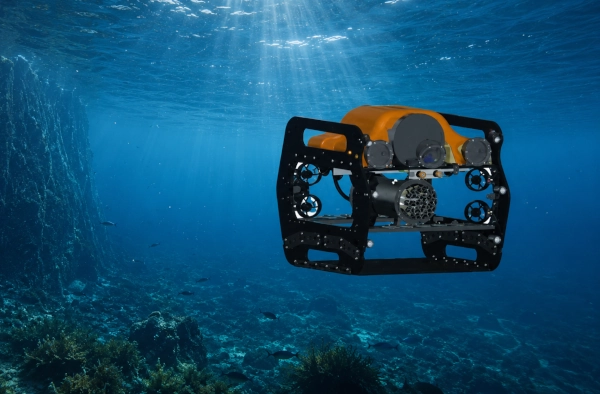
India’s dams, ports, ships, underwater tunnels, offshore energy systems and subsea pipelines require regular inspection to detect corrosion, cracks, structural damage, blockages and other developing risks. These tasks have traditionally depended on divers, shutdowns and specialised imported equipment. Kochi-based EyeROV is working to change this model by developing indigenous remotely operated vehicles, autonomous marine robots and AI-supported inspection platforms capable of entering environments that are difficult, dangerous or expensive for humans to access.
EyeROV operates through IROV Technologies Private Limited from the Kerala Technology Innovation Zone at Kalamassery in Kochi. Founded by Johns T. Mathai and Kannappa Palaniappan, the company has developed a full-stack marine robotics platform combining underwater vehicles, surface craft, sensors, navigation systems, inspection software and data analytics. Its products include the compact TUNA family of remotely operated vehicles, the larger SAGARA deep-sea platform, autonomous surface systems and specialised robots for long tunnels and confined underwater structures.
Why Underwater Inspection Is Difficult
Infrastructure below the waterline is exposed to a highly demanding environment. Saltwater accelerates corrosion, currents place repeated stress on structures, marine organisms accumulate on surfaces and sediment can obscure defects. Visibility may fall sharply because of darkness, suspended particles or algae, while water pressure rises with depth.
Divers can conduct close visual inspections, yet their operating time, depth and safety are constrained. Strong currents, narrow passages, polluted reservoirs, entanglement hazards and unstable structures increase the risk. Deep-water diving also requires complex support systems and decompression procedures.
Underwater robots allow operators to remain on the surface while the vehicle carries cameras, sonar, lights and inspection instruments to the structure. Live video and sensor information can be transmitted through a tether, enabling engineers to examine submerged assets without exposing personnel to the same level of danger.
Robotic inspection can also reduce the need to drain reservoirs, close tunnels or take generating units out of service for extended periods. This can save time and limit disruption to power generation, water supply, shipping and industrial operations.
TUNA: A Compact Underwater Inspection Robot
TUNA is EyeROV’s compact remotely operated vehicle designed for visual inspection and survey work. The vehicle can be controlled from the surface through a laptop and joystick while its onboard camera transmits a live view of the underwater environment.
The platform is intended for applications such as examining dam walls, sluice gates, ship hulls, bridge foundations, reservoirs, pipelines and other submerged structures. Its compact form allows it to be transported and deployed by a relatively small field team.
EyeROV’s current TUNA Standard platform is rated for operations at depths of up to 200 metres. It offers autonomous-navigation functions, illumination of around 6,000 lumens, a speed of approximately two knots and a neutrally buoyant tether extending up to 150 metres. The design supports modular payloads, allowing additional devices such as sonar, non-destructive testing instruments and environmental sensors to be attached according to the mission.
The company also offers TUNA Mini for shallower and more portable inspection requirements. This smaller platform is aimed at assignments where ease of deployment and mobility matter more than extreme depth or heavy payload capacity.
TUNA’s importance lies in its ability to make underwater inspection more accessible. Large work-class ROVs are commonly deployed from specialised vessels and require substantial crews. A compact observation-class platform can be mobilised faster for reservoirs, canals, ports and industrial sites where such large systems would be uneconomical.
SAGARA: Built for More Demanding Deep-Water Missions
SAGARA is EyeROV’s larger and more capable remotely operated platform, developed for deep-sea inspection, defence-related missions and operations in stronger currents and more demanding conditions.
According to EyeROV, SAGARA can operate at depths of up to 300 metres. It incorporates a primary 4K camera with 10x optical zoom, a wide-angle Full HD camera with a field of view of approximately 120 degrees and lighting exceeding 6,000 lumens. This imaging package allows operators to examine large areas while zooming in on defects, marine growth, welds and structural features.
The vehicle provides six degrees of freedom, allowing forward and backward movement, vertical movement, lateral translation and rotational control. This manoeuvrability is particularly valuable when the robot must maintain a stable position beside a pipeline, ship hull or offshore structure while currents push against it.
SAGARA has a reported maximum speed exceeding three knots and is designed with rugged construction for military-grade and industrial use. Its autonomous-navigation and station-keeping capabilities can reduce the constant manual input required from the pilot, allowing the vehicle to follow planned paths or hold its position during close inspection.
The platform occupies the space between compact observation robots and very large work-class offshore vehicles. It can support detailed inspections in coastal waters, reservoirs, offshore installations and strategically sensitive maritime areas while remaining more deployable than heavy imported systems.
Inspecting Dams and Hydroelectric Infrastructure
Dams contain extensive submerged structures that remain hidden during normal operation. Intake gates, spillway components, concrete faces, trash racks, turbine entrances and underwater foundations must be examined for cracking, erosion, corrosion, debris and mechanical damage.
Conventional inspection may require divers or the lowering of the reservoir level. Both approaches can be difficult. Draining water affects power generation and irrigation, while diving inside intake zones and enclosed passages creates serious safety risks.
EyeROV’s robots can travel along submerged dam surfaces while recording high-resolution video and sonar data. Operators can mark the location of suspected defects and return to the same point for closer examination.
The company states that its systems have been used in hydroelectric and energy-sector assignments. EyeROV cites the inspection of a 4,174-metre tunnel for Tata Power as an example of robotic surveys conducted across extensive underwater infrastructure.
Repeat inspections can also create a visual record over time. Engineers can compare the same section of a dam across successive years and assess whether a crack, area of erosion or patch of corrosion is expanding.
Long-Distance Tunnel Inspection
Underwater tunnels are among the most difficult assets to inspect. They may extend for several kilometres, have limited entry points and contain little space for turning or recovery. Radio and satellite-navigation signals do not travel effectively through water, making positioning and communication challenging.
EyeROV has developed a specialised tunnel-survey robot capable of travelling through confined tunnels and pipelines for distances reported at up to 10 kilometres. Such a system can inspect hydropower tunnels, water-conveyance passages and other long enclosed structures that ordinary tethered ROVs may struggle to reach.
Long-range tunnel inspection requires careful tether management, reliable propulsion, low-light imaging and methods for estimating the robot’s position throughout the mission. The vehicle must also remain stable when water flow changes and preserve sufficient power and communication capacity for the complete journey.
Robotic tunnel surveys can help identify wall damage, sediment accumulation, displaced linings, obstructions and foreign objects. This information allows operators to plan maintenance before a defect develops into a major failure.
Pipelines and Offshore Energy Assets
Subsea pipelines carry oil, gas, water and industrial products between offshore facilities and the coast. Their condition must be monitored for corrosion, coating damage, free spans, leaks, exposed sections and disturbance caused by anchors, fishing activity or seabed movement.
An underwater robot can follow the pipeline while cameras and sonar collect a continuous record. Additional sensors may be used to inspect wall thickness, identify metallic defects or measure environmental conditions.
EyeROV provides pipeline-inspection services and has reported work with organisations in the energy sector. The company’s systems can inspect pipelines in reservoirs, coastal zones, industrial facilities and offshore environments.
In offshore oil and gas operations, ROVs can also inspect platform legs, risers, mooring systems, underwater valves and structural joints. Detecting damage early can help prevent leaks, environmental incidents and costly unplanned shutdowns.
Ship Hulls and Port Infrastructure
The underwater section of a ship can accumulate marine growth, suffer coating damage or develop deformation around the hull, propeller, rudder and sea-chest openings. Regular inspection helps shipowners assess maintenance needs and identify possible safety or efficiency problems.
A robot can inspect a vessel while it remains afloat, reducing dependence on dry-docking for preliminary examination. It can record the condition of the hull, propeller, rudder, thrusters and underwater fittings.
Ports contain a similar range of submerged assets, including quay walls, pilings, mooring structures, jetties, breakwaters and navigation infrastructure. These structures are exposed to vessel impacts, corrosion, currents and continuous loading.
Compact ROVs can move around pilings and beneath jetties while operators remain on the dock or a small boat. Sonar becomes particularly useful in muddy harbour water where ordinary cameras provide limited visibility.
Sonar and Inspection in Low Visibility
Underwater cameras depend on light and clear water. In reservoirs, estuaries and ports, suspended sediment may reduce visibility to only a few centimetres.
Sonar addresses this limitation by transmitting sound pulses and measuring their return. The resulting image can reveal structures, obstacles and seabed features even when optical visibility is poor.
EyeROV’s platforms support the integration of sonar and other external sensors. This allows inspection teams to combine visual footage with acoustic data. Sonar may first be used to identify a suspicious feature, after which the robot can approach closely with cameras and lights when conditions permit.
More advanced missions may use multibeam sonar to construct three-dimensional representations of submerged structures. These models help engineers measure deformation, map debris and compare changes across repeated inspections.
From Video Footage to Actionable Data
Collecting underwater video is only one part of an inspection. Engineers must organise many hours of footage, identify defects, record locations and generate reports that maintenance teams can use.
EyeROV has developed the EyeROV Visualization Analytics Platform, or EVAP, to process and present information collected by its robots. The platform supports data visualisation, inspection analysis and the creation of structured records from underwater missions.
AI-assisted analysis can potentially identify cracks, corrosion, marine growth or other anomalies within video and images. It can also help organise observations by location and severity.
The company’s wider technology approach includes automated defect detection, three-dimensional reconstruction and digital-twin creation. A digital twin is a computer representation of a physical asset that can be updated with new inspection data. Engineers can use it to monitor condition, compare changes and plan maintenance.
The value of this system grows as inspections are repeated. A single video shows the condition of an asset at one moment, while a structured historical database shows how that asset is changing.
Remotely Operated and Autonomous Systems
A remotely operated vehicle remains connected to the surface through a tether carrying power, commands and data. An operator controls the vehicle while viewing live video and instrument readings.
The tether provides reliable communication and can enable long operating periods. It can also become difficult to manage around obstacles, inside tunnels or in strong currents.
An autonomous underwater vehicle follows a programmed mission with limited direct control from the surface. It may use inertial navigation, sonar, depth sensors and other instruments to determine its path.
EyeROV is developing both remotely controlled and increasingly autonomous systems. Features such as position holding, automatic depth control, planned-route navigation and obstacle response can reduce pilot workload while retaining a human supervisor.
Autonomy is especially valuable during repetitive surveys. A robot can follow a standard route along a dam wall or pipeline and gather data from approximately the same positions during each inspection.
Surface Robots and Coordinated Marine Operations
EyeROV’s portfolio extends beyond underwater vehicles. The company has also developed autonomous and remotely operated surface craft, including systems such as iBOAT ALPHA and Sea Serpent.
Surface vessels can carry sonar, cameras, communication equipment and environmental sensors. They may conduct bathymetric surveys, monitor coastal areas, map reservoirs or act as communication and navigation support for underwater robots.
A coordinated marine-robotics system could combine an autonomous surface vessel with one or more underwater vehicles. The surface craft can provide positioning, communication and mission supervision while the submerged robot performs the detailed inspection.
This approach reduces the need for a larger crewed vessel and may allow longer-duration surveys in remote or hazardous areas.
Defence and Maritime Security Applications
Underwater robots also have direct applications in naval operations and coastal security. They can inspect ship hulls, harbour entrances, jetties and underwater installations for suspicious objects, mines or damage.
ROVs can assist in search-and-recovery missions, examine wrecks and survey areas where sending divers would be hazardous. They can also support underwater surveillance around naval bases and strategic ports.
EyeROV has expanded into defence applications and has reportedly secured an order valued at approximately ₹47 crore to supply underwater robotic systems to the Indian Navy. The company’s platforms have also been associated with India’s iDEX defence-innovation ecosystem.
An indigenous supply base is strategically important because naval underwater systems involve sensitive data, specialised software and maintenance requirements. Domestic manufacturing can reduce dependence on imported platforms and allow systems to be adapted to Indian coastal, tropical and operational conditions.
Search, Recovery and Scientific Exploration
Underwater robots can search for missing vessels, equipment and other objects without exposing divers to unstable wreckage or deep water. Cameras and sonar help locate targets, while manipulators may assist in retrieving small items or attaching recovery lines.
Scientific institutions can use the same platforms to study coral reefs, aquatic habitats, reservoir ecology and seabed conditions. Sensors can measure temperature, depth, water quality and other environmental parameters.
EyeROV’s systems have been used for surveys, shipwreck identification and research-oriented missions. The company’s combination of portable robots and analytics tools can support universities, environmental organisations and government agencies that require repeatable underwater observations.
Building Marine Robotics in Kerala
EyeROV’s location in Kochi gives it access to a major maritime environment containing ports, shipyards, naval institutions, fisheries, inland waterways and offshore industries.
The company operates from Maker Village within the Kerala Technology Innovation Zone. This ecosystem has supported the development of hardware startups requiring laboratories, fabrication facilities and access to technical talent.
The founders combined engineering experience from institutions including IITs with practical work in marine systems. Beginning with compact underwater robots, EyeROV has gradually expanded into larger platforms, long-range inspection systems, autonomous surface vehicles and AI analytics.
The company’s development reflects a broader change in India’s startup ecosystem. Deep-technology firms are moving beyond software services into robotics, sensors, defence electronics, space systems and industrial hardware.
Commercial Growth and Funding
EyeROV has raised approximately US$3 million to US$3.4 million according to recent company profiles and investor disclosures. Its investors and institutional supporters have helped finance product development, field testing and expansion into energy, maritime and defence markets.
The company serves public-sector organisations, energy companies, port operators and maritime institutions. Reported users and clients include organisations associated with hydropower, oil and gas, shipping, defence and coastal infrastructure.
Its business model includes the sale of robotic platforms, inspection services, data analysis and long-term asset-monitoring solutions. This combination can be valuable because many infrastructure operators require a complete inspection outcome rather than simply purchasing a robot.
Offering field services also allows EyeROV to gather operational data from different water conditions and asset types. This information can then be used to improve vehicle design, navigation software and analytics.
Advantages for India
India has a vast network of dams, ports, coastal facilities, hydropower tunnels, offshore energy assets and maritime infrastructure. Maintaining these systems will require increasing investment in inspection technology.
Indigenous underwater robots can lower procurement and maintenance costs while making technical support more readily available. Components and software can also be modified for local operating conditions.
Domestic capability carries additional importance in defence, where underwater mapping and inspection data may be sensitive. Locally developed systems allow greater control over software, data storage, communications and system upgrades.
The technology can also support India’s blue-economy ambitions. Offshore wind, deep-sea research, coastal infrastructure, marine conservation and subsea energy projects will all require robotic inspection and monitoring.
The Challenges Ahead
Underwater robotics remains one of the most difficult areas of engineering. Water blocks ordinary radio communication, limits visibility and places pressure on housings and seals. Saltwater corrodes components, while currents disturb navigation and tethers.
A system that performs successfully in a reservoir may face very different conditions in the open sea. Offshore operations require greater endurance, stronger propulsion, robust launch and recovery equipment and reliable performance in waves and currents.
Accurate positioning is another challenge. GPS signals are unavailable underwater, so vehicles must rely on inertial systems, acoustic positioning, sonar and estimates derived from their own movement.
Autonomy also requires careful validation. A robot operating inside a long tunnel must identify obstacles, manage its tether or energy supply and recover safely when a sensor fails.
Commercial success will depend on reliability, operating depth, image quality, mission endurance, ease of deployment and the ability to produce inspection reports accepted by engineering and regulatory authorities.
Independent field data covering mission completion, defect-detection accuracy, downtime and performance under difficult conditions would help customers compare EyeROV’s systems with established international platforms.
EyeROV Changing India’s industrial and maritime technology landscape
EyeROV is addressing an important gap in India’s industrial and maritime technology landscape. Much of the country’s critical infrastructure extends below water, where inspection remains expensive, risky and technically demanding.
The TUNA platform provides a portable tool for routine underwater surveys, while SAGARA extends the company’s capabilities towards deeper and more demanding missions. Tunnel robots, autonomous surface craft and analytics software broaden the system into a complete marine-inspection ecosystem.
The company’s work can reduce the need for dangerous dives, support preventive maintenance and provide engineers with clearer records of submerged structures. Its expansion into naval and security applications also strengthens India’s indigenous underwater-technology capability.
As offshore infrastructure, ports, dams and maritime operations expand, underwater robots will increasingly become standard maintenance tools rather than specialist equipment. EyeROV’s progress from a Kochi hardware startup to a supplier of full-stack marine robotic systems demonstrates how Indian deep-technology companies can build solutions for some of the world’s most inaccessible environments.
References:
- EyeROV. “AI-Powered Autonomous Underwater ROVs for Inspection.”
https://eyerov.com/ - EyeROV. “About EyeROV.”
https://eyerov.com/company/about-eyerov/ - EyeROV. “TUNA Standard — Underwater Inspection ROV.”
https://eyerov.com/products/tuna-standard/ - EyeROV. “TUNA Mini — Compact Shallow-Water ROV.”
https://eyerov.com/products/tuna-mini/ - EyeROV. “SAGARA — ROV Engineered for Deep-Sea Missions.”
https://eyerov.com/products/sagara/ - EyeROV. “TUNA vs SAGARA ROV: A Complete Comparison for Underwater Inspections.”
https://eyerov.com/blogs/tuna-vs-sagara-rov-comparison/ - Kerala Startup Mission. “EyeROV TUNA.”
https://business.startupmission.in/product/41745a1d-3b92-4f48-976b-d2d8a856f933 - Bharat Innovates. “EyeROV — Indigenous Full-Stack Marine Robotics Platform.”
https://bharatinnovates.in/startups/eyerov - Inc42. “How EyeROV Is Taking India Through the Uncharted Waters of Marine Robotics.” 3 March 2026.
https://inc42.com/startups/eyerov-india-startup-marine-robotics-rovs/ - The Better India. “Two IIT Graduates Built AI Underwater Robots to Dive Where Humans Cannot.” 10 July 2026.
https://thebetterindia.com/innovation/sustainability-innovation/kerala-eyerov-ai-underwater-robots-coral-reef-conservation-12151449 - EyeROV. “Tech Dive — TUNA, SAGARA, iBOAT ALPHA and EVAP.”
https://eyerov.com/events/tech-dive/ - EyeROV. “Building India as a Global Deep-Tech Hub for Underwater Robotics.”
https://eyerov.com/blogs/building-underwater-global-deep-tech-hub/ - Blue Robotics. “EyeROV — Marine Robotics and Underwater Inspection Services.”
https://bluerobotics.com/service-providers/eyerovirov-technologies-pvt-ltd/ - Unicorn India Ventures. “EyeROV Case Study.”
https://www.unicornivc.com/case-studies-eyerov.php
You may also like
-
HPCL Commissions India’s First Indigenous Blue Hydrogen Unit at Visakhapatnam Refinery
-
Sigma Advanced Systems Secures ₹174 Crore Export Order for 155mm Artillery Ammunition Subsystems
-
Bharat Electronics Secures ₹1,011 Crore in New Defence Orders for Radar, Communication and Sonar Systems
-
India’s 300 kW Laser Weapon Ambitions Could Strengthen Future Defence Against Cruise Missiles
-
Indian Army Seeks 360-Degree Laser Warning System with Automatic Smoke Protection for Tanks
