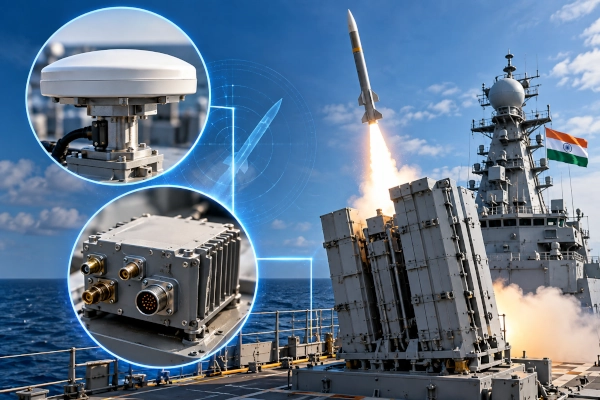
The Indian Navy has initiated another step towards deeper localisation of its Medium Range Surface-to-Air Missile, or MRSAM, ecosystem, seeking indigenous design and development of GPS PS1 and PS2 assemblies associated with the air-defence system.
A Government e-Marketplace tender issued under the Ministry of Defence, Department of Military Affairs and Indian Navy calls for the “Indigenous Design and Development of GPS PS1 & PS2 for MRSAM System.” The procurement represents a development requirement rather than a large production order, indicating that the Navy is seeking to establish an indigenous technical solution before any possible future scaling.
The move adds another specialised subsystem to the broader effort to reduce dependence on imported components used across complex naval weapon systems.
Indian Navy Tender Focuses on Indigenous Development
The tender was issued on September 2, 2026, under GeM bid number GEM/2026/B/7788844.
The requirement is listed under the Ministry of Defence, with the Department of Military Affairs as the department and the Indian Navy as the procuring organisation. The bid pertains to Maharashtra and specifies a total quantity of one development unit or lot.
The procurement window closed on September 23, 2026.
The limited quantity is significant because it shows that the requirement is centred on indigenous design and development, rather than immediate fleet-wide procurement. Such development tenders allow the Navy to evaluate domestic technical solutions, manufacturing capability and compliance before considering larger orders.
What Are GPS PS1 and PS2?
The publicly available tender title identifies the components only as GPS PS1 and PS2 for the MRSAM system.
The tender information available publicly does not provide sufficient technical detail to establish exactly where PS1 and PS2 are located within the wider MRSAM architecture or what specific functions they perform.
They should therefore be described conservatively as GPS-associated assemblies or subsystems linked to the MRSAM system, rather than being identified as missile guidance components, launcher equipment or fire-control hardware without supporting technical documentation.
This distinction is important because the MRSAM weapon complex contains several interconnected elements, including sensors, command-and-control equipment, launchers, communications systems and missile-related subsystems.
MRSAM Forms a Major Layer of Indian Air Defence
The Medium Range Surface-to-Air Missile system is an important component of India’s layered air-defence architecture.
Official Ministry of Defence information describes MRSAM as a sophisticated surface-to-air missile system developed through cooperation between India’s Defence Research and Development Organisation and Israel Aerospace Industries.
The system architecture includes a command post, multi-function radar and mobile launcher, together with the associated missile and support infrastructure required to detect, track and engage aerial threats.
MRSAM variants have been developed for different branches of the Indian Armed Forces, including the Navy, Army and Air Force.
The system is designed to engage a range of airborne threats at medium ranges and forms part of India’s broader effort to build an integrated multi-layered air-defence network.
Localisation Moves Beyond Major Platforms
Indian defence indigenisation is increasingly moving beyond complete aircraft, ships, missiles and radars into the smaller subsystems that determine whether those larger systems can be supported domestically throughout their service lives.
Navigation electronics, antennas, control assemblies, test equipment, communication systems, power supplies and maintenance equipment can all become critical dependencies if their supply chains remain overseas.
By developing such items within India, the armed forces can gradually reduce exposure to foreign supply disruptions while improving their ability to repair, replace and upgrade equipment locally.
The Indian Navy’s MRSAM GPS localisation programme fits this broader pattern.
Navy Also Pursuing Indigenous MRSAM Support Equipment
The GPS PS1 and PS2 tender comes amid other indigenous development requirements connected with the MRSAM complex.
During 2026, the Indian Navy also sought the indigenous design and development of an Advanced Weapon Boresight System for the MRSAM complex.
A boresight system is generally used to establish and verify alignment between sensors, sights or related weapon-system components, making such equipment important for maintenance, calibration and operational readiness.
The appearance of multiple MRSAM-related development requirements suggests that the Navy is progressively addressing support equipment and subsystem localisation alongside the weapon system itself.
A Broader Push for Naval Self-Reliance
The Indian Navy has placed strong emphasis on self-reliance and indigenisation, particularly as the fleet expands and increasingly complex combat systems enter service.
Modern naval vessels depend on thousands of individual electronic, mechanical and software components. Even when the principal platform is built domestically, continued dependence on imported subassemblies can affect maintenance costs, repair timelines and long-term operational availability.
Developing indigenous replacements for specialised components therefore has strategic value beyond the immediate size of an individual tender.
For systems expected to remain operational for decades, access to domestic design knowledge, manufacturing capability and technical support can become as important as the initial acquisition itself.
GPS Localisation Could Strengthen Long-Term Sustainment
The GPS PS1 and PS2 development programme should be viewed primarily as an indigenisation and sustainment initiative.
Its immediate procurement volume is small, but successful indigenous development could establish technical capability that may later be used for production, replacement inventories or future upgrades.
It could also provide Indian defence companies with experience in designing and qualifying specialised electronics for sophisticated air-defence systems.
For the Navy, such localisation can gradually increase control over the maintenance and support chain surrounding one of its important air-defence capabilities.
MRSAM Indigenisation Continues Component by Component
India’s defence localisation programme increasingly depends on thousands of relatively small engineering projects rather than only high-profile platforms.
The Indian Navy’s request for indigenous GPS PS1 and PS2 assemblies for MRSAM, following its earlier GPS antenna requirement, illustrates this incremental approach.
Each successful localisation removes another external dependency from the weapon-system supply chain and adds manufacturing, testing and design knowledge to the domestic defence ecosystem.
References
Government e-Marketplace, Ministry of Defence / Department of Military Affairs / Indian Navy — GeM Bid GEM/2026/B/7788844, “Indigenous Design and Development of GPS PS1 & PS2 for MRSAM System,” issued September 2, 2026.
Government e-Marketplace, Ministry of Defence / Department of Military Affairs / Indian Navy — GeM Bid GEM/2025/B/6233079, “Indigenous Design and Development of GPS Antenna for MRSAM System,” dated July 1, 2025.
Press Information Bureau, Ministry of Defence — Official MRSAM development information describing the DRDO-IAI programme and MRSAM weapon-system architecture.
Ministry of Defence / Indian Navy procurement records — Indigenous Design and Development of Advanced Weapon Boresight System for MRSAM Complex, 2026.
You may also like
-
Indian Semiconductor Companies Propose New Manufacturing and Chip Design Investments in Madhya Pradesh
-
CSIR-CRRI Partners with Industry to Develop Advanced Indigenous Airport Runway and Pavement Materials
-
Paras Semiconductors Secures 43 Acres in Madhya Pradesh for Proposed ₹6,200 Crore Advanced Chip Packaging Facility
-
Indian Army Special Forces Depart for Indonesia for Exercise Garuda Shakti 2026
-
India to Train 600 Nigerian Army Soldiers in Specialised Jungle and Mountain Warfare
