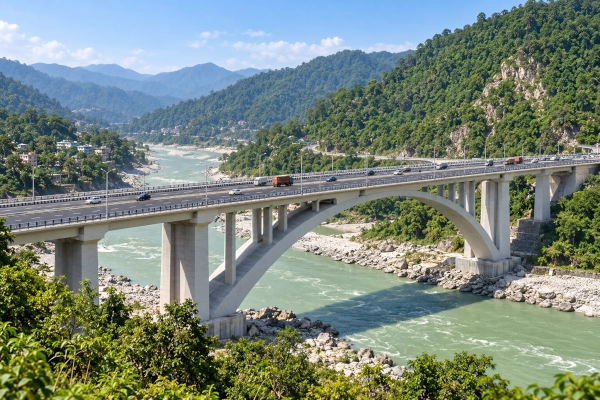
The Ministry of Road Transport and Highways has approved ₹1,176 crore for the construction of a new six-lane bridge across the Teesta River at Sevoke in West Bengal’s Darjeeling district, strengthening one of the most important road connections between the Siliguri region, Sikkim and the wider North-East.
Union Minister for Road Transport and Highways Nitin Gadkari announced the approval on September 30, 2026. The project will involve construction of a 6.9-kilometre-long six-lane major bridge and its approaches on National Highway 10, providing additional capacity across a strategically important transport corridor.
New Teesta Bridge to Strengthen NH-10 Connectivity
NH-10 serves as one of the principal road links connecting the Siliguri region with Sikkim. Sevoke occupies a crucial position on this route, where road infrastructure must negotiate the Teesta River and difficult Himalayan foothill terrain.
The proposed six-lane bridge is intended to improve the movement of passenger vehicles and freight across this section while providing additional capacity for traffic moving between West Bengal, Sikkim and the North-Eastern states.
According to the Road Transport and Highways Minister, the project will strengthen connectivity between Sikkim, the North-East and the Siliguri Corridor while supporting smoother movement of passengers and goods.
6.9-Kilometre Project Includes Bridge and Approach Sections
The approved project has a total length of approximately 6.9 kilometres, including the major bridge across the Teesta and associated approach sections.
The six-lane configuration represents a significant increase in road capacity for the Sevoke section of NH-10. Wider carriageways and improved approaches can reduce congestion at the river crossing while allowing more efficient movement of commercial vehicles and passenger traffic.
Bridge infrastructure of this scale also provides greater resilience along a corridor where geography places natural constraints on road expansion.
Sevoke Is a Critical Gateway to Sikkim
Sevoke lies close to the point where the plains around Siliguri transition into the Himalayan foothills. NH-10 continues from this region towards Kalimpong and Sikkim, making the corridor central to the movement of goods, tourists and essential supplies.
Sikkim’s road connectivity with the rest of India depends heavily on the Siliguri-Sevoke axis. Strengthening infrastructure at the Teesta crossing therefore has significance beyond the immediate Darjeeling district.
Improved capacity at Sevoke can support more reliable freight transport into Sikkim while helping accommodate increasing passenger and tourist traffic along the corridor.
Project Strengthens the Siliguri Corridor Transport Network
The Siliguri region is one of India’s most important transport junctions. Roads and railways passing through the area connect the rest of the country with Sikkim and the North-Eastern states while also serving trade and travel routes towards neighbouring countries.
The new Teesta bridge will form part of a wider programme of road improvements around Siliguri and Sevoke.
The Ministry of Road Transport and Highways had earlier taken up four- and six-laning of NH-31, now part of NH-10, between the Shivmandir area and Sevoke Army Cantonment. The project was intended to reduce congestion around Siliguri while improving connectivity towards the North-East and neighbouring countries.
The latest bridge approval extends this capacity-building effort further along the strategic route.
Faster Freight Movement to Support Regional Trade
One of the principal benefits expected from the new bridge is improved freight movement.
A large share of goods transported into Sikkim moves by road through the Siliguri-Sevoke corridor. Bottlenecks along this route can increase logistics costs and travel times, particularly during periods of high traffic.
Additional six-lane capacity across the Teesta will allow commercial vehicles to move more efficiently through the corridor and reduce dependence on existing constrained road infrastructure.
Better freight connectivity can support construction, agriculture, retail, manufacturing and other economic activity across Sikkim and adjoining regions.
Tourism Connectivity to Sikkim and the Eastern Himalayas
Tourism is another major beneficiary of improved road infrastructure around Sevoke.
The region provides access to destinations across Sikkim, Kalimpong and the eastern Himalayan belt. Tourist traffic can place significant pressure on existing roads during peak travel seasons.
The new bridge and improved approaches are expected to provide smoother traffic flow while reducing congestion and delays.
Better connectivity can also improve access to smaller tourism destinations by strengthening the primary transport corridors feeding into the hill-road network.
Improved Road Capacity Can Reduce Travel Time
The Ministry expects improved infrastructure to reduce travel time and make passenger and freight movement more efficient.
Congestion around major river crossings can create delays extending far beyond the bridge itself because queues spread into connecting roads. Expanding the crossing to six lanes provides additional capacity and creates the possibility of more consistent traffic flow.
For commercial transport operators, reduced delays can improve vehicle utilisation and lower logistics costs. For local residents and tourists, the project can make journeys between Siliguri, the Teesta valley and Sikkim more predictable.
New Bridge Fits Into Wider North-East Highway Expansion
The Sevoke bridge forms part of a much larger transformation of highway connectivity across India’s eastern and North-Eastern regions.
The government is developing multiple access-controlled and high-capacity corridors aimed at connecting Guwahati, Shillong, Silchar and other major centres.
The Cabinet has already approved the 166.8-kilometre four-lane greenfield Shillong-Silchar High-Speed Corridor at a capital cost of ₹22,864 crore. The project is designed to strengthen movement between Assam and Meghalaya while providing faster access towards other North-Eastern states.
A separate 135.87-kilometre access-controlled Guwahati-Tezpur Corridor on NH-15 was approved in August 2026 at a cost of ₹8,970.20 crore.
Together, these investments are expanding road capacity across a region where difficult terrain and long travel times have historically constrained transport.
Connectivity Has Economic and Strategic Importance
High-capacity infrastructure around Siliguri has both economic and strategic importance because the region acts as the principal land bridge between much of India and the North-East.
The government has also been reviewing infrastructure associated with the Siliguri Corridor as part of wider efforts to strengthen connectivity and resilience.
Road projects in this region therefore serve several purposes simultaneously. They improve civilian mobility, support freight and tourism, strengthen access to border states and provide more resilient transport networks.
The proposed Teesta bridge adds another major piece of infrastructure to this broader network.
Six-Lane Teesta Bridge to Become a Major Eastern Himalayan Link
The ₹1,176 crore Sevoke bridge represents a substantial upgrade to one of the most important road crossings on the route towards Sikkim.
Its six-lane configuration, combined with improved approach roads, is intended to ease congestion, shorten journeys and strengthen the movement of freight and passengers across the Teesta.
The project also complements ongoing highway development around Siliguri and across the North-East, where new high-capacity corridors are gradually creating a more integrated road network.
Once completed, the new Teesta crossing will provide additional capacity at a critical gateway to the eastern Himalayas, strengthening regional trade, tourism and logistics while improving the reliability of road connectivity between Sikkim, West Bengal and the wider North-East.
References
Nitin Gadkari, Union Minister for Road Transport and Highways — Official announcement on approval of ₹1,176 crore for the six-lane major bridge across the Teesta River at Sevoke on NH-10, September 30, 2026.
https://x.com/nitin_gadkari
Press Information Bureau, Ministry of Road Transport and Highways — Shri Nitin Gadkari Inaugurates and Lays Foundation Stone of 3 NH Projects Worth ₹1,206 Crore in Siliguri, West Bengal, November 17, 2022.
https://www.pib.gov.in/Pressreleaseshare.aspx?PRID=1876754
Press Information Bureau, Ministry of Road Transport and Highways — Cabinet Approves Development of Greenfield High-Speed Corridor of 166.80 km from Mawlyngkhung near Shillong to Panchgram near Silchar, April 30, 2025.
https://www.pib.gov.in/PressReleasePage.aspx?PRID=2125469
Press Information Bureau, Ministry of Road Transport and Highways — Cabinet Approves 135.87 km Four-Lane Guwahati-Tezpur Corridor, August 6, 2026.aspx
https://www.pib.gov.in/PressReleasePage.aspx?PRID=2295490
Press Information Bureau, Ministry of Home Affairs — Official review of security and infrastructure projects in the Siliguri Corridor, August 22, 2026.
https://www.pib.gov.in/PressReleasePage.aspx?PRID=2302397
You may also like
-
India Advances Trade Diplomacy at G20 Ministerial in Milwaukee
-
Kokasa Launches to Build Indigenous Mission-Critical Systems for Su-30MKI, MiG-29 and T-72
-
Tata Projects and MDS Aero Partner to Build Advanced Aero-Engine Test Infrastructure in India
-
Flying Wedge Defence Partners With Portugal’s Keydef to Manufacture Kaal Bhairava and YAMA Drones in Europe
-
Armenia Conducts Live-Fire Exercise With Indo-French TRAJAN 155 mm Howitzers Manufactured in India
