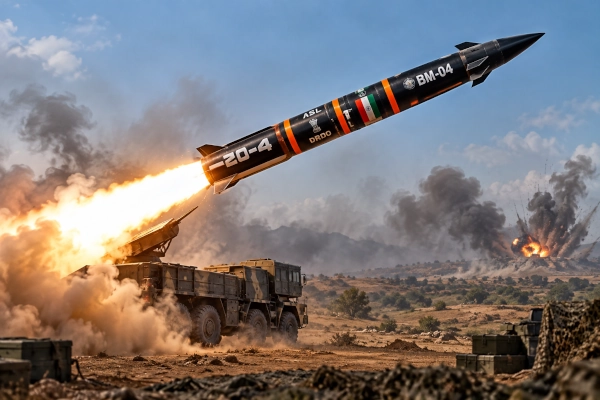
India’s conventional long-range strike capability is expanding with the emergence of BM-04, a new Defence Research and Development Organisation ballistic missile designed to carry a 500-kg conventional warhead to a maximum stated range of 1,500 kilometres. The missile combines two-stage solid propulsion, canisterised deployment, road mobility and precision guidance, placing it in a category considerably beyond conventional battlefield missile systems.
BM-04 is particularly significant because of the role suggested by its publicly disclosed specifications. India already possesses longer-range ballistic missiles associated primarily with strategic deterrence, while systems such as Pralay provide shorter-range conventional ballistic strike capability. BM-04 extends the conventional ballistic missile envelope much farther, potentially providing the Armed Forces with a means of striking important military targets deep inside hostile territory without depending exclusively on combat aircraft or long-range cruise missiles.
The missile was publicly displayed by DRDO at Vigyan Vaibhav 2025 in Hyderabad, where a full-scale model was accompanied by an information board containing several important specifications. The disclosure provided the first detailed public picture of a missile programme that could eventually become an important component of India’s long-range conventional strike forces.
A 1,500-Km Conventional Ballistic Missile
According to the specifications displayed with the missile, BM-04 has an operational range extending from approximately 400 kilometres to 1,500 kilometres. It carries a 500-kg conventional warhead and has a launch weight of approximately 11,500 kg. The missile measures around 10.2 metres in length and 1.2 metres in diameter.
Propulsion is provided by two solid-fuel stages, while the missile is carried inside a launch canister on a road-mobile transporter-erector-launcher. The combination provides a weapon that can remain stored in a protected condition, be transported between deployment areas and prepared for launch without the extensive fuelling procedures associated with older liquid-propellant ballistic missiles.
The 1,500-km maximum range places BM-04 well beyond the traditional battlefield missile category. At the same time, its explicitly identified conventional warhead indicates a mission distinct from India’s strategic nuclear missile force. Its primary value lies in combining substantial reach with the accuracy necessary for conventional precision strikes.
Why the 500-Kg Conventional Warhead Is Important
The conventional warhead is central to understanding the purpose of BM-04. A nuclear ballistic missile can compensate for a comparatively larger miss distance because of the enormous destructive radius of its warhead. A conventionally armed missile does not have that advantage and must therefore deliver its payload much closer to the intended target.
DRDO’s displayed specifications give BM-04 a claimed Circular Error Probable of less than 30 metres. If this level of accuracy is demonstrated consistently during development and user trials, it would allow the missile to employ its 500-kg conventional payload against relatively concentrated military targets rather than functioning simply as an area-strike weapon.
India has not publicly released a target set or operational doctrine for BM-04, and it would be inappropriate to assign one to the missile without official confirmation. Conventional ballistic missiles of this class, however, are generally intended to provide rapid long-range strike options against important military infrastructure and other high-value targets located well beyond the immediate battlefield.
The United States has adopted a comparable philosophy with its Precision Strike Missile programme, which is intended to engage targets such as air-defence systems, missile launchers, command-and-control facilities and other important military assets. BM-04 operates in a substantially greater range class, but the underlying requirement for accurate conventional land-based deep strike is comparable.
Precision Guidance Through INS, GPS and NavIC
BM-04’s guidance architecture combines an inertial navigation system with satellite-navigation updates from GPS and India’s NavIC constellation. An inertial navigation system allows the missile to continuously calculate its position and movement after launch without relying entirely on external signals, while satellite updates can be used to correct accumulated navigation errors during flight.
The inclusion of NavIC gives the system an important indigenous navigation component. India has progressively expanded the military utility of its own satellite-navigation infrastructure precisely because precision weapons cannot be built around permanent dependence on foreign positioning services.
DRDO has not publicly disclosed the complete navigation architecture of BM-04, including its resistance to electronic jamming or the possible presence of additional terminal guidance systems. The confirmed combination of inertial and satellite navigation, however, is consistent with the missile’s stated requirement for high accuracy at considerable range.
Solid Propulsion and Canisterised Deployment
The use of two solid-propellant stages gives BM-04 an important operational advantage. Solid-fuel missiles can remain ready for deployment for extended periods and generally require less preparation before launch than liquid-fuel systems. This is particularly valuable for a mobile conventional missile force that may need to relocate frequently and operate from dispersed positions.
Canisterisation further improves storage, transportation and operational readiness. The missile remains protected inside a sealed launch container during movement and deployment, reducing exposure to environmental conditions and simplifying handling in the field.
The road-mobile launcher completes this arrangement. Instead of being tied to a fixed missile installation that can be continuously monitored, BM-04 batteries could be dispersed and relocated between prepared or temporary operating areas. Mobility increases survivability because an adversary must continuously locate and track the launchers rather than simply maintaining surveillance over known fixed sites.
These characteristics are already familiar within India’s strategic missile programmes, but their application to a long-range conventional precision-strike weapon would provide a different type of operational capability.
The Unusual BM-04 Re-entry Vehicle
One of the most interesting features of BM-04 is the configuration of the vehicle above its booster stages. Photographs of the missile displayed by DRDO show aerodynamic surfaces associated with the upper vehicle, including fins that have attracted considerable attention from missile analysts.
Jane’s assessment of the displayed configuration noted these aerodynamic features and raised the possibility that the vehicle may have a more sophisticated flight profile than a conventional ballistic re-entry vehicle. This has subsequently led to BM-04 being described in some reports as a quasi-ballistic or even boost-glide weapon.
A conventional ballistic missile follows a relatively predictable trajectory after its powered phase. A manoeuvring re-entry vehicle can alter its path during atmospheric flight, while a boost-glide vehicle uses aerodynamic lift to travel along a considerably different trajectory after being accelerated by its booster.
The aerodynamic surfaces visible on BM-04 indicate that the upper vehicle deserves attention, but photographs alone cannot establish its manoeuvring envelope or flight profile. Until DRDO provides further information, BM-04 is best described according to the organisation’s own public presentation: a conventionally armed ballistic missile.
Is BM-04 Quasi-Ballistic?
India already has an officially recognised quasi-ballistic missile in Pralay. DRDO has described Pralay as a solid-propellant quasi-ballistic surface-to-surface missile incorporating advanced guidance and navigation technology.
A quasi-ballistic missile differs from a traditional ballistic weapon by retaining a greater degree of manoeuvrability during portions of its flight. This can make its trajectory less predictable and complicate interception by missile-defence systems designed to calculate a ballistic target’s future position.
Whether BM-04 uses a comparable or more advanced trajectory remains unknown. The visible aerodynamic surfaces have generated understandable speculation, but there is presently insufficient official evidence to classify the missile definitively as quasi-ballistic.
Its speed is another unanswered question. Ballistic missiles routinely reach hypersonic velocities during portions of their trajectories, but that fact alone does not make a weapon a hypersonic glide vehicle or hypersonic cruise missile. DRDO has not publicly disclosed BM-04’s maximum velocity or terminal flight characteristics.
Where BM-04 Fits Alongside Pralay
Pralay provides a useful starting point for understanding BM-04’s position within India’s missile inventory. It is a conventionally armed surface-to-surface missile intended to provide accurate battlefield strike capability while possessing manoeuvring characteristics that can complicate interception.
BM-04 extends this general conventional ballistic-strike concept much farther. With a stated maximum range of 1,500 kilometres, it potentially creates a second layer of land-based ballistic fire beyond systems intended primarily for shorter-range battlefield missions.
The two systems would therefore not necessarily duplicate one another. A shorter-range missile can be smaller, easier to deploy in larger numbers and better suited to targets closer to the operational theatre. A 1,500-km weapon can hold much deeper targets at risk without requiring its launchers to move close to the forward battle area.
This layered approach is increasingly visible among major military powers, which are building families of precision weapons covering progressively greater distances rather than relying on a single missile for every mission.
BM-04 Alongside BrahMos
BM-04 also complements rather than replaces India’s cruise-missile capabilities. BrahMos and BM-04 approach the long-range strike problem through fundamentally different flight profiles.
BrahMos uses sustained propulsion and atmospheric flight, while BM-04 uses powerful rocket stages to accelerate along a ballistic trajectory. The resulting differences in altitude, speed, approach geometry and detection conditions present different challenges to an air-defence network.
A force capable of employing ballistic and cruise missiles simultaneously can consequently complicate defensive planning. An air-defence system optimised to detect low-flying cruise missiles faces a different engagement problem from a ballistic missile arriving at high velocity from altitude.
India’s continued development of ballistic, cruise and hypersonic technologies suggests that its future conventional strike architecture will contain several complementary weapon types rather than depend on a single missile family.
America’s PrSM Is the Closest Western Comparison in Mission
There is no exact Western equivalent to BM-04 based on the specifications currently available. The closest American comparison in terms of operational philosophy is the US Army’s Precision Strike Missile.
PrSM is a road-mobile, solid-fuel conventional ballistic missile designed to provide long-range precision fires from existing M142 HIMARS and M270A2 launchers. Its compact dimensions allow two missiles to be carried in the launcher space previously occupied by one ATACMS.
The currently fielded PrSM Increment 1 has an officially acknowledged range exceeding 400 kilometres. Future increments are intended to expand both its range and target-engagement capabilities.
PrSM and BM-04 therefore share several broad characteristics. Both are mobile, conventionally armed precision ballistic missiles intended to extend land forces’ ability to strike important targets beyond normal artillery ranges.
The difference is scale. BM-04’s stated 1,500-km maximum range places it considerably beyond the currently deployed PrSM and gives it a deeper strike role.
Dark Eagle Occupies the Other End of the American Spectrum
The United States has another land-based missile system beyond PrSM: the Long-Range Hypersonic Weapon, commonly known as Dark Eagle.
Dark Eagle uses a large rocket booster to accelerate a Common Hypersonic Glide Body to hypersonic velocity. The glide vehicle subsequently separates and manoeuvres towards its target through the atmosphere.
Public US government information places the system’s range at approximately 1,725 miles, or about 2,776 kilometres. Dark Eagle therefore has considerably greater reach than the publicly disclosed 1,500-km maximum range of BM-04.
The two weapons should not be treated as direct equivalents. Dark Eagle is explicitly designed around a hypersonic boost-glide vehicle, while DRDO has not confirmed that BM-04 employs such a configuration.
The comparison nevertheless helps locate BM-04 within the wider spectrum of modern land-based strike weapons. In terms of range, it lies above current battlefield precision missiles such as PrSM but below much larger long-range hypersonic systems such as Dark Eagle.
Typhon Reaches Similar Distances Through a Different Route
The US Army’s Mid-Range Capability, known as Typhon, provides another useful comparison because it addresses the deep-strike requirement through cruise missiles rather than a new ballistic weapon.
Typhon uses a land-based launcher derived from the US Navy’s Mk 41 Vertical Launch System and can employ Tomahawk cruise missiles as well as SM-6.
Tomahawk provides a land-attack reach broadly comparable with BM-04’s maximum distance, depending on the missile variant, but it reaches its target through sustained atmospheric cruise rather than a ballistic trajectory.
The comparison illustrates an important difference in how countries are approaching the same military problem. The United States has filled portions of the gap between PrSM and Dark Eagle by deploying a mobile launcher capable of firing existing naval missiles. India appears to be developing a purpose-built conventional ballistic missile extending to approximately 1,500 kilometres.
Europe Is Rebuilding Its Own Deep-Strike Capability
European militaries are also returning to land-based long-range strike after decades in which such systems received comparatively limited attention.
MBDA’s NCM-LCM Mk2 programme includes a mobile land-based cruise missile intended to strike targets at ranges exceeding 1,000 kilometres. The system relies on a different penetration method from BM-04, using low observable characteristics, route planning and atmospheric flight rather than a ballistic trajectory.
Once again, it is not a direct BM-04 equivalent. It demonstrates, however, that the requirement for mobile conventional weapons capable of reaching well beyond the battlefield is becoming increasingly important across several major military powers.
The common objective is to give land forces the ability to influence operations far beyond the range of traditional artillery without depending on aircraft for every deep-strike mission.
Why BM-04 Has No Exact Western Counterpart
BM-04 occupies an unusual position when compared with currently disclosed Western land-based missile systems. The individual capabilities represented by the Indian weapon all exist in Western arsenals, but they are distributed across several different systems.
PrSM provides mobile conventional ballistic precision strike but currently operates at substantially shorter ranges. Tomahawk and Europe’s emerging land-based cruise missiles provide comparable deep-strike distances but use cruise-missile flight profiles. Dark Eagle travels considerably farther and employs a sophisticated hypersonic glide vehicle, placing it in a higher-end category.
BM-04, based on what DRDO has publicly shown, combines a 1,500-km maximum range, two-stage solid propulsion, road mobility, canisterised deployment, a 500-kg conventional warhead and claimed accuracy below 30 metres in a single ballistic missile system.
This does not make BM-04 inherently superior or inferior to those Western weapons. Each reflects different operational requirements, launcher architectures, cost considerations and strike doctrines. It does mean that there is currently no obvious one-for-one Western system matching the complete publicly disclosed BM-04 configuration.
The Conventional Ballistic Missile Programme Moves Towards Procurement
An important development occurred on January 1, 2026, when the Ministry of Defence reviewed DRDO’s achievements during the previous year.
The Government stated that Acceptance of Necessity had been accorded by the Defence Acquisition Council and Services Procurement Board for 22 DRDO-developed systems valued at approximately ₹1.30 lakh crore.
Among the programmes specifically identified was a “Conventional Ballistic Missile System”.
Acceptance of Necessity is an important stage in India’s defence acquisition process because it establishes the requirement for procurement before subsequent acquisition procedures move forward.
The Ministry of Defence did not identify the system as BM-04. It is therefore not possible from the public announcement alone to establish that the Conventional Ballistic Missile System receiving Acceptance of Necessity is the missile displayed at Vigyan Vaibhav.
The announcement nevertheless confirms that a conventional ballistic missile system is part of India’s formal acquisition pipeline, demonstrating that the requirement for this class of weapon extends beyond laboratory research.
A New Layer of India’s Long-Range Conventional Strike Capability
BM-04 represents an important development because it potentially expands the reach of India’s conventional land-based missile forces into a range category previously associated more closely with strategic systems or long-range cruise missiles.
Its stated 400-to-1,500-km envelope provides considerable flexibility. The 500-kg conventional warhead gives the missile a substantial payload, while the claimed sub-30-metre accuracy is intended to make that payload effective against specific targets. Solid propulsion and canisterisation improve readiness, and road mobility makes the launcher considerably more difficult to locate than a fixed missile installation.
Questions remain about some of the missile’s most interesting characteristics. DRDO has not publicly disclosed its maximum velocity, complete flight trajectory, terminal manoeuvring capability, penetration aids, development timetable or induction schedule. The precise relationship between BM-04 and the Conventional Ballistic Missile System mentioned in the 2026 government review also remains unconfirmed.
Those unknowns should not obscure what has already been disclosed. India is developing a mobile, conventionally armed ballistic missile with a stated reach of 1,500 kilometres and a 500-kg payload, supported by indigenous guidance and a claimed accuracy measured in tens rather than hundreds of metres.
BM-04 therefore fills a distinctive position between India’s shorter-range battlefield missile systems and its longer-range strategic arsenal. Alongside Pralay, BrahMos and India’s emerging hypersonic programmes, it could eventually form part of a layered conventional strike architecture capable of approaching defended targets through several very different flight profiles and from substantially different distances.
The Western comparison reinforces that point. BM-04 cannot accurately be described as an Indian PrSM, Typhon or Dark Eagle because none matches its publicly disclosed combination of characteristics. Its closest counterparts are spread across several Western programmes, suggesting that India has chosen to address the 1,500-km conventional deep-strike requirement through a missile class of its own.
References
Defence Research and Development Organisation — Newspaper Clippings, BM-04 specifications and technical reporting — 6 March 2025
https://www.drdo.gov.in/drdo/sites/default/files/drdo-news/NPC06Mar2025.pdf
Press Information Bureau, Ministry of Defence — DRDO 68th Foundation Day; Conventional Ballistic Missile System listed among systems receiving Acceptance of Necessity — 1 January 2026
https://www.pib.gov.in/PressReleasePage.aspx?PRID=2210663&lang=2®=3
US Army — Soldiers Complete Successful Flight Test Series of the U.S. Army’s Precision Strike Missile
https://www.army.mil/article/288874/soldiers_complete_successful_flight_test_series_of_the_u_s_armys_precision_strike_missile
US Army — Army Announces First Precision Strike Missiles Delivery
https://www.army.mil/article/272301/army_announces_first_precision_strike_missiles_delivery
US Army — Prepare to Launch: Mid-Range Capability, PrSM and Long-Range Hypersonic Weapon
https://www.army.mil/article/277922/prepare_to_launch
US Army — Mid-Range Capability System
https://www.army.mil/article/267971
MBDA — NCM-LCM Mk2 Land Cruise Missile
https://www.mbda-systems.com/mbda-unveils-naval-cruise-missile-land-cruise-missile-mk2-eurosatory
Jane’s — India’s DRDO Unveils BM-04 SRBM
https://www.janes.com/defence-intelligence-insights/defence-news/defence/indias-drdo-unveils-bm-04-srbm
You may also like
-
Nayan Technologies Selected by JSW MG Motor to Advance AI-Based Road Monitoring and Smart Mobility
-
Indian Navy to Commission Indigenous Anti-Submarine Warfare Ship Mangrol on October 12
-
JSW Steel’s Crude Steel Production Rises 5% to 7.27 Million Tonnes in Q2 FY2027
-
Kabra Extrusiontechnik’s GEON Commissions 20 MWh Battery Storage Project in Rajasthan
-
OBSC Perfection Secures ₹8.9 Crore Israeli Defence Order for Precision Fuze Components
