Indian space-tech company GalaxEye has entered into a strategic partnership with Safran Space to develop next-generation Earth Observation technologies, bringing together an emerging Indian satellite-imaging company and one of Europe’s major aerospace and space technology groups.
The two companies signed a Memorandum of Understanding during Bengaluru Space Expo 2026. The agreement is intended to combine GalaxEye’s expertise in multi-sensor Earth Observation with Safran’s capabilities in space systems, testing infrastructure and mission-critical technologies.
The partnership comes as India’s private space sector increasingly moves beyond building individual satellite components towards developing complete spacecraft, sensors and commercially deployable Earth Observation services.
Collaboration Across Technology and Product Development
Under the partnership, GalaxEye and Safran will explore cooperation in product development, technology integration and future space missions. The companies will also examine opportunities to jointly address customers in India and international markets.
Safran has described its agreements signed during Bengaluru Space Expo as the beginning of deeper cooperation involving joint research and development, co-design and co-development. The French aerospace group is seeking to combine its established space engineering capabilities with India’s rapidly expanding private space ecosystem.
For GalaxEye, the partnership provides access to expertise extending beyond satellite imaging itself. Safran’s space businesses operate across areas including spacecraft electronics, propulsion, optical systems, telemetry, testing and other mission-critical technologies, creating several potential areas where the two companies could work together as GalaxEye expands its satellite programme.
GalaxEye Builds Around OptoSAR
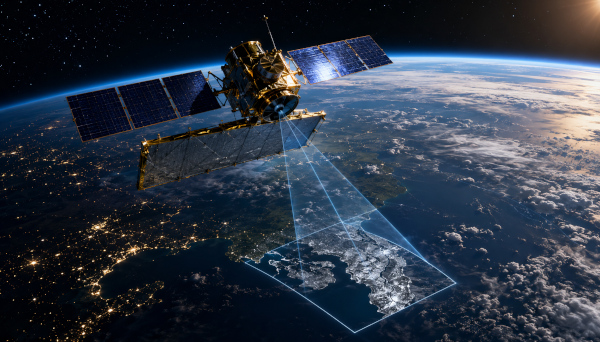
At the centre of GalaxEye’s technology strategy is its OptoSAR architecture, which combines Synthetic Aperture Radar and optical imaging aboard the same spacecraft.
Conventional optical Earth Observation satellites can produce detailed and easily interpreted imagery, but clouds, haze and darkness can restrict their usefulness. Synthetic Aperture Radar, or SAR, can operate during both day and night and can image through cloud cover, although radar imagery differs significantly from conventional optical photographs.
GalaxEye’s approach is designed to bring the two sensing techniques together. Its system synchronises optical and microwave sensors so that both can observe the same area under closely matched spatial and temporal conditions.
The company recently secured a United States patent covering the core technology behind this sensor architecture, adding to intellectual-property protection already obtained in India. The development strengthens GalaxEye’s position as it seeks to commercialise multi-sensor satellite imagery for customers requiring persistent and reliable Earth Observation.
Mission Drishti Demonstrates the Technology in Orbit
GalaxEye has already moved the concept from development laboratories into orbit through its first satellite, Mission Drishti.
Launched on May 3, 2026 aboard a Falcon 9 rocket from California, the approximately 190-kg spacecraft carries both multispectral optical imaging equipment and an X-band Synthetic Aperture Radar payload. GalaxEye describes it as the first satellite designed around its OptoSAR imaging architecture.
Mission Drishti operates at an altitude of roughly 500 kilometres and has been designed to provide imagery with resolution ranging from approximately 1.2 metres to 3.6 metres, depending on the imaging mode and sensor involved.
The company ultimately plans to expand beyond a single spacecraft. GalaxEye is working towards a constellation capable of providing increasingly frequent observations, allowing customers to obtain information about changing conditions on the ground rather than relying on occasional satellite passes.
Applications Extend Beyond Conventional Satellite Mapping
Reliable multi-sensor Earth Observation has applications across defence, agriculture, infrastructure, disaster management, maritime surveillance and environmental monitoring.
For defence and strategic users, the ability to continue observing an area despite cloud cover or darkness can improve persistent surveillance. In agriculture, the combination of radar and optical information can assist in monitoring crops, soil conditions and flooding. Similar capabilities can support insurance assessments, infrastructure monitoring and emergency response after cyclones, floods or landslides.
The commercial value therefore lies not merely in producing satellite photographs but in generating dependable streams of geospatial information that can be processed into operational intelligence.
An Indo-French Space Technology Partnership
The GalaxEye-Safran agreement also reflects the changing nature of international cooperation in India’s space sector. Partnerships that were once dominated by national space agencies are increasingly being complemented by direct collaboration between private companies.
Safran has emphasised building sovereign technological capabilities and strengthening India’s domestic space supply chain. At Bengaluru Space Expo, the company announced agreements not only with GalaxEye but also with other Indian technology companies as part of its wider effort to deepen its presence in the country’s emerging commercial space industry.
For GalaxEye, cooperation with an established global aerospace group could help accelerate the transition from demonstrating OptoSAR technology to deploying it across a larger constellation and commercial customer base.
The MoU itself remains a framework for cooperation rather than a specific satellite order or manufacturing contract. However, its focus on joint technology development, integration and future missions makes it significant. If the partnership progresses into concrete programmes, it could bring Indian-developed multi-sensor Earth Observation technology together with Safran’s established space engineering capabilities to create systems aimed at both domestic and international markets.
You may also like
-
DFCCIL Sets New Freight Operations Record with 946 Train Interchanges in a Single Day
-
NTPC Identifies Three Nuclear Power Plant Sites as India Advances 30 GW Atomic Energy Expansion
-
Seven Indian SMEs Debut on Stock Exchanges as Electronics, Software and Engineering Firms Access Public Markets
-
DRDO Advances Indigenous Submarine AIP System as ₹1,990 Crore Kalvari-Class Integration Programme Progresses
-
Paras Defence Clarifies Guardian-1 Counter-Drone Partnership with US Firm Powerus Amid Pakistan Deal Concerns
