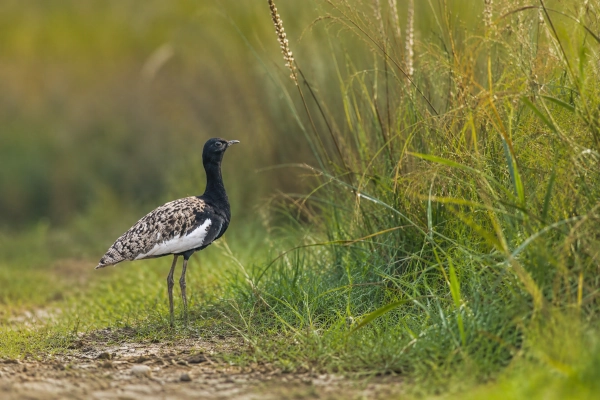
The Bengal Florican, scientifically known as Houbaropsis bengalensis, is one of the rarest and most striking birds of the Indian subcontinent’s grasslands. A member of the bustard family, it inhabits a fragmented chain of floodplain and alluvial grasslands stretching from the Terai of Uttar Pradesh and Nepal to the Brahmaputra Valley of Assam and the plains of Arunachal Pradesh. A separate subspecies survives in Cambodia, creating two widely separated global populations. The species is classified as Critically Endangered, and conservation assessments continue to describe its population as extremely small and declining.
For much of the year, the Bengal Florican remains hidden among tall grasses. During the breeding season, however, the male transforms the quiet grassland into a dramatic stage. He rises above the vegetation in a sudden display flight, revealing bright white wings against a glossy black body before descending into his territory. This unforgettable performance has made the bird one of the most celebrated symbols of the Terai and Brahmaputra floodplain ecosystems.
A Bird Shaped by the Grasslands
The natural home of the Bengal Florican consists of moist alluvial grasslands formed and renewed by rivers. These landscapes develop on sediment deposited by shifting waterways across the plains below the Himalayas and along the Brahmaputra. Seasonal flooding, fire, grazing and the growth of different grass heights create a changing mosaic of open display grounds, feeding areas and concealed nesting sites.
The bird requires a carefully balanced habitat. Males favour short, open and relatively undisturbed grasslands where they can establish territories and perform their aerial displays. Females use taller and denser vegetation nearby for concealment and nesting. Research in Nepal has identified short grasslands dominated by Imperata cylindrica, interspersed with taller patches, as particularly valuable breeding habitat.
This dependence on several grassland conditions makes the Bengal Florican highly sensitive to environmental change. A uniform landscape of very tall grass offers few suitable display grounds, while excessive cutting, burning or grazing removes the cover needed by females and chicks. Effective conservation therefore requires carefully timed management that preserves a varied grassland structure throughout the breeding cycle.
Identifying the Male and Female
The adult male Bengal Florican possesses one of the most distinctive breeding plumages among South Asian grassland birds. His head, neck and lower body appear deep black, accompanied by elongated feathers around the neck and breast. The upper body is patterned in buff and brown, while the wings carry broad white areas that become especially prominent during flight.
When the male leaps above the grass, the contrast between his black body and white wings becomes visible from a considerable distance. On the ground, he can disappear quickly as the surrounding grass breaks up his outline.
The female presents an entirely different appearance. Her plumage is predominantly buff-brown with darker mottling, providing excellent camouflage among dry stalks and vegetation. She is slightly larger than the male, an unusual characteristic among bustards. Immature males initially resemble females and develop the dark adult breeding plumage as they mature.
The female’s camouflage reflects her central role in reproduction. She must remain concealed while incubating eggs on the ground and later guide vulnerable chicks through grassland containing predators and seasonal disturbances.
The Spectacular Courtship Display
The breeding season generally begins during February or March and continues into June, with some regional variation. Adult males occupy individual territories in areas of short grass and defend them from rivals. Several male territories may occur across a broader breeding area, forming what ornithologists describe as an “exploded lek.”
The male begins his performance from the ground. He adopts a prominent posture, expands his ornamental feathers and suddenly launches himself above the vegetation. His white wings flash against the black body as he rises, flutters or glides briefly and returns to the grass. The display may be repeated many times, especially during the early morning and late afternoon.
These aerial performances advertise the male’s presence to females hidden within the surrounding vegetation. They also warn competing males that the territory is occupied. Encounters between rivals can involve chasing, posturing and territorial conflict.
The repeated appearance of a displaying male allows researchers to survey breeding sites, although counting males provides only part of the population picture. Females are considerably harder to detect, and birds may move between breeding and post-breeding habitats. Satellite-tagging studies conducted by conservation groups in India and Nepal have helped reveal that the species also depends on grasslands and agricultural areas beyond the boundaries of protected reserves.
Nesting and the Female’s Role
Following mating, the male takes little direct part in nesting or chick-rearing. The female selects a concealed site on the ground, usually within taller vegetation. Rather than constructing an elaborate nest, she creates a shallow scrape and normally lays one or two eggs.
Ground nesting exposes the eggs and chicks to numerous dangers. Fire spreading through breeding grasslands can destroy a nest within minutes. Early cutting removes protective cover, while livestock, machinery and human movement may disturb or crush eggs. Predators can also locate nests after the vegetation has been thinned.
The female’s patterned plumage provides her principal defence. She remains still among the grasses and relies on concealment. After hatching, the chicks leave the nesting area with their mother and begin feeding within the surrounding grassland.
Food and Daily Life
The Bengal Florican is omnivorous. Its diet includes seeds, grain, tender grass shoots, grasshoppers, beetles, ants and other invertebrates. Frogs have also been recorded among its food. This varied diet allows the bird to use different parts of the floodplain landscape as vegetation and insect abundance change through the seasons.
The birds are often most active during the cooler hours of morning and evening. They walk quietly through the vegetation while searching for food, using their long legs to move between grass clumps. When alarmed, they may crouch and depend on camouflage before taking flight.
Seasonal movements form an important part of their survival. After the breeding season, some individuals leave protected grasslands and enter nearby farmland or other open habitats. These movements connect several small habitat patches and show that protecting only the display grounds provides an incomplete conservation solution.
Assam: An Eastern Stronghold
Assam holds some of the most important surviving Bengal Florican habitats in India. The bird is principally associated with the great grassland and riverine landscapes of Manas, Orang and Kaziranga, while its wider historical range extended through other suitable areas of the Brahmaputra Valley and towards Arunachal Pradesh. The Bombay Natural History Society identifies Manas, Orang and Kaziranga among the principal Indian reserves supporting the species.
Manas National Park is especially important because its grasslands lie along the Himalayan foothills and form part of a wider landscape extending towards Bhutan. The park’s mixture of river channels, woodland and tall alluvial grass supports Bengal Floricans alongside pygmy hogs, hispid hares, elephants, wild buffaloes and numerous specialised grassland birds.
Kaziranga and Orang contain floodplain grasslands shaped by the Brahmaputra and its tributaries. Annual floods may cause temporary disruption, yet they also prevent permanent woodland from covering the plains, deposit fresh sediment and renew the vegetation. Grassland management in these parks influences an entire ecological community that includes the Bengal Florican, Indian rhinoceros, swamp deer and several threatened birds.
The survival of the florican in Assam therefore represents more than the protection of one species. Its presence indicates that open floodplain grasslands retain the structural variety required by a wider range of wildlife.
The Northern Terai Population
West of Assam, the Bengal Florican survives within the Terai Arc Landscape extending across northern India and southern Nepal. In Uttar Pradesh, major habitats include Dudhwa, Kishanpur and Pilibhit. The Wildlife Institute of India regards the bird as an indicator of moist Terai grassland health and has documented severe pressures from land conversion, plantations, pesticides, invasive plants and uncontrolled grazing.
Across the international border, Nepal’s remaining breeding population has become concentrated in Shuklaphanta National Park, Chitwan National Park and Koshi Tappu Wildlife Reserve with adjoining areas. A 2024 review estimated that Nepal held fewer than 100 birds and recorded major long-term declines at its principal sites. The review also reported that the species formerly bred in Bardia National Park, where it has remained unrecorded since 2010.
These figures reveal the fragility of the northern Terai population. Protected areas remain essential breeding refuges, while post-breeding movements carry birds into surrounding farmland where they encounter further risks from disturbance, trapping, hunting and agricultural chemicals. India and Nepal must therefore view the species as a shared landscape-level conservation responsibility.
A Fragmented Global Range
The Bengal Florican has two isolated geographical populations. The South Asian subspecies, Houbaropsis bengalensis bengalensis, occurs in India and Nepal. The Indochinese subspecies, Houbaropsis bengalensis blandini, survives primarily in Cambodia. Bangladesh has lost its former population, while the species’ status in Vietnam has become highly uncertain.
The separation between South and Southeast Asian populations means that each represents an irreplaceable evolutionary and ecological lineage. A collapse in either region would remove the species from a vast part of its historical world.
Why the Bengal Florican Is Disappearing
The principal threat is the disappearance and degradation of natural grassland. Large areas of the Terai and Brahmaputra plains have been converted into farms, settlements, roads, plantations and other land uses. Surviving grasslands are often fragmented into isolated patches that support only a few birds.
Grasslands also face a persistent perception problem. Open land is frequently treated as vacant or unproductive and may be targeted for tree planting. For the Bengal Florican, dense plantations and advancing woodland eliminate the open ground required by displaying males.
Management activities can create additional pressure when their timing fails to match the bird’s breeding cycle. Burning, cutting or intensive grazing after nesting has begun may expose females, destroy eggs and remove feeding cover. Agricultural pesticides threaten birds that enter farmland and may also reduce the insects on which they feed.
Infrastructure introduces further dangers through habitat division, disturbance and collisions. Small populations separated from one another also face reduced opportunities for movement and reproduction.
Conserving a Grassland Flagship
The Bengal Florican can serve as a flagship for the conservation of India and Nepal’s riverine grasslands. Protecting its habitat benefits many species that receive less public attention, including grassland warblers, babblers, francolins, raptors, small mammals, reptiles and insects.
Conservation requires the creation of mosaics containing short display grass, taller nesting cover and seasonally available feeding areas. Burning and cutting must be planned before nesting or divided into rotating sections so that suitable refuge remains available throughout the year. Woody encroachment and invasive plants require careful control, while essential movement routes between protected and community-managed land must remain open.
Satellite tracking, repeated population surveys and research on females are particularly important. Traditional surveys focus heavily on displaying males because they are easier to locate. A full understanding of the species requires better information about female survival, nesting success, juvenile dispersal and post-breeding habitat use. BNHS studies in India and collaborative tracking work in Nepal have already demonstrated the importance of habitats outside protected-area boundaries.
Local communities remain central to the bird’s future. Farmers, livestock keepers and grass collectors possess detailed knowledge of seasonal conditions. Conservation programmes can work with them to protect nests, limit harmful disturbance, retain grassland patches and reduce pesticide exposure. Nepal has adopted a Bengal Florican Conservation Action Plan covering 2024–2033, reflecting the urgency of coordinated research, habitat management and community participation.
The Future of the Grassland Monarch
The Bengal Florican embodies the wild character of Assam’s floodplains and the Himalayan Terai. Its survival depends upon landscapes where rivers can shape the soil, grasses can grow in varied heights and seasonal management can follow the rhythms of breeding wildlife.
When a male Bengal Florican rises above the grass with white wings spread against a black body, the display lasts only a few seconds. Yet it represents thousands of years of adaptation to one of South Asia’s richest ecosystems. Preserving that flight will require long-term protection of natural grasslands, scientific management, cooperation between India and Nepal and sustained participation from the communities who live beside the bird’s remaining habitat.
Saving the Bengal Florican would also preserve the riverside grasslands that support countless other forms of life. Its future has therefore become inseparable from the future of the Terai and Brahmaputra plains themselves.
References
BirdLife International. “Bengal Florican — Houbaropsis bengalensis: Species Factsheet.” BirdLife DataZone.
https://datazone.birdlife.org/species/factsheet/bengal-florican-houbaropsis-bengalensis
Convention on Migratory Species. “Proposal for the Inclusion of the Bengal Florican (Houbaropsis bengalensis bengalensis) in Appendix I of CMS.” United Nations Environment Programme, 2019.
https://www.cms.int/sites/default/files/document/cms_cop13_doc.27.1.5_proposal-inclusion-bengal_florican_india_e.pdf
Bombay Natural History Society. “Bengal Florican.” Information on the species’ Indian distribution, satellite-tracking studies and conservation requirements.
https://www.bnhs.org/content-details/bengal-florican
Wildlife Institute of India. “Status and Habitat Assessment of Bengal Florican Houbaropsis bengalensis in the Grasslands of Uttar Pradesh.” WII Digital Repository, 2014.
https://digitalrepository.wii.gov.in/items/8906e74a-a8ad-482b-9e8a-32a106eeaab5
Thakur, Miranda, et al. “Current Conservation Status of Bengal Florican Houbaropsis bengalensis in Manas National Park, Assam, India.” Journal of Threatened Taxa, Vol. 16, No. 7, 2024.
https://www.threatenedtaxa.org/index.php/JoTT/article/view/8247
Department of National Parks and Wildlife Conservation, Government of Nepal. “Bengal Florican Conservation Action Plan 2024–2033.”
https://dnpwc.gov.np/content/91/bengal-florican-conservation-action-plan–2024-2033-/
Last modified: 16 July 2026.
You may also like
-
Chhattisgarh Plans Innovative Tree Surgery to Save Over 500 Damaged Trees in Udanti Sitanadi Tiger Reserve
-
Kerala’s Peechi Wildlife Survey Records 395 Species, Adds 36 New Entries to Biodiversity Checklists
-
Tiger Returns to Maharashtra’s Beed Forests After Nearly 100 Years, Highlights Importance of Wildlife Corridors
-
Himachal Pradesh Achieves Major Success in Rare Cheer Pheasant Conservation
-
Blackbucks to Return to Chhattisgarh’s Gomarda Wildlife Sanctuary After Five Decades
