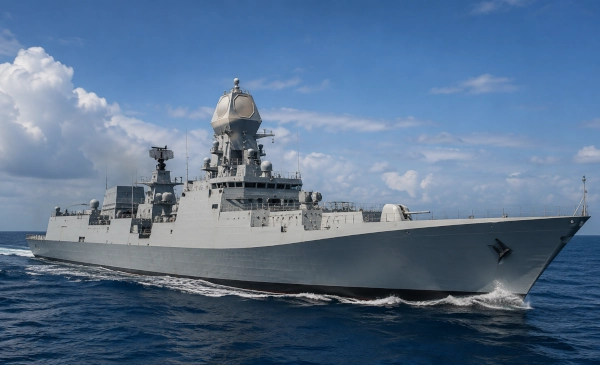
India’s next major destroyer programme is gradually emerging as one of the most important future projects in the Navy’s surface-fleet modernisation plan.
While detailed specifications circulating around Project 18 remain largely unofficial, statements made by Mazagon Dock Shipbuilders Limited (MDL) provide firm evidence that the Indian Navy is working towards a substantially larger, more complex and more heavily armed successor to the existing Project 15B destroyers.
MDL management confirmed in May 2024 that four Next Generation Destroyers were expected in the forthcoming requirement. The company also stated that tenders had not yet been issued and discussions with the Navy were continuing.
The programme has since remained in the Navy’s future acquisition pipeline. In October 2025, MDL Chairman and Managing Director Capt. Jagmohan told investors that the Navy was expected to bring forward another destroyer-class project, either a Project 15C-type follow-on or the Next Generation Destroyer, with a potential value of approximately ₹70,000 crore to ₹80,000 crore.
That figure provides the strongest official indication so far of the possible financial scale of India’s next destroyer programme.
Four Destroyers Expected in the Initial Batch
The most concrete indication of numbers came from MDL’s official investor discussions.
During its May 30, 2024 investor call, MDL was asked directly how many Next Generation Destroyers were likely to be required. Director Shipbuilding Biju George replied that the expected quantity was four ships.
Earlier, in August 2023, MDL management had said discussions had evolved from six destroyers to a possible requirement for eight vessels divided into two phases of four ships each.
Taken together, the statements suggest that four ships could form the first construction batch, while additional vessels may follow later depending on the Navy’s force-planning requirements.
However, the Ministry of Defence has not publicly announced an eight-ship acquisition, and the programme should therefore be described at present as an anticipated initial requirement for four Next Generation Destroyers rather than a confirmed eight-vessel order.
A Major Step Beyond Project 15B
The future destroyers would follow the Navy’s highly successful Project 15B Visakhapatnam-class guided-missile destroyers.
The four P15B ships — INS Visakhapatnam, INS Mormugao, INS Imphal and INS Surat — represent the latest operational generation of India’s indigenous destroyer programme.
The fourth and final vessel, INS Surat, entered service on January 15, 2025. The Ministry of Defence describes the ship as one of the world’s largest and most sophisticated destroyers and notes its high level of indigenous content, advanced weapon-sensor package and network-centric capabilities.
Project 15B itself evolved from the Kolkata-class Project 15A destroyers, continuing a design lineage developed largely within India.
The Visakhapatnam-class ships displace around 7,300 tonnes, measure approximately 163 metres in length and use four gas turbines in a Combined Gas and Gas propulsion arrangement to achieve speeds exceeding 30 knots.
Their armament includes BrahMos supersonic surface-to-surface missiles, Barak-8 surface-to-air missiles, naval guns, torpedoes and indigenous anti-submarine warfare systems, supported by modern radar, sonar and electronic warfare equipment.
A Next Generation Destroyer would therefore have to represent a significant improvement over an already sophisticated combat platform.
MDL Says Future Destroyer Will Be Larger and More Weapon Intensive
One of the clearest official indications of what the Navy expects from its next destroyer came from MDL management itself.
During the May 2024 investor call, MDL said the Next Generation Destroyer was likely to be “significantly larger and more complex” than the existing destroyers and also more weapon intensive.
This statement is important because it supports the broader expectation that the future ship will carry considerably greater combat capability.
Increasing a destroyer’s size provides naval designers with additional internal volume and electrical capacity for missiles, radars, electronic warfare equipment, aviation facilities and future weapon systems.
It can also provide greater fuel and stores capacity, improving endurance during long deployments across the Indian Ocean and beyond.
Defence reporting frequently associates Project 18 with displacement figures of around 10,000 tonnes or more, but the Indian Navy and Ministry of Defence have not publicly released a final displacement figure. Any precise tonnage should therefore remain identified as reported rather than officially confirmed.
Greater Missile Capacity Is a Logical Priority
The description of the future ship as more “weapon intensive” points towards one of the most important trends affecting modern destroyer design: the increasing need for large numbers of vertical-launch missile cells.
A modern surface combatant may need to simultaneously defend itself and a naval task group against aircraft, anti-ship missiles, drones and potentially ballistic or hypersonic threats. It may also carry long-range anti-ship and land-attack weapons.
This creates strong demand for additional missile capacity.
Project 15B already combines BrahMos anti-ship and land-attack capability with the Barak-8 air-defence system. A larger successor could provide considerably more space for future Indian missile systems.
However, reports describing specific Project 18 vertical-launch cell counts, missile numbers or individual future weapons have not yet been officially confirmed.
The final armament configuration will depend on the Navy’s operational requirements when the design is frozen.
Sensors Will Define the Next Leap in Capability
The future destroyer is also expected to take advantage of major advances underway in India’s radar, electronic warfare and network-centric combat technologies.
The Project 15B class already carries sophisticated sensors and digital combat-management systems. INS Surat, for example, was commissioned with advanced network-centric capabilities and a substantial indigenous weapon and sensor package.
The next-generation design will have to deal with an even more demanding threat environment involving stealth aircraft, low-flying cruise missiles, unmanned systems and increasingly sophisticated electronic warfare.
This will place greater emphasis on long-range surveillance, multi-function radar technology, electronic support measures and the ability to exchange targeting information with aircraft, satellites, submarines and other warships.
India is steadily increasing indigenous participation in these areas, making sensors and combat-management systems likely candidates for substantial domestic content in the future programme.
The precise radar configuration associated with Project 18, however, remains unconfirmed publicly.
Electric Propulsion Is Emerging as an Important Navy Technology
Another major development relevant to future Indian warships is the Navy’s push towards electric propulsion technology.
India and the United Kingdom signed a Statement of Intent in November 2024 covering cooperation in the design and development of electric propulsion systems for future Indian naval ships.
The arrangement covers co-design, co-creation and co-production of electric propulsion capability, reflecting India’s intention to establish domestic expertise in a technology increasingly important to advanced naval platforms.
The programme moved another step forward on July 3, 2026, when the Defence Acquisition Council approved establishment of a Land Based Testing Facility for Electric Propulsion Systems for the Indian Navy.
According to the Ministry of Defence, the facility will support testing of motors and associated propulsion systems for naval assets.
Electric and integrated-electric propulsion systems can offer several advantages for large combatants. They can improve how electrical power is generated and distributed throughout a ship and potentially make greater power available for advanced sensors and future high-energy systems.
They can also provide naval architects with additional flexibility in arranging machinery inside the hull.
However, although integrated electric propulsion has frequently been associated with Project 18 in defence reporting, the Ministry of Defence has not publicly confirmed that the final Next Generation Destroyer design will use a specific electric-propulsion architecture.
The Navy’s investment in the technology nevertheless makes it highly relevant to future large-warship programmes.
Stealth Will Extend Beyond Hull Shaping
India’s indigenous destroyer designs have progressively reduced radar signatures through hull shaping and radar-transparent fittings.
Project 15B incorporated improved stealth, survivability, seakeeping and manoeuvrability compared with earlier generations.
A larger future destroyer would likely continue this progression.
Modern naval stealth involves much more than making the hull difficult to detect on radar. Designers must control radar reflections from sensors, weapons, communications antennas and deck equipment while reducing infrared, acoustic and electromagnetic signatures.
This becomes increasingly challenging on heavily armed warships carrying powerful radar systems.
The future destroyer therefore provides an opportunity for the Navy’s Warship Design Bureau and Indian industry to incorporate lessons accumulated across the Delhi, Kolkata, Visakhapatnam and Nilgiri-class programmes into a substantially more sophisticated surface combatant.
A ₹70,000–80,000 Crore Industrial Opportunity
The financial scale of the programme could make it one of India’s largest indigenous surface-warship projects.
During MDL’s October 2025 earnings call, Capt. Jagmohan identified a forthcoming destroyer programme with an estimated value of approximately ₹70,000–80,000 crore.
This should not yet be interpreted as a sanctioned government budget.
MDL itself described the figure as the expected scale of either a Project 15C-type destroyer or Next Generation Destroyer programme. The final cost will depend on the approved number of ships, weapons, sensors, imported components, development expenditure and construction model.
Nevertheless, even the indicative figure demonstrates the programme’s industrial importance.
Destroyer construction involves hundreds of Indian companies supplying steel, propulsion equipment, electrical machinery, missiles, radars, sonar, electronic warfare systems, communications equipment, pumps, valves and thousands of smaller components.
The investment therefore spreads far beyond the shipyard responsible for final assembly.
MDL Preparing Infrastructure for Larger Warships
Mazagon Dock is already expanding its infrastructure in anticipation of larger naval platforms.
MDL has repeatedly identified the Next Generation Destroyer as an important future opportunity and has invested in facilities capable of handling vessels larger than its current destroyers.
The company’s new 12,000-tonne lifting-capacity Floating Dry Dock at Nhava Yard forms part of this wider expansion.
During its May 2024 investor discussions, MDL said future platforms were expected to have larger dimensions and deeper drafts and that the shipyard was consequently investing significantly in additional capacity.
The development of Nhava therefore has strategic relevance beyond MDL’s immediate order book. It provides additional infrastructure for the much larger surface combatants India intends to construct over the coming decades.
Approval Has Not Yet Been Publicly Announced
Despite the growing indications surrounding the programme, there is an important distinction between planning and formal acquisition approval.
As of August 20, 2026, the Ministry of Defence has not publicly announced an Acceptance of Necessity for a programme specifically identified as Project 18 or the Next Generation Destroyer.
The Defence Acquisition Council’s July 3, 2026 meeting approved several naval requirements, including the Multi Influence Ground Mine, Naval Shipborne Unmanned Aerial System and Land Based Testing Facility for Electric Propulsion Systems. A destroyer acquisition was not included in the published approvals.
MDL had similarly stated in May 2024 that the Next Generation Destroyer tender had not been issued and that discussions concerning the requirement were continuing.
This means reports suggesting that construction has already been authorised or that a final ₹80,000-crore contract has been approved go beyond what official sources currently establish.
Building on India’s Indigenous Destroyer Lineage
Whatever final configuration emerges, the Next Generation Destroyer programme represents the continuation of one of India’s most successful defence-industrial developments.
India moved progressively from the Delhi-class Project 15 destroyers to the Kolkata-class Project 15A and then the Visakhapatnam-class Project 15B.
Each generation introduced higher indigenous content, improved sensors, greater automation and increasingly sophisticated weapons.
The fourth P15B destroyer, INS Surat, entered service with around 75% indigenous content, according to the government, illustrating how far domestic warship construction has progressed.
A future Next Generation Destroyer would push that process into a substantially larger technological domain.
Greater missile capacity, high electrical power generation, advanced radar, enhanced stealth and more extensive indigenous weapons could transform the ship from an evolutionary successor to P15B into a new category of Indian surface combatant.
Much of its final configuration remains classified or undecided. What official information already confirms, however, is significant: the Indian Navy intends to move beyond Project 15B towards a larger, more complex and more heavily armed indigenous destroyer, with four ships expected in the initial requirement and a programme that could eventually be worth as much as ₹70,000–80,000 crore.
Next Generation Destroyer programme would become another major milestone in India’s transition from building foreign-derived naval platforms to designing and constructing increasingly sophisticated frontline warships at home.
Official Sources
Mazagon Dock Shipbuilders Limited — Investor Call, May 30, 2024: Confirms that Next Generation Destroyers were under discussion, identifies an expected quantity of four ships and describes the future destroyer as larger, more complex and more weapon-intensive than the existing class.
Mazagon Dock Shipbuilders Limited — Investor Call, October 28, 2025: Places the prospective destroyer programme at approximately ₹70,000–80,000 crore.
Ministry of Defence / PIB — July 3, 2026: Confirms DAC approval for the Navy’s Land Based Testing Facility for Electric Propulsion Systems.
Ministry of Defence / PIB — November 29, 2024: Confirms the India-UK framework for co-design, co-creation and co-production of electric propulsion capability for future Indian naval ships.
Ministry of Defence / PIB — January 2025: Official information on INS Surat and the Project 15B destroyer programme, including indigenous content, weapons and sensors.
You may also like
-
ICAR Scientists Develop Indigenous Protective Gloves for Cotton Farmers, Sign Commercial Manufacturing Agreement
-
India Moves Towards Five-Year Assured Orders for Defence Startups Under New Procurement Reforms
-
BHEL–Coal India Joint Venture Begins Construction of ₹25,016 Crore Indigenous Coal Gasification Project in Odisha
-
Zen Technologies Introduces Indigenous Hyper-Strike Falcon AI-Guided Counter-Drone Interceptor
-
L&T and Germany’s SCHOTTEL Expand Partnership for Controllable Pitch Propeller Systems in Indian Shipbuilding
