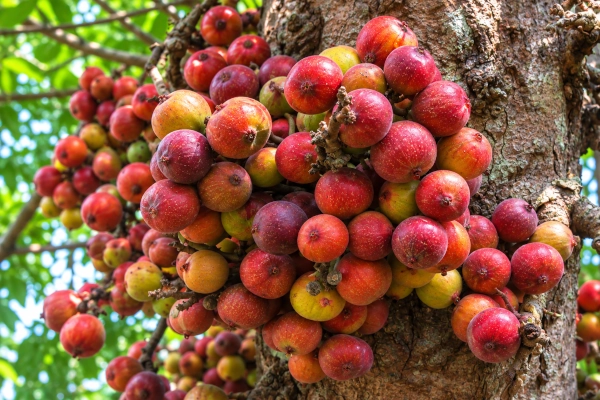
Botanical Name: Ficus racemosa L.
Sanskrit Name: Udumbara
Common Names: Cluster Fig, Indian Fig, Gular Fig, Country Fig
Family: Moraceae
Hindi: Gular
Malayalam: Athi
Tamil: Atthi
Kannada: Atthi Mara
Telugu: Udumbaramu, Atthi
Marathi: Umbar, Audumbar
Parts Traditionally Used: Stem bark, fruits, latex, roots, leaves and leaf buds
Among the great Ficus trees of India, Udumbara occupies a distinctive place. Its fruits do not hang from thin outer twigs like ordinary orchard fruits. Instead, rounded figs emerge in dense clusters directly from the trunk and older branches.
This unusual appearance gives Ficus racemosa its English name, Cluster Fig.
For Ayurveda, however, Udumbara is far more than an unusual fruit tree. Its bark, fruit, latex, roots and leaves have been used for centuries. The plant is especially associated with wounds, excessive bleeding, diarrhoeal conditions, burning sensations and disorders involving aggravated Pitta and Kapha. CCRAS historical research identifies Udumbara with Ficus racemosa and documents its long presence in Indian medical and cultural literature.
Modern botanical authorities recognise Ficus racemosa L. as an accepted species in the Moraceae family. Its native range stretches from Pakistan and India through Southeast Asia to northern Australia. The older botanical name Ficus glomerata Roxb. is now treated as a synonym.
Udumbara in the Ayurvedic Tradition
Udumbara has been known in India since ancient times. Ayurvedic and Vedic literature associates the tree with both medicine and ritual practice. CCRAS describes Udumbara as a well-known drug used from ancient times and notes its importance in religious traditions.
Traditional names reveal different characteristics of the tree.
Names such as Ksheeri refer to its milky latex. Yajnanga and related names reflect its association with Yajna. Sheetaphala points towards the cooling quality attributed to the fruit. Traditional synonyms such as Jantuphala refer to the insects commonly found within its fig structures.
Charaka places Udumbara within the Kashaya Skandha, the group dominated by astringent taste. It also appears in the Mutrasangrahaniya group. Sushruta and Vagbhata include it within the Nyagrodhadi group of medicinal trees.
Ayurvedic Profile of Udumbara
The medicinal character of Udumbara is dominated by Kashaya Rasa, or astringency.
| Ayurvedic Property | Udumbara |
|---|---|
| Rasa — Taste | Kashaya — astringent |
| Guna — Qualities | Guru, Ruksha — heavy and dry |
| Virya — Potency | Sheeta — cooling |
| Vipaka — Post-digestive effect | Katu — pungent |
| Dosha Action | Mainly Pitta-Kapha Shamaka |
| Important Actions | Stambhana, Vranaropana, Vranashodhana, Dahahara, Mutrasangrahaniya |
These characteristics are recorded in contemporary Ayurvedic references drawing upon classical Dravyaguna traditions.
Udumbara’s astringency explains many of its traditional applications. Kashaya substances produce a contracting effect and are often used where excessive fluid loss, discharge or bleeding is present.
Its Sheeta Virya gives the plant a cooling character. This helps explain its traditional association with Pitta, burning sensations and Rakta-related disturbances.
Stambhana — The Stabilising Action of Udumbara
Stambhana is one of Udumbara’s most characteristic Ayurvedic actions.
Stambhana refers to checking or restraining excessive flow. This action corresponds closely with the plant’s strong Kashaya Rasa. Ayurvedic sources consequently describe Udumbara in conditions involving excessive bleeding, loose stools and abnormal secretions.
However, Stambhana does not mean that every form of bleeding should be suppressed with a home remedy.
Unexplained rectal bleeding, vomiting of blood, heavy menstrual bleeding or repeated nosebleeds can have serious causes. They require proper medical evaluation.
Udumbara is therefore best understood as a medicinal plant used within a complete Ayurvedic diagnosis.
Udumbara and Raktapitta
Udumbara has a strong traditional association with Raktapitta, a classical Ayurvedic condition involving disturbed Pitta and Rakta.
The cooling potency and astringent action of the fruit and bark help explain this role. Traditional descriptions specifically associate Udumbara with reducing bleeding and conditions involving aggravated Pitta and Rakta.
The ripe fruit is traditionally regarded as cooling. Classical food descriptions also associate it with thirst, burning sensations and Pitta disturbances.
Raktapitta should not simply be translated as every modern bleeding disorder.
Anaemia, clotting disorders, gastrointestinal bleeding and abnormal uterine bleeding require modern diagnosis when appropriate.
Vranashodhana — Traditional Cleansing of Wounds
Udumbara holds an important place in Ayurvedic wound care.
Traditional sources describe it as Vranashodhana, meaning supportive of cleansing unhealthy wounds. It is also described as Vranaropana, referring to the healing process.
Modern research provides an interesting bridge to this classical use.
A laboratory study of Ficus racemosa stem bark found that selected constituents supported cell migration while also showing antimicrobial activity. The researchers concluded that these combined actions offered scientific support for the plant’s traditional wound-healing use.
Animal studies using extracts from Ficus racemosa roots have also reported improved wound contraction, epithelialisation and wound strength.
These studies are encouraging, but they remain preclinical.
Deep wounds, infected wounds, diabetic ulcers and severe burns should not be treated with crude tree material.
Vranaropana — Supporting the Healing Process
Ayurveda does not view wound management as a single action.
A wound may first need cleansing. Later, tissue repair and closure become more important. Udumbara appears in the tradition in both contexts.
This distinction makes its modern wound research especially interesting.
Researchers examining the bark identified activity related to both tissue migration and antimicrobial effects. Such findings suggest possible mechanisms behind historical wound applications.
However, laboratory activity cannot establish a standard clinical treatment.
Modern wound healing depends on blood supply, infection control, nutrition, diabetes status and the depth of tissue damage.
Udumbara Bark — The Principal Medicinal Part
The stem bark is among the most important medicinal parts of Udumbara.
CCRAS research collections preserve authenticated stem bark, roots, leaves, stems and fruits of Ficus racemosa. This reflects the plant’s established importance within Indian medicinal-plant research.
Bark preparations have traditionally been used where astringency and cooling action are required.
Ayurvedic references describe bark decoctions in relation to bleeding, malabsorption, urinary disturbances and certain reproductive conditions.
Medicinal bark should come from correctly identified and responsibly harvested material.
Removing large quantities of bark from a living tree can cause serious damage.
Udumbara Fruit — Raw and Ripe Are Different
As with many Ayurvedic fruits, the stage of ripeness changes the character of Udumbara.
The unripe fruit is strongly astringent. Traditional descriptions also associate it with Deepana and selected digestive uses.
The ripe fruit becomes sweeter and remains cooling. It is traditionally linked with reducing thirst, fatigue, burning sensations and aggravated Pitta.
This distinction is important.
Ayurveda does not treat “Udumbara fruit” as one chemically and therapeutically identical substance throughout its development.
Ripening changes taste, texture and composition.
The Strange Fruit That Grows From the Trunk
Udumbara is one of the most visually unusual Indian fig trees.
Its figs develop in large clusters directly from the trunk and major branches. Botanists describe this type of fruiting habit as cauliflory.
The visible structure is not technically a simple fruit.
Like other figs, Udumbara produces a specialised enclosed structure called a syconium. Tiny flowers develop inside this structure. The resulting fig therefore represents a complex reproductive system rather than one ordinary fleshy fruit.
Kew recognises Ficus racemosa as a widespread tropical tree across South and Southeast Asia and northern Australia.
Udumbara and the Remarkable Fig-Wasp Relationship
Figs have evolved one of nature’s most specialised relationships with insects.
The flowers of Ficus species develop inside their enclosed fig structures. Specialised fig wasps enter these structures and participate in pollination.
This close relationship helps explain some of Udumbara’s traditional names associated with insects.
It also demonstrates that the tree is not merely an isolated medicinal resource. It forms part of a specialised ecological system.
For this reason, mature fig trees can play an important role in supporting biodiversity.
Udumbara and Atisara
Udumbara’s Kashaya Rasa and Stambhana action explain its traditional use in Atisara, or diarrhoeal disorders.
An astringent substance tends to contract tissues. Within Ayurvedic reasoning, this can help when intestinal contents are passing excessively.
However, diarrhoea is not one disease.
It may result from contaminated food, bacterial or viral infection, parasites, medicines or chronic intestinal disease.
Severe or prolonged diarrhoea can cause dehydration. Blood in stools, high fever or significant weakness requires medical care.
Udumbara should not delay oral rehydration or appropriate treatment.
Grahi and the Concept of Retention
The traditional digestive role of Udumbara is closely connected with Grahi and Stambhana principles.
These actions are especially relevant when the body is losing fluids too freely.
Ayurveda does not recommend Grahi substances simply because loose stools occur. The physician also evaluates Ama, Agni and the disease stage.
Using an astringent too early in some digestive disturbances may be inappropriate.
This illustrates why classical Ayurvedic medicines cannot always be reduced to simple symptom-to-herb formulas.
Udumbara and Burning Sensations
Udumbara is traditionally described as Dahahara, meaning useful where excessive burning sensations are present.
Its Sheeta Virya helps explain this indication.
Classical descriptions of the fruit similarly associate it with thirst and Pitta-related heat.
This does not mean Udumbara treats every cause of burning.
Burning in the chest may indicate reflux or heart disease. Burning during urination may indicate infection. Burning in the feet may occur with neuropathy.
The underlying condition must be identified.
Gastroprotective Research
Modern researchers have also examined Ficus racemosa in experimental models of gastric injury.
A standardised bark extract showed gastroprotective activity in animal experiments. Researchers proposed that the effects could involve gastric defence mechanisms and phenolic compounds.
This offers an interesting scientific parallel to the traditional cooling and protective reputation of Udumbara.
However, animal gastroprotection does not mean that bark decoction is a proven treatment for human ulcers.
Peptic ulcer disease may involve Helicobacter pylori, anti-inflammatory medicines and other factors requiring specific treatment.
Udumbara and Prameha
Udumbara also appears in Ayurvedic traditions relating to Prameha.
Prameha is a broad metabolic and urinary disease category. Some aspects overlap with diabetes, but the Sanskrit term should not automatically be replaced with “diabetes mellitus.”
The plant’s historical use in this area has led to substantial scientific interest.
Laboratory research on Ficus racemosa bark has reported glucose-lowering potential. More recent animal research has also investigated fruit extracts for effects on hyperglycaemia.
These results remain insufficient to establish Udumbara as a diabetes treatment.
People taking insulin or glucose-lowering medicines should not add concentrated Udumbara preparations without professional guidance.
What the Diabetes Research Really Means
Medicinal-plant research often begins with laboratory enzymes, cells or animal models.
Such studies can identify interesting biological activity. They cannot establish human dose, long-term safety or treatment effectiveness.
A 2010 study reported in-vitro hypoglycaemic potential from Ficus racemosa bark. A 2025 mouse study found glucose-lowering activity from a fruit extract and identified compounds for further investigation.
These findings justify further research.
They do not justify stopping metformin, insulin or any prescribed treatment.
Udumbara Latex
Like many Ficus species, Udumbara produces a white milky latex when injured.
Traditional medicine has used this latex in selected conditions. Ayurvedic references include it among the useful medicinal parts of the tree.
Latex is biologically active and deserves caution.
It should not be assumed safe simply because it comes directly from a tree.
Raw plant latex can irritate skin and sensitive tissues. It should not be placed in the eyes or applied indiscriminately to open wounds.
Internal use requires professional supervision.
Udumbara and Women’s Health
Traditional Ayurvedic literature contains several uses of Udumbara in Pradara and excessive menstrual bleeding.
The strong astringent, cooling and Stambhana properties provide the classical rationale for these applications.
Yet heavy menstrual bleeding can result from fibroids, hormonal disorders, pregnancy complications, clotting abnormalities and other causes.
Persistent heavy bleeding can also produce severe anaemia.
Therefore, traditional Udumbara preparations should not replace gynaecological assessment when bleeding is abnormal.
Udumbara in Panchavalkala
Udumbara is one of the important trees associated with the Ayurvedic Panchavalkala tradition.
Panchavalkala brings together the bark of several latex-bearing trees, especially members of the Ficus group.
Traditional formulations use this combination primarily where astringent, cleansing and healing actions are desired.
A review of Udumbara’s Ayurvedic applications found extensive external use across classical formulations. Wound care was among the most frequently cited areas.
This shows that Udumbara was often used as part of a formulation rather than as an isolated household remedy.
Research Into Antioxidant Activity
The stem bark of Ficus racemosa contains phenolic compounds that have attracted experimental interest.
Animal research has examined the antioxidant-related effects of bark extracts in models involving drug-induced kidney, reproductive and cardiac injury.
These studies show pharmacological activity under controlled experimental conditions.
They should not be converted into claims that Udumbara protects humans from heart disease, kidney disease or chemotherapy toxicity.
Human treatment requires clinical evidence.
Important Phytochemicals
Scientific investigations of Ficus racemosa have identified several classes of plant compounds.
Published reviews discuss phytosterols, flavonoids, triterpenoids, phenolics and related constituents. Ayurvedic pharmacognostic references also record compounds such as beta-sitosterol, lupeol and friedelin from the fruit.
Different parts of the tree contain different chemical profiles.
The bark cannot therefore be assumed to act identically to the ripe fruit.
The latex is different again.
This reinforces a principle Ayurveda already follows: the plant part matters.
Traditional Knowledge and Modern Evidence
A major scientific review published in 2010 described Ficus racemosa as a widely used Indian medicinal plant with a long history in Ayurveda. Researchers reviewed its traditional applications, phytochemistry and experimental pharmacology.
Since then, additional studies have investigated wound healing, glucose metabolism and gastroprotection.
The evidence is strongest at the laboratory and animal level.
Human clinical research remains much more limited.
For a medicinal plant article, this distinction is essential.
Traditional use deserves documentation. Experimental findings deserve attention. Neither should be exaggerated into clinical certainty.
Udumbara Is Not the Common Fig
Udumbara is sometimes confused with the common dried fig sold as Anjeer.
They are different species.
Udumbara is Ficus racemosa.
The common edible fig is Ficus carica.
Their fruits differ in appearance, chemistry and Ayurvedic properties.
Substituting Anjeer for Udumbara in a medicinal preparation is therefore not botanically correct.
Udumbara and Banyan Are Also Different
Udumbara should also be distinguished from the Banyan, or Vata.
Banyan is Ficus benghalensis.
Udumbara is Ficus racemosa.
Both belong to the Moraceae family and both produce latex. Ayurveda uses bark from both trees in important formulations.
Yet they are separate medicinal species and should not be treated as interchangeable.
Correct identification is one of the foundations of Dravyaguna.
An Important Ecological Tree
Udumbara’s value extends beyond medicine.
Like other fig trees, it produces large numbers of fruits that can provide food for wildlife. Its wide native range demonstrates its adaptation to tropical landscapes across Asia and northern Australia.
The tree therefore contributes both to medicinal traditions and to living ecosystems.
This matters when medicinal bark is harvested.
Removing bark carelessly can weaken or kill a mature tree. Sustainable sourcing should therefore be an essential part of Ayurvedic plant use.
A medicinal tree is more valuable alive than destroyed for one batch of medicine.
Safety and Precautions
Udumbara is a medicinal tree and should not be treated as an unrestricted supplement.
Bark, latex and concentrated extracts can produce physiological effects. Anyone using diabetes medicines should be particularly careful because experimental research has reported glucose-lowering activity.
Pregnant or breastfeeding women should seek professional advice before medicinal use.
People with chronic kidney, liver or gastrointestinal disease should also consult a qualified practitioner.
Raw latex should be handled cautiously and kept away from the eyes.
Persistent bleeding, non-healing wounds, severe diarrhoea or unexplained urinary symptoms require diagnosis rather than self-treatment.
Udumbara Through the Ayurvedic Lens
Udumbara demonstrates how Ayurvedic pharmacology connects a plant’s qualities with its therapeutic character.
Its Kashaya Rasa gives astringency.
Its Ruksha Guna contributes dryness.
Its Sheeta Virya provides cooling action.
Its Katu Vipaka shapes its post-digestive influence.
Together, these qualities help explain its traditional Pitta-Kapha Shamaka, Stambhana, Vranaropana and Dahahara actions.
Modern science approaches the same plant through cell migration, antimicrobial activity, phenolic compounds and metabolic pathways.
The two frameworks are different.
Yet the areas chosen for modern investigation often reflect the very uses that made Udumbara important in the first place.
Udumbara — The Healing Fig Growing From the Trunk
Few medicinal trees look quite like Udumbara.
Clusters of figs appear directly against its trunk. White latex flows when its tissues are damaged. Its bark carries the powerful astringency valued by Ayurveda.
For generations, practitioners have used that bark where cooling, contraction and healing were required.
Modern researchers have now found experimental evidence worth pursuing. Bark compounds have shown wound-related activity. Extracts have been examined for gastroprotection and glucose regulation. Government institutions continue to preserve authenticated Ficus racemosa material for medicinal-plant research.
Yet Udumbara’s importance is greater than any one laboratory finding.
It belongs to a lineage of Indian trees in which ecology, Ayurveda and cultural memory meet.
Its fruits feed living ecosystems.
Its bark entered classical medicine.
Its wood and leaves entered ritual traditions.
Its unusual clusters gave the tree an identity that could never be mistaken once properly recognised.
Ayurveda remembers Udumbara especially for stability, cooling and astringency.
Modern science is beginning to investigate the mechanisms behind some of those observations.
The ancient cluster fig still has much to teach.
References
Royal Botanic Gardens, Kew recognises Ficus racemosa L. as an accepted species in the Moraceae family. Kew records its native range from Pakistan through South and Southeast Asia to northern Australia.
The Central Council for Research in Ayurvedic Sciences documents Udumbara in historical Indian medical literature and maintains authenticated specimens of Ficus racemosa bark, stems, fruits, roots and leaves.
The National Institute of Indian Medical Heritage identifies Udumbara as Ficus racemosa in its Ayurvedic medicinal reference material.
Peer-reviewed research has investigated Ficus racemosa in wound healing, gastroprotection and glucose metabolism. Much of the present evidence remains laboratory-based or preclinical.
A peer-reviewed review of Ficus racemosa discusses its traditional medicinal uses, phytochemistry and experimental pharmacological activity.
Health Disclaimer
This article is intended for educational and informational purposes only. It is not medical advice and should not be used to diagnose, treat, cure or prevent any disease. Udumbara bark, latex, roots and concentrated extracts are medicinal substances. Internal medicinal use should take place under the guidance of a qualified Ayurvedic practitioner or physician. Udumbara must not replace prescribed treatment for diabetes, gastrointestinal bleeding, heavy menstrual bleeding, infections, ulcers, diarrhoea or chronic wounds. Raw latex can irritate sensitive tissues. Pregnant or breastfeeding women, children, people with chronic illnesses and those taking prescription medicines should seek professional advice before medicinal use.
You may also like
-
Ayurveda and Hydration: How Much Water Should We Really Drink?
-
Warm Water in Ayurveda: When and Why It Is Recommended
-
Women Make Up 43% of India’s Ayush Workforce as Sector Supports 17.6 Lakh Livelihoods
-
Sunfox Technologies Raises $7 Million to Take India-Built Spandan ECG Platform Global
-
Ayurveda on Fasting: When Restraint Supports Digestion
