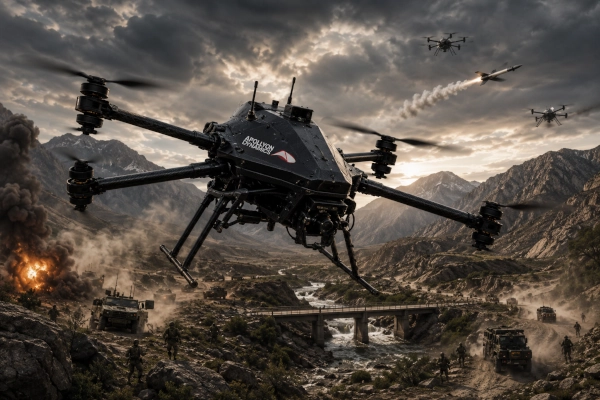
Hyderabad-based defence technology startup Apollyon Dynamics has developed a high-speed electric interceptor drone that has set a new Indian benchmark for multirotor unmanned aircraft. The company’s Ahuti Mk II achieved a certified top speed of 498 km/h, earning recognition from the India Book of Records for the maximum speed achieved by a multirotor UAV in India.
The achievement was reported on September 1, 2026, with Apollyon publicly announcing the milestone on September 2. The company says the new aircraft substantially exceeds the earlier Indian multirotor benchmark of around 325 km/h.
Unlike conventional multirotor drones optimised primarily for hovering, surveillance or payload carriage, Ahuti Mk II has been developed specifically as a high-speed aerial interceptor. Its intended mission is to close rapidly on hostile unmanned aircraft and loitering munitions before they reach their targets.
From Ahuti to Ahuti Mk II
Ahuti Mk II evolved from Apollyon’s original Ahuti platform, which reached approximately 300 km/h in 2025. Rather than simply modifying the earlier aircraft, the company substantially redesigned the interceptor around the requirement for greater speed.
Founder Jayant Khatri said the development process involved around 10 iterations covering the airframe, propulsion architecture and motor configuration before the final design reached its current performance level. The result represents an increase of roughly 66% over the original Ahuti’s reported top speed.
The Mk II remains an electrically powered multirotor, making its recorded speed particularly notable. Multirotor aircraft typically trade outright speed for vertical take-off, manoeuvrability and the ability to hover, while fixed-wing drones can exploit aerodynamic lift for higher-speed and longer-duration flight.
Apollyon’s design attempts to push the multirotor architecture in a different direction by prioritising rapid acceleration and interception performance.
Designed to Chase Hostile Drones
The operational logic behind Ahuti Mk II reflects the rapid expansion of one-way attack drones and loitering munitions in contemporary warfare.
Small unmanned aircraft are increasingly being used for reconnaissance, artillery spotting and precision attack, while larger one-way strike systems can threaten military bases, logistics nodes and critical infrastructure from substantial distances.
Countering these threats with conventional surface-to-air missiles can create an unfavourable cost equation, particularly when inexpensive drones are launched in numbers. High-speed interceptor drones offer another option by using relatively small unmanned aircraft to chase and physically defeat incoming UAVs.
For an interceptor, speed directly affects the amount of territory that can be protected. A faster aircraft can reach an approaching threat later in its flight path, respond to detections over a wider area and reduce the time available to the hostile UAV before engagement.
Ahuti Mk II has therefore been developed around response speed rather than endurance or conventional surveillance performance.
498 km/h Sets a New Indian Multirotor Record
The India Book of Records recognised the aircraft’s 498-km/h performance under the category for maximum speed achieved by a multirotor UAV.
Apollyon says the figure exceeds the previously recorded Indian benchmark of approximately 325 km/h by more than 170 km/h. The record applies specifically to the multirotor UAV category rather than establishing Ahuti Mk II as the fastest Indian unmanned aircraft of every type.
That distinction is important because fixed-wing UAVs, jet-powered unmanned aircraft and target drones operate under very different aerodynamic and propulsion conditions and can achieve substantially higher speeds.
Within the electrically powered multirotor category, however, the 498-km/h figure demonstrates how far high-performance drone engineering has moved beyond conventional quadcopters.
Developed by a BITS Pilani-Incubated Startup
Apollyon Dynamics was founded in 2025 by Jayant Khatri and Sourya Choudhury and is incubated at the BITS Pilani Hyderabad Campus.
The Ahuti Mk II development team included Aman Virani, Manas Vichare and Ishaan Suri, with the new aircraft emerging from the company’s earlier work on high-speed unmanned systems.
The company itself represents an emerging category within India’s defence ecosystem: small technology teams developing specialised unmanned platforms through rapid design and testing cycles rather than traditional long-duration aerospace programmes.
Apollyon’s earlier development work grew from high-performance drone experimentation into military applications, with the company subsequently developing training, autonomous, long-range and expendable UAV systems.
Earlier Apollyon Drones Have Reached the Indian Army
The company already has experience working with Indian military users.
Apollyon has previously stated that it supplied high-speed kamikaze drones capable of around 300 km/h to the Indian Army, while earlier reporting documented collaboration with Army units on unmanned systems and a mobile drone-manufacturing concept designed for operation closer to the frontline.
Company material also states that its unmanned platforms have been deployed or supported at multiple Indian Army locations.
The new speed record should nevertheless be separated from those earlier deployments. There has been no official announcement that the Indian Army has ordered or inducted Ahuti Mk II itself.
The current milestone establishes the platform’s demonstrated speed performance; military acceptance would require further evaluation against operational requirements extending well beyond maximum velocity.
Counter-Drone Warfare Is Becoming a Major Indian Defence Market
Ahuti Mk II enters an Indian defence environment where counter-UAS capability has become a major investment priority.
The armed forces are evaluating layered approaches combining radar and electro-optical detection, electronic warfare, jammers, guns, missiles and dedicated drone interceptors. No single technology can economically address every class of aerial threat.
High-speed interceptor drones could occupy a useful layer against small and medium unmanned targets, particularly when electronic attack is ineffective against autonomous navigation or when conventional missiles would be disproportionately expensive.
The challenge is considerably broader than speed alone. A practical interceptor also requires reliable target detection, guidance, autonomous tracking, communications, manoeuvrability and an effective means of neutralising the target.
Apollyon’s record therefore validates one important part of the interception problem — the ability to build an electrically powered multirotor capable of rapidly closing distance.
Apollyon Expands Into More Advanced Unmanned Weapons
The company’s ambitions now extend beyond Ahuti.
Apollyon is developing Nightshade ADX-1, described by the company as a jet-powered long-range unmanned strike platform. Its corporate roadmap also points towards increasingly larger autonomous and high-speed aerial systems.
For Apollyon Dynamics, the 498-km/h Ahuti Mk II record provides a highly visible validation of its high-speed UAV engineering capability less than two years after the company’s formation.
More importantly, the aircraft addresses a requirement that is becoming central to modern air defence: defeating relatively inexpensive unmanned threats without depending exclusively on expensive conventional missiles. Ahuti Mk II’s significance therefore lies not simply in setting a speed record, but in demonstrating the emergence of an indigenous Indian effort to develop a new class of fast, potentially affordable counter-drone interceptors.
You may also like
-
Indian Semiconductor Companies Propose New Manufacturing and Chip Design Investments in Madhya Pradesh
-
CSIR-CRRI Partners with Industry to Develop Advanced Indigenous Airport Runway and Pavement Materials
-
Paras Semiconductors Secures 43 Acres in Madhya Pradesh for Proposed ₹6,200 Crore Advanced Chip Packaging Facility
-
Indian Army Special Forces Depart for Indonesia for Exercise Garuda Shakti 2026
-
India to Train 600 Nigerian Army Soldiers in Specialised Jungle and Mountain Warfare
