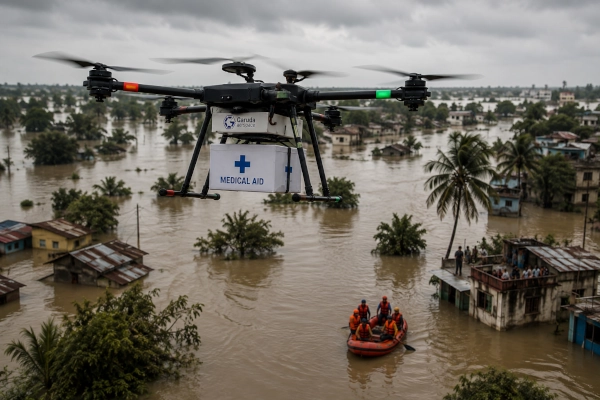
Indian drone manufacturer Garuda Aerospace has deployed its Sanjeevani logistics drones in Nepal’s flood-hit Rasuwa district, using unmanned aircraft to carry essential supplies into mountainous areas where damaged roads and disrupted infrastructure have made conventional relief operations difficult.
The deployment represents a significant real-world application of Indian drone technology in an international humanitarian emergency. Garuda’s aircraft are being used for point-to-point transportation of food, medicines, drinking water and other essential supplies to isolated communities affected by the floods.
The Sanjeevani drones being used in Nepal can carry payloads of up to 25 kg, allowing relief teams to move meaningful quantities of critical supplies without waiting for damaged roads or bridges to be restored. In mountainous terrain, even relatively short distances can become major logistical obstacles when landslides, flooding or washed-out infrastructure prevent vehicles from reaching remote settlements.
Garuda Aerospace is not providing aircraft alone. The company is also supporting operations with battery systems, communication equipment, ground-support systems and certified drone pilots, creating a more complete deployment package capable of sustaining repeated missions in difficult terrain.
The company says the drones can also support aerial assessment and emergency-response teams, providing another layer of assistance beyond cargo transportation. Rapid aerial observation can help relief coordinators assess inaccessible areas and determine where supplies or personnel are most urgently required.
Rasuwa Faces Severe Access Challenges
Rasuwa is among the areas badly affected by the catastrophic flooding that struck Nepal in late August. Floodwaters, mud and debris damaged roads, bridges, telecommunications infrastructure and hydropower facilities across affected regions, leaving rescuers dependent on helicopters, temporary crossings, heavy machinery and increasingly drones to reach cut-off locations.
The wider disaster has demonstrated how unmanned aircraft can perform several different functions during emergency operations. Drones have already been used in Nepal to search inaccessible locations, identify stranded people and assist relief teams where terrain is too dangerous or difficult for conventional access.
Garuda’s deployment adds aerial logistics to that response.
Cargo drones cannot replace the far greater carrying capacity of helicopters or trucks, but they can fill an important gap between large-scale transport and the final destination. A helicopter can move tonnes of relief supplies to a regional base, while smaller unmanned aircraft can distribute urgently needed medicines, food or equipment to individual communities that remain disconnected from the road network.
That makes the technology particularly relevant to Himalayan disaster response, where steep valleys, unstable slopes and limited road connectivity can make the final few kilometres of a relief mission disproportionately difficult.
From Drone Demonstrations to Operational Logistics
The Nepal operation is also an important milestone for India’s rapidly expanding drone industry.
Much of the discussion surrounding Indian unmanned systems has traditionally centred on agricultural spraying, mapping, surveillance and defence applications. Logistics remains a technically more demanding area because cargo aircraft must combine useful payload capacity with sufficient endurance, flight stability and reliable command-and-control systems.
Disaster operations add further complications. Aircraft may have to operate in changing weather, mountainous terrain and areas where communications and electricity infrastructure are already damaged.
By deploying not only drones but batteries, ground systems, communications equipment and trained pilots, Garuda is effectively testing an integrated unmanned logistics capability under conditions far removed from a controlled demonstration environment.
Founder and CEO Agnishwar Jayaprakash said the company hoped its teams and drones could help ensure essential supplies reached people in locations that remained difficult to access during the emergency.
Garuda Has Used Drones in Previous Disaster Operations
Garuda Aerospace has accumulated experience using UAVs during earlier emergencies.
The company deployed drones during heavy rainfall and flooding in Chennai in 2024, where unmanned aircraft were used to help deliver food, water and medicines to affected communities. Its drones have also been associated with emergency-response operations involving Indian agencies in other difficult environments.
Such missions are helping establish disaster management as a distinct commercial and public-service application for India’s drone sector.
The technology can potentially be used for rapid mapping, search and rescue, thermal imaging, communications support, medical delivery and emergency logistics. Garuda itself markets drone solutions for disaster response and relief that provide aerial situational awareness to emergency teams.
A Growing Role for Heavy-Lift Indian Drones
Garuda’s wider product portfolio shows how Indian drone companies are moving towards heavier logistics platforms. The manufacturer currently lists cargo UAVs in several payload classes, including systems designed to carry 10 kg, 50 kg and 75 kg, alongside surveillance and specialised industrial platforms.
Developing heavier payload capability could open applications extending well beyond disaster relief.
For the armed forces, similar platforms could transport ammunition, food, medical supplies, batteries and equipment to forward locations without exposing drivers or helicopter crews to unnecessary risk. In civilian markets, cargo drones could support mining, infrastructure projects, offshore facilities, islands and remote communities where surface transportation is slow or expensive.
The Nepal deployment therefore illustrates a broader technological transition. Indian drone manufacturers are gradually moving from lightweight observation platforms towards systems capable of carrying useful physical payloads and performing increasingly complex logistics missions.
Drones Can Bridge the Last-Mile Relief Gap
The greatest value of a logistics drone during a disaster is often not long-distance transportation but solving the last-mile problem.
Relief material may already have reached a nearby town or military base, yet damaged bridges, flooded rivers or landslides can prevent it from reaching individual villages. In such circumstances, even a 25-kg aerial payload can be valuable when it contains antibiotics, emergency medicines, drinking water, communications equipment or other urgently needed supplies.
Drones also require substantially less landing infrastructure than helicopters. Depending on configuration, they can operate from relatively small areas and conduct repeated short-distance missions between a relief hub and inaccessible communities.
The ability to send unmanned aircraft into hazardous areas can simultaneously reduce risk to rescue personnel.
An Indian Deep-Tech Capability Tested Beyond India
For India’s drone ecosystem, the Rasuwa operation is particularly noteworthy because the technology is being deployed outside India during an active humanitarian crisis.
India has spent the past several years trying to build a domestic drone manufacturing ecosystem through regulatory reforms, procurement programmes and support for indigenous production. Commercial success will ultimately depend not simply on the number of drones manufactured but on whether Indian companies can demonstrate reliable operational capabilities in demanding real-world environments.
Disaster response provides one such proving ground.
Garuda Aerospace’s Sanjeevani deployment in Nepal therefore carries significance beyond the immediate relief operation. It demonstrates how an Indian-developed unmanned logistics capability can be mobilised rapidly across borders and integrated into a larger humanitarian response involving aircraft, ground teams and emergency agencies.
As climate-related disasters, floods, landslides and extreme-weather events increasingly threaten difficult-to-access regions, drones are likely to become a more routine part of emergency logistics.
The Rasuwa mission offers an early example of that future: large aircraft and trucks moving relief supplies towards a disaster zone, while smaller autonomous and remotely piloted cargo aircraft bridge the final gap to communities that conventional transport cannot yet reach.
You may also like
-
Indian Semiconductor Companies Propose New Manufacturing and Chip Design Investments in Madhya Pradesh
-
CSIR-CRRI Partners with Industry to Develop Advanced Indigenous Airport Runway and Pavement Materials
-
Paras Semiconductors Secures 43 Acres in Madhya Pradesh for Proposed ₹6,200 Crore Advanced Chip Packaging Facility
-
India Strengthens Trade Ties with Netherlands as Piyush Goyal Visits Port of Rotterdam
-
India to Train 600 Nigerian Army Soldiers in Specialised Jungle and Mountain Warfare
