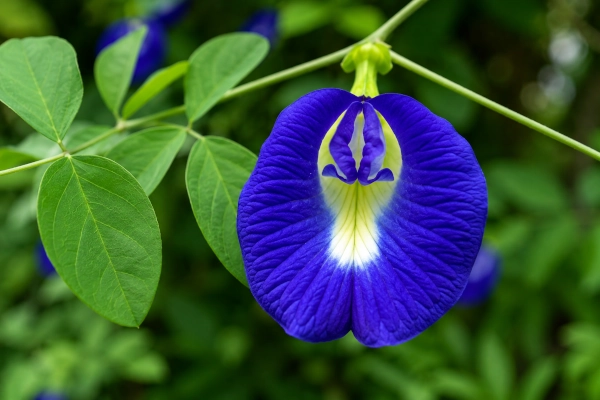
Botanical Name: Clitoria ternatea L.
Sanskrit Name: Aparājitā
Common Names: Butterfly Pea, Blue Pea, Asian Pigeonwings
Family: Fabaceae
Common Indian Names: Aparajita, Gokarna, Shankhapushpam, Kakkattan/Kakkanam
Among India’s medicinal flowering plants, few are as visually striking as Aparajita. Its deep blue flowers are instantly recognisable. White-flowered varieties are also widely cultivated.
Ayurveda values Aparajita for much more than its appearance. The plant has traditionally been associated with Medhya, or support for intellect and mental functions. It is also described in Ayurvedic literature for its Vishaghna, Shothahara and digestive actions.
Modern botanical identification recognises Aparajita as Clitoria ternatea L., a member of the Fabaceae family. The Central Council for Research in Ayurvedic Sciences lists Clitoria ternatea under the Ayurvedic name Aparajita. The National Medicinal Plants Board also includes it among India’s medicinal plants.
Today, the plant has attracted scientific interest because of its pigments, flavonoids, peptides and other phytochemicals. However, many therapeutic claims still rely mainly on traditional practice, laboratory experiments and animal studies. Human clinical evidence remains limited.
Understanding the Name Aparajita
The Sanskrit word Aparājitā carries the sense of being “unconquered” or “undefeated.”
The name is appropriate for a hardy climbing plant that grows readily in India’s tropical climate. Its flowers may appear delicate, but the vine itself can grow vigorously with suitable support.
The plant is also known as Gokarna in parts of India. The flower’s distinctive shape has contributed to several regional names.
In Kerala, Clitoria ternatea is commonly called Shankhapushpam. This can sometimes create confusion with the Ayurvedic drug Shankhapushpi.
The National Medicinal Plants Board has documented regional differences in plants identified as Shankhapushpi. Clitoria ternatea is used as a source in some regions, while Evolvulus alsinoides and Convolvulus species are used elsewhere.
For medicinal use, correct botanical identification therefore remains important.
Botanical Description
Aparajita is a slender climbing or twining herb belonging to the pea family.
Its leaves are compound and usually carry several oval leaflets. The flowers occur individually and have the characteristic appearance of a large pea flower. Blue is the best-known colour, although white varieties are also common.
After flowering, the plant develops elongated pods containing several seeds.
CCRAS medicinal gardens identify Clitoria ternatea as Aparajita and place it within the Fabaceae family. Roots and seeds are among the traditionally used medicinal parts recorded in CCRAS material.
Flowers have meanwhile become especially popular as herbal infusions and natural food colourants.
Ayurvedic Profile of Aparajita
Traditional descriptions vary slightly between texts and regional traditions. A commonly cited Ayurvedic profile is:
| Ayurvedic Property | Aparajita |
|---|---|
| Rasa — Taste | Katu, Tikta, Kashaya — pungent, bitter and astringent |
| Guna — Qualities | Laghu, Ruksha — light and dry |
| Virya — Potency | Sheeta — cooling |
| Vipaka — Post-digestive effect | Katu — pungent |
| Dosha action | Traditionally described as balancing, particularly where Kapha and Pitta are involved |
| Important Karma | Medhya, Vishaghna, Shothahara and Krimighna |
Ayurvedic institutional sources commonly describe Aparajita as having Laghu and Ruksha qualities, Sheeta Virya and Katu Vipaka.
These characteristics help explain many of its traditional applications.
Aparajita as a Medhya Herb
One of Aparajita’s most interesting traditional roles is its association with Medhya activity.
In Ayurveda, Medhya substances are linked with functions such as memory, learning, concentration and intellect. Traditional preparations containing Clitoria ternatea have consequently been studied for their possible effects on the nervous system.
Animal research has reported improvements in learning and memory-related measures after administration of Clitoria ternatea root extracts. Other experimental work has examined possible neuroprotective mechanisms.
These findings are promising, but they should not be interpreted as proof that Aparajita treats human dementia or neurological disease.
Clinical evidence is still far smaller than the preclinical evidence.
Traditional Support for Memory and Concentration
Ayurvedic practitioners have traditionally used Aparajita in preparations intended to support mental clarity.
Its Medhya reputation has made the plant particularly interesting in modern research into cognition.
Studies in animal models suggest that extracts of the root may influence memory, cholinergic activity and oxidative stress within nervous tissue.
This provides a scientific basis for further investigation.
It does not, however, justify replacing established treatment for memory disorders with the herb.
A Herb Associated With Calmness
Traditional Ayurvedic use also connects Aparajita with the mind and nervous system.
Modern laboratory and animal studies have investigated possible anxiolytic, stress-modulating and neuroprotective effects. Research in these areas remains preliminary.
The important point is that Ayurveda’s description of Aparajita as a mind-supporting herb has generated genuine scientific interest.
More controlled human studies are needed before firm conclusions can be drawn.
Vishaghna — The Traditional Concept of Countering Harmful Substances
Another important Ayurvedic description of Aparajita is Vishaghna.
The term is often translated simply as “antitoxic.” Its classical meaning is broader and belongs to the Ayurvedic understanding of Visha and its effects on the body.
A review of Aparajita across Ayurvedic Nighantus notes its repeated association with Vishaghna activity and cooling properties.
This traditional classification should not be confused with modern emergency treatment for poisoning.
Aparajita must never be used as a substitute for urgent medical care, antivenom or established treatment after poisoning, snakebite or toxic exposure.
Shothahara — Traditional Use in Swelling and Inflammatory States
Aparajita is also traditionally described as Shothahara, a term associated with reducing Shotha or swelling.
Modern laboratory research has explored anti-inflammatory activity in different extracts of Clitoria ternatea. Reviews of the plant describe flavonoids, anthocyanins and other phytochemicals that may contribute to biological activity.
Most of this evidence remains preclinical.
It is therefore more accurate to describe Aparajita as a plant with investigated anti-inflammatory potential rather than as a proven treatment for inflammatory disease.
Aparajita and Digestion
Its Tikta, Katu and Kashaya characteristics help explain Aparajita’s traditional association with digestion.
Ayurvedic descriptions include Deepana and Pachana actions. These terms refer to supporting digestive activity and the processing of poorly digested material.
Its Laghu and Ruksha qualities also make the plant traditionally relevant where excessive heaviness and Kapha are considered prominent.
This use belongs to the Ayurvedic framework and should not automatically be equated with treatment for ulcers, inflammatory bowel disease or other diagnosed digestive conditions.
Krimighna — Traditional Use Against Krimi
Aparajita has traditionally been classified as Krimighna.
Krimi in Ayurveda has a wider meaning than the modern term “intestinal worms.” However, the concept includes organisms and pathological factors that may disturb normal body functions.
Laboratory investigations have reported antimicrobial and related biological activities from different Clitoria ternatea extracts.
Such laboratory findings do not establish the herb as a replacement for clinically proven anti-parasitic or antimicrobial medicines.
The Brilliant Blue Pigments of Aparajita
The spectacular colour of blue Aparajita flowers is produced largely by specialised anthocyanin pigments.
Researchers often refer to the characteristic polyacylated anthocyanins of butterfly pea as ternatins. The flowers also contain flavonols and other phenolic compounds.
These pigments have attracted major interest from the food industry.
Unlike many artificial colourants, butterfly pea provides an intense natural blue colour.
Its colour also changes according to acidity.
Adding an acidic ingredient such as lemon can shift a blue infusion toward purple or pink. This occurs because anthocyanin pigments respond to changes in pH.
Antioxidant Potential
The flower’s anthocyanins and other phenolic compounds have demonstrated antioxidant activity in laboratory studies.
A number of studies have measured the ability of Clitoria ternatea extracts to interact with oxidative processes.
Antioxidant activity in a laboratory test, however, does not automatically translate into prevention or treatment of disease in humans.
The human body has complex antioxidant systems.
Aparajita should therefore be viewed as a phytochemical-rich plant rather than marketed as a cure for diseases supposedly caused by “toxins” or free radicals.
Aparajita and Blood Sugar: What Research Actually Shows
Butterfly pea has also attracted research into metabolic health.
One small randomised crossover study involved 15 healthy men. Researchers studied a butterfly pea flower beverage consumed with sucrose.
The study found changes in post-meal glucose, insulin and antioxidant measurements.
Later research has continued to investigate these effects.
This evidence is interesting but limited.
It does not establish butterfly pea tea as a treatment for diabetes.
People taking insulin or glucose-lowering medicines should not use concentrated herbal preparations to alter blood sugar without professional guidance.
Cyclotides — An Unusual Group of Plant Peptides
One scientifically fascinating feature of Clitoria ternatea is its production of cyclotides.
Cyclotides are small cyclic peptides with an unusually stable molecular structure. Researchers have studied them because of their biological activity and resistance to breakdown.
In the plant itself, some cyclotides appear to contribute to defence against insects.
Their discovery has made Clitoria ternatea interesting not only to herbal medicine researchers but also to scientists studying peptide chemistry and biotechnology.
Blue Aparajita and White Aparajita
Two forms are commonly encountered in India:
Neela Aparajita bears blue flowers.
Shweta Aparajita bears white flowers.
Both belong to Clitoria ternatea, although traditional texts and regional practices may distinguish their uses in particular preparations.
The National Medicinal Plants Board recognises both blue and white varieties of Clitoria ternatea within medicinal-plant conservation programmes.
Medicinal use should therefore rely on the specific plant part and preparation prescribed rather than assuming every Aparajita preparation is interchangeable.
Parts Used in Ayurveda
Different traditions use different parts of the plant.
These include:
- Root
- Seeds
- Leaves
- Flowers
- Whole plant in selected preparations
Roots occupy an important place in classical medicinal use. CCRAS medicinal-garden documentation specifically records the root and seeds among the useful parts.
The flowers have become especially prominent in modern herbal beverages and food products.
This distinction matters because the chemistry of a flower infusion is not identical to that of a root extract.
Butterfly Pea Tea and Ayurvedic Medicine Are Not the Same Thing
The modern popularity of blue butterfly pea tea can sometimes blur the distinction between food use and Ayurvedic medicine.
A mild flower infusion is very different from a concentrated extract.
It is also different from root powder, seed preparations, decoctions or classical formulations.
Ayurvedic treatment considers factors such as Prakriti, Vikriti, Agni, age, strength, disease state, season and accompanying herbs.
Therefore, drinking blue tea and undergoing treatment with Aparajita under an Ayurvedic physician should not be regarded as equivalent practices.
Modern Research: Promising, but Still Developing
Modern research on Clitoria ternatea has investigated several areas.
These include antioxidant effects, inflammation, cognition, glucose metabolism, antimicrobial activity and neuroprotective mechanisms.
Much of the evidence comes from:
- laboratory studies;
- isolated phytochemical research;
- animal experiments;
- small human studies;
- food-science investigations.
This is an important distinction.
Traditional experience can guide research, but scientific validation requires well-designed clinical trials.
Aparajita has considerable research potential. It should not be promoted as a proven cure for serious diseases before that evidence exists.
Aparajita in the Garden
Aparajita also illustrates the close relationship between Ayurveda and India’s household gardens.
The plant is an attractive climber and can grow rapidly when given support. Its flowers provide colour for much of the growing season.
Because it belongs to the legume family, the plant is also interesting from an agricultural perspective. Clitoria ternatea has been cultivated internationally as a forage species and can contribute to soil systems associated with legumes.
A single plant can therefore connect ornamental gardening, traditional medicine, food culture and agricultural science.
An Important Identification Caution
The terms Aparajita, Shankhapushpam and Shankhapushpi should not automatically be treated as interchangeable.
Clitoria ternatea is firmly recognised as Aparajita.
However, India’s regional medicinal traditions use several botanical species under names related to Shankhapushpi. NMPB-supported work has specifically documented this variation.
Correct botanical identification becomes especially important when roots or concentrated medicinal preparations are being used.
Precautions
Aparajita has a long history of traditional use, and butterfly pea flowers are consumed as food and beverages in parts of Asia.
This does not mean every preparation is suitable for everyone.
Extra caution is advisable for:
- pregnant or breastfeeding women;
- young children;
- people taking medicines for diabetes;
- people taking several prescription medicines;
- individuals with chronic liver or kidney disease;
- anyone considering concentrated extracts;
- people preparing medicinal remedies from the root or seeds.
Experimental studies generally suggest relatively low acute toxicity for flower preparations at tested levels, but available safety information is not sufficient to establish unrestricted medicinal use.
Traditional medicinal doses should therefore be determined by a qualified Ayurvedic physician.
Aparajita — Where Tradition Meets a Remarkable Plant
Aparajita occupies an unusual place within India’s medicinal heritage.
It is beautiful enough to be cultivated simply for its flowers. It is useful enough to have remained part of Ayurvedic practice. Its blue pigments have attracted the food industry, while its peptides and phytochemicals have attracted modern researchers.
Ayurveda remembers the plant especially for its Medhya, Vishaghna and Shothahara traditions.
Modern science is now examining some of the biological mechanisms that may lie behind these observations.
Yet Aparajita also offers an important lesson in how traditional medicine should be approached.
Respecting Ayurveda does not require exaggerating scientific evidence. Likewise, recognising the limitations of present clinical research does not erase centuries of traditional knowledge.
The more valuable approach is to study both carefully.
In Aparajita, India’s ancient medicinal tradition has handed modern science a striking blue flower with an equally fascinating chemistry.
The “undefeated” flower still has many secrets left to reveal.
References
- Central Council for Research in Ayurvedic Sciences, Ministry of Ayush — medicinal-garden records identifying Aparajita as Clitoria ternatea.
- National Medicinal Plants Board, Ministry of Ayush — medicinal plant listings and research concerning Clitoria ternatea.
- Mukherjee et al., Journal of Ethnopharmacology — review of Clitoria ternatea from traditional Ayurvedic use to scientific assessment.
- Jeyaraj et al. — review of butterfly pea flower extraction, phytochemistry and biological properties.
- Oguis et al. — research review of Clitoria ternatea as a cyclotide-bearing plant.
- Chusak et al. — randomised crossover study examining butterfly pea flower beverage, postprandial glycaemia and antioxidant capacity.
Health Disclaimer
This article is intended for educational and informational purposes only. It is not medical advice and should not be used to diagnose, treat, cure or prevent any disease. Ayurvedic herbs can have significant physiological effects and may interact with medicines or existing health conditions. Pregnant or breastfeeding women, children, people with chronic illnesses and those taking prescription medicines should consult a qualified physician or registered Ayurvedic practitioner before using Aparajita medicinally. Do not use Aparajita as a substitute for emergency treatment, antivenom, diabetes medication, psychiatric treatment or other prescribed medical care.
You may also like
-
Ayurveda on Eating at the Right Time: How Food Timing Supports Balance and Health
-
Ayurveda and Late-Night Living: What Irregular Sleep Does to the Body
-
India’s Ayush Services Economy Reaches $36.92 Billion, RIS Study Projects Strong Growth to 2047
-
Daytime Sleep in Ayurveda: When It Helps and When It Harms
-
Ayurveda and Sleep: Understanding Nidra as a Pillar of Health
