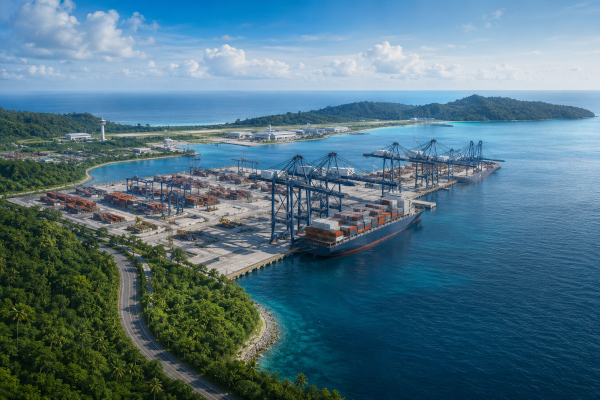
India is pushing ahead with one of the most ambitious maritime infrastructure projects in its history — transforming the Andaman and Nicobar Islands, especially Great Nicobar Island, into a major international transshipment and logistics hub in the Indo-Pacific. At the centre of this strategy is the proposed International Container Transshipment Port (ICTP) at Galathea Bay, a project that the Government of India believes could fundamentally reshape India’s maritime trade position and reduce dependence on foreign ports such as Singapore, Colombo, and Port Klang.
The broader vision is part of the “Holistic Development of Great Nicobar Island” initiative conceptualised through NITI Aayog and being implemented through the Andaman and Nicobar Islands Integrated Development Corporation (ANIIDC). The mega-project includes not just a deep-water transshipment port, but also a dual-use international airport, township infrastructure, power generation systems, tourism infrastructure, and strategic military-support facilities. Estimates place the overall project value between ₹72,000 crore and ₹90,000 crore depending on different phases and revised projections.
The strategic importance of the Andaman and Nicobar Islands comes from geography itself. The islands sit close to the Malacca Strait — one of the busiest maritime chokepoints in the world through which a major portion of global trade and energy shipments move. Great Nicobar lies near the East-West international shipping corridor linking Asia, Europe, and the Middle East. Officials believe this gives India an opportunity to become a serious transshipment competitor in global shipping logistics.
Currently, a large share of India’s container cargo is transshipped through foreign ports, especially Colombo, Singapore, and Port Klang. This results in additional shipping costs, longer turnaround times, and strategic dependence on overseas infrastructure. The proposed Galathea Bay transshipment terminal aims to capture a substantial portion of this traffic by offering a deep-draft automated port capable of handling some of the world’s largest container vessels directly.
The Government of India has already moved to formally designate Galathea Bay as India’s 13th major port. Plans indicate that the port could eventually handle over 14 million TEUs (twenty-foot equivalent units), placing it among the major container hubs of Asia if fully realised. Phase-I alone is expected to have a handling capacity of around 5.6 million TEUs, with expansion planned in later phases.
The project is also deeply tied to India’s maritime-security calculations in the Indo-Pacific. Analysts increasingly describe Great Nicobar as a potential “unsinkable aircraft carrier” for India because of its proximity to crucial sea lanes and the growing strategic competition in the Indian Ocean region. The Andaman and Nicobar Command — India’s only integrated tri-services command — already gives the islands major military significance. A large logistics and transshipment ecosystem there could substantially enhance India’s naval reach, surveillance capability, maritime domain awareness, and ability to monitor movements around the Malacca Strait.
The development push also aligns with broader national initiatives such as Sagarmala, port-led industrialisation, maritime connectivity expansion, and India’s Indo-Pacific strategy. The government has repeatedly argued that India cannot become a major global trading power while remaining dependent on foreign transshipment infrastructure for its own cargo movement.
According to project plans, the development will not be limited to cargo operations alone. The proposed international airport at Great Nicobar is expected to support both civilian and strategic operations. New township infrastructure, tourism zones, industrial corridors, renewable energy systems, and logistics parks are also envisioned. Long-term planning documents reportedly project a dramatic population and economic expansion in the region over the coming decades.
The project, however, has also triggered intense debate and controversy. Environmental groups, scientists, and tribal-rights activists have raised serious concerns regarding ecological damage, deforestation, seismic vulnerability, and the impact on indigenous communities such as the Shompen and Nicobarese tribes. Great Nicobar is one of India’s most ecologically sensitive zones, home to dense tropical forests, coral ecosystems, mangroves, and endangered species including the giant leatherback turtle. Galathea Bay itself is considered an important nesting site for leatherback turtles in the Indian Ocean region.
Critics have pointed to the large-scale forest diversion involved in the project, warning that the ecological costs may be irreversible. Concerns have also been raised regarding the island’s vulnerability to earthquakes and tsunamis, especially after the devastating 2004 Indian Ocean tsunami which heavily impacted the Nicobar region.
The Government of India, meanwhile, has defended the project by arguing that strategic infrastructure and environmental safeguards can coexist. Officials maintain that adequate mitigation measures, ecological safeguards, and tribal-protection mechanisms are being incorporated into the project framework. The National Green Tribunal (NGT) has also allowed the project to proceed while imposing several environmental conditions and safeguards.
From a geopolitical perspective, many strategic analysts see the Great Nicobar project as part of India’s attempt to strengthen its position amid intensifying Indo-Pacific competition. With China rapidly expanding its maritime footprint across the Indian Ocean through ports, logistics networks, and dual-use infrastructure under the Belt and Road Initiative, India increasingly views the Andaman and Nicobar Islands as critical to maintaining strategic balance in the eastern Indian Ocean.
If successfully executed, the Andaman and Nicobar transshipment hub could emerge as one of India’s most consequential maritime infrastructure achievements since independence. It has the potential to reshape trade routes, strengthen India’s naval posture, create a new logistics ecosystem in the Bay of Bengal, and position India as a major maritime power in the Indo-Pacific century. At the same time, the project will remain under global scrutiny because it sits at the intersection of economic ambition, strategic competition, environmental conservation, and indigenous rights — making Great Nicobar one of the most debated infrastructure projects in modern India.
Source:
https://www.pib.gov.in/PressReleaseDetail.aspx?PRID=2257174&lang=1®=3
https://sagarmala.gov.in/
https://en.portnews.ru/news/391058/
https://www.drishtiias.com/daily-updates/daily-news-analysis/13th-major-port-of-galathea-bay
https://www.drishtiias.com/daily-updates/daily-news-analysis/ngt-approved-great-nicobar-project
https://raksha-anirveda.com/great-nicobar-project-indias-strategic-leverage-in-indo-pacific/
https://earth.org/the-great-nicobar-gamble-exploring-the-hidden-toll-of-the-10-billion-development-project/
https://www.visionias.in/blog/current-affairs/great-nicobar-project-strategic-necessity-or-ecological-threat
https://en.wikipedia.org/wiki/Great_Nicobar_Island_Development_Project
https://www.lemonde.fr/en/environment/article/2024/12/27/in-india-the-pristine-island-of-great-nicobar-threatened-by-a-mega-development-project_6736474_114.html
You may also like
-
CG Power Strengthens India’s Semiconductor Manufacturing Ecosystem with ₹7,600 Crore Sanand Investment
-
Kargil Gets Its First Heat-Pump Dehydration and Cold Storage Facility to Boost Ladakh’s Agricultural Economy
-
India Explores 3,000 km Power Corridor to Supply 2,000 MW of Clean Electricity to Singapore
-
ONGC Explores Three Advanced Oilfield Technologies to Improve Mumbai High Well Operations
-
Kabra Extrusiontechnik’s GEON Commissions 20 MWh Battery Storage Project in Rajasthan
