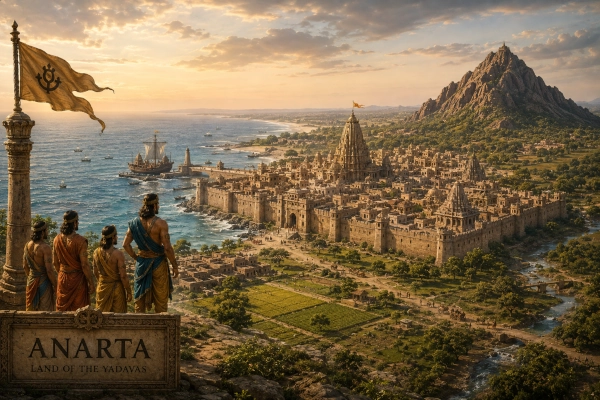
The Mahabharata does not leave Anarta as an obscure name in a geographical catalogue. It repeatedly identifies the land of the Anartas as a living political region inhabited by the Vrishni-Dasarha peoples. Draupadi’s sons travel there to study warfare, Abhimanyu resides among the Yadavas there, warriors from Anarta accompany Krishna and Arjuna, and both Satyaki and Kritavarma emerge from this western political world.
At the same time, Anarta should not simply be equated with the whole of modern Gujarat. Ancient geographical names overlapped and changed over time. The Mahabharata also recognises Saurashtra separately, suggesting that Anarta represented a particular western region rather than a universal name for every part of Gujarat.
Anarta → northern and central Gujarat → wider Yadava political sphere extending toward Dvaraka and western Gujarat → India
Anarta at a Glance
| Feature | Description |
|---|---|
| Ancient Name | Anarta / Ānarta |
| Modern Identification | Northern and central Gujarat, with broader links to western Gujarat |
| Major Epic Association | Vrishni, Andhaka, Bhoja, Dasarha and other Yadava clans |
| Most Famous Figure | Krishna |
| Important Warriors | Satyaki and Kritavarma |
| Major Yadava Centre | Dvaraka |
| Important Mountain | Raivataka |
| Later Ancient Centre | Anartapura, identified with Vadnagar |
| Mahabharata References | Vana Parva, Virata Parva, Bhishma Parva, Karna Parva, Shalya Parva |
| Political Character | Yadava-dominated western region |
| Modern State | Gujarat |
| Country Today | India |
The Land of Anarta
Anarta belonged to the western geographical world of ancient Bharat. Modern reconstructions generally place its core in Gujarat, especially the northern part of the state, while later literary traditions sometimes extend the term into adjoining parts of western India. Sanskrit geographical traditions identify Anarta with a western country, and later sources connect it with northern Gujarat and portions of the Malwa-facing region.
North Gujarat → central Gujarat → routes toward Saurashtra and Dvaraka → western coast
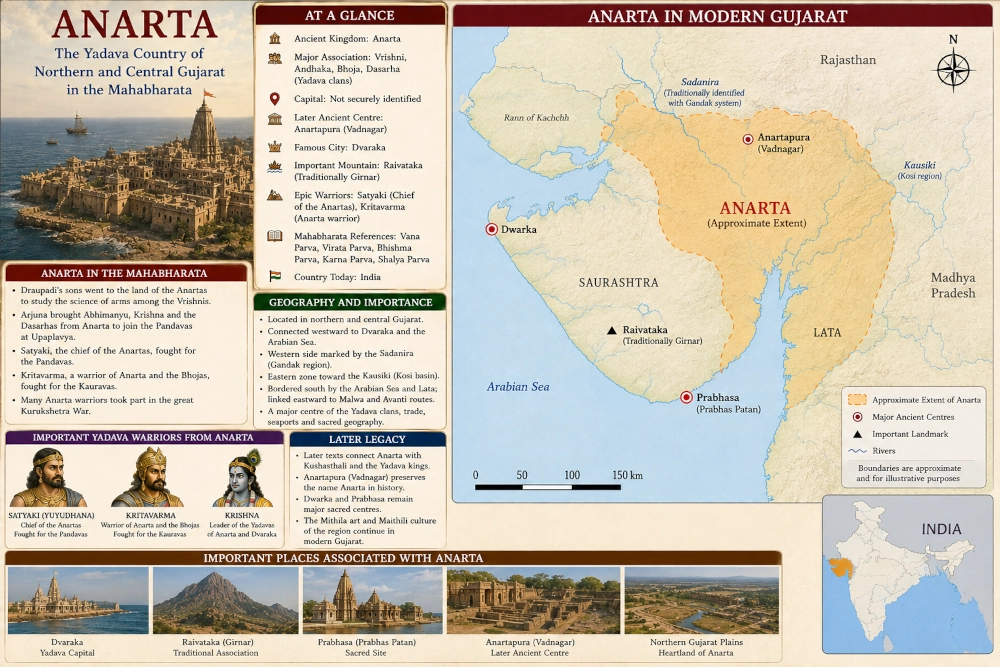
This should not be interpreted as a fixed modern-style boundary. Political authority in the Mahabharata world followed settlements, clans, river valleys, pasture lands, trade routes and fortified centres rather than surveyed administrative lines.
Anarta was particularly important because it stood between inland western India and the Arabian Sea.
Anarta in the Mahabharata’s Geography of Bharatavarsha
The Mahabharata explicitly includes the Anartas among the peoples of Bharatavarsha.
In the Bhishma Parva’s great geographical description of the land, Anarta appears among the numerous peoples and regions known to the epic tradition. This alone establishes the name as part of the Mahabharata’s political geography rather than a designation invented only by later texts.
Other passages provide much more detail.
The Anartas are closely associated with the Yadava clans whose political centres lay in western India. This connection becomes particularly clear during the exile of the Pandavas and in the preparations for the Kurukshetra War.
Draupadi’s Sons Travel to Anarta
One of the clearest descriptions of Anarta occurs during the Pandavas’ forest exile.
Krishna tells Draupadi that her sons are safe and devoted to learning the science of arms. Although they could have remained in Panchala with their grandfather Drupada and their maternal relatives, the young princes instead travelled to the land of the Anartas, where they took great pleasure in military training among the Vrishnis.
This passage is exceptionally important for understanding Anarta.
It demonstrates that Anarta possessed established Yadava settlements and martial institutions capable of training princes of the Pandava family. The region was therefore not simply a vague tribal territory. It formed part of a sophisticated political and military network.
Krishna also speaks of powerful western clans prepared to support the Pandavas, including groups identified with the Satvatas, Dasharhas, Kukuras, Andhakas, Bhojas and Vrishnis.
Anarta thus emerges as one of the principal western bases of Yadava power.
Abhimanyu and the Anarta Connection
Arjuna’s son Abhimanyu also belonged closely to this world.
His mother Subhadra was Krishna’s sister, making Abhimanyu part of both the Kuru-Pandava and Vrishni-Yadava family networks. During the years when the Pandavas lived in exile, their children remained connected with the Yadavas of Anarta.
When the Pandavas finally completed their thirteenth year and assembled at Upaplavya, Arjuna brought Abhimanyu, Krishna and numerous members of the Dasarha race from the Anarta country to join them.
This is one of the strongest political references to Anarta in the Mahabharata.
It shows that the region could supply warriors and allied clans for the approaching conflict at Kurukshetra.
The Yadava Political World
Anarta’s identity in the Mahabharata is inseparable from the complex Yadava confederacy.
The epic frequently speaks of the Vrishnis, Andhakas, Bhojas, Satvatas, Kukuras and Dasarhas. These were not always represented as a single tightly centralised monarchy. Different chiefs possessed their own followers and military forces while remaining connected by ancestry, marriage and political alliances.
Krishna stood at the centre of this network, but powerful figures such as Balarama, Satyaki, Kritavarma, Akrura and Ugrasena also possessed substantial authority.
This explains one of the most striking features of the Kurukshetra War: Yadava warriors did not all fight on the same side.
Anarta’s political world divided along personal and clan loyalties.
Satyaki: The Chief of the Anartas
Among the greatest warriors associated directly with Anarta was Satyaki, also known as Yuyudhana.
Satyaki was one of Krishna’s closest allies and a devoted supporter of the Pandavas. The Shalya Parva explicitly describes him as the chief of the Anartas while recounting the fighting during the closing phase of the Kurukshetra War.
This designation is extremely valuable geographically.
It indicates that Anarta was not merely the territory in which certain Yadavas happened to live. The name could represent a recognised political community with leading warriors identified as its chiefs.
Satyaki fought throughout the war on the Pandava side and became one of their most formidable commanders.
Kritavarma: Another Warrior of Anarta
The political complexity of Anarta appears even more clearly in Kritavarma.
While Satyaki supported the Pandavas, Kritavarma joined Duryodhana and fought for the Kauravas.
The Karna Parva explicitly describes Kritavarma as a dweller of the Anarta country, the son of Hridika, a great chariot warrior, a leading Satvata and chief among the Bhojas.
The fact that two celebrated Yadava warriors from the same broad western political world fought on opposite sides illustrates the decentralised character of Yadava politics.
Krishna himself refused to wield weapons at Kurukshetra. His personal support went to Arjuna, while the military force offered in the famous choice went to Duryodhana. Balarama ultimately remained outside the war.
Anarta therefore occupied an unusual position: its warriors influenced both sides of the greatest conflict in the Mahabharata.
Anarta Warriors at Kurukshetra
The epic records Anarta warriors participating directly in the fighting.
During the war, warriors identified with Anarta appear within the Pandava-aligned formations associated with Satyaki, while Kritavarma commands troops on the Kaurava side. The Mahabharata even records large numbers of Anarta warriors being killed during the conflict.
These references establish Anarta as a significant military region.
Its importance did not depend solely on Krishna’s presence. The country supplied trained warriors, commanders and entire bodies of troops.
This fits the earlier Vana Parva description of Draupadi’s sons travelling to Anarta specifically to advance their knowledge of weapons.
Dvaraka and the Western Yadava Sphere
No discussion of Anarta can avoid Dvaraka, the great coastal city associated with Krishna and the Yadavas.
The Mahabharata places the Vrishni-Dasarha world of Anarta in close relationship with Dvaraka. Later Sanskrit and Puranic traditions make the association even more explicit and connect Anarta’s early royal tradition with Kushasthali, the earlier name traditionally associated with Dvaraka.
Modern Dwarka lies on Gujarat’s Arabian Sea coast and continues to preserve one of India’s strongest Krishna traditions. Government tourism sources identify the city with the sacred Dvaraka tradition, while archaeological investigations by the Archaeological Survey of India have explored both onshore and offshore remains around modern Dwarka.
The archaeological evidence should be treated separately from the literary narrative. Underwater discoveries establish ancient maritime activity and settlement around the coast, but they do not by themselves prove every chronological detail described in the epic.
For our geographical reconstruction, Dvaraka should be shown as the principal western Yadava centre associated with the broader Anarta political world.
Why Dvaraka Does Not Define the Entire Anarta Boundary
Placing Dvaraka within the Anarta-Yadava world does not mean that all of Saurashtra should automatically be labelled Anarta.
The Mahabharata itself mentions Saurashtra as a geographical name. In the Virata Parva, Arjuna lists Saurashtra among the countries surrounding the broader Kuru-centred political world, while elsewhere the epic specifically speaks of Dasarhas coming from the Anarta country.
The survival of both names suggests that the regions could be distinguished even if their political and cultural spheres overlapped.
This is particularly important for our map series.
A map should therefore avoid shading the entire Gujarat peninsula as unquestionably Anarta. A better reconstruction would show the main Anarta zone in northern and central Gujarat, with its Yadava connections extending westward toward Dvaraka.
Raivataka: The Mountain of the Yadavas
Another major landmark in the western Mahabharata landscape is Mount Raivataka.
During Arjuna’s travels, Krishna takes him toward Raivataka. The epic later describes a great festival being celebrated at the mountain, attended by the Vrishnis and other Yadavas. It is in this setting that Arjuna sees Subhadra, beginning the sequence that leads to their marriage.
Subhadra herself later worships at Raivataka before departing, reinforcing the mountain’s religious importance within the Yadava landscape.
Later tradition has commonly associated Raivataka with the Girnar region of Gujarat, although this identification should be presented as traditional rather than absolutely certain.
Raivataka adds another geographical anchor linking the Mahabharata’s Yadavas with western Gujarat.
The Festival at Raivataka
The Raivataka episode also reveals something about the cultural life of the region.
The Mahabharata does not portray the western Yadava country only through warfare. The mountain becomes the setting for a great gathering involving music, celebration, pilgrimage and members of the Vrishni clans.
The scene illustrates the relationship between sacred geography and political community.
Mountains, rivers and pilgrimage sites often acted as shared centres at which dispersed clans could gather. Raivataka appears to have fulfilled such a role for the Yadavas.
Its prominence also helps place the Anarta-Dvaraka world within the varied geography of Gujarat, extending from inland plains toward mountainous Saurashtra and the Arabian Sea.
The Puranic Origin of the Name Anarta
Later Puranic traditions preserve a genealogy explaining the name of the country.
They describe Anarta as a son of Sharyati, with the country subsequently bearing his name. His descendants are associated with Revata or Raivata, and Kushasthali becomes an important royal centre in the tradition.
This genealogical account belongs to the Puranic layer of tradition and should not be treated as modern historical documentation.
It is nevertheless valuable because it shows that ancient Sanskrit literature remembered Anarta as an established western territorial identity with its own royal traditions.
The recurring names Anarta, Raivata and Kushasthali also connect several strands of western Indian sacred geography.
Anartapura and Modern Vadnagar
One of the most important later historical survivals of the name appears in Anartapura.
The Archaeological Survey of India identifies modern Vadnagar in northern Gujarat as an ancient settlement known by several historical names, including Anartapura and Anandapura. Archaeological work there has revealed a long sequence of occupation extending across more than two millennia.
This evidence is particularly important for establishing the long historical association between the name Anarta and northern Gujarat.
However, Anartapura should not automatically be labelled as the Mahabharata capital of Anarta.
The Mahabharata does not securely identify Vadnagar as the political capital of Krishna’s Anarta. The name belongs more clearly to later historical geography.
For the infographic, Vadnagar can therefore be marked as:
Anartapura — later ancient centre preserving the Anarta name
rather than:
Capital of Mahabharata Anarta
That distinction keeps the map historically responsible.
Anarta and the Trade Geography of Gujarat
Anarta’s location placed it within one of the most naturally connected landscapes of western India.
Northern Gujarat opened toward Rajasthan and the desert routes of the northwest. Central Gujarat provided access toward the Narmada valley and Malwa. Western routes reached Saurashtra, Dvaraka and the Arabian Sea.
Such geography would have connected inland agricultural and pastoral communities with coastal settlements.
The later historical prosperity of Gujarat’s inland and maritime centres demonstrates the advantages of this location, although those later developments should not simply be projected unchanged into the Mahabharata period.
What the epic does show clearly is that Anarta belonged to a politically connected western region capable of supporting powerful clans, armies and long-distance movement.
Anarta Between Rajasthan, Malwa and Saurashtra
On a modern geographical map, Anarta can be understood as occupying a strategic zone between several larger landscapes.
To the north and northeast lay the approaches toward Rajasthan.
To the east were routes toward Malwa and Avanti.
To the south lay the territories that eventually became associated with Lata and other regions of Gujarat.
To the west stretched Saurashtra and the maritime world of Dvaraka.
This helps explain why Anarta could participate so actively in the politics of northern India despite being located far from Hastinapura.
The Yadavas were not isolated on India’s western edge. Through marriage, military alliances and travel, they were deeply connected with the Kurus, Pandavas, Panchalas and Matsyas.
Arjuna, Subhadra and the Western Connection
The marriage of Arjuna and Subhadra created one of the strongest dynastic connections between the Pandavas and the western Yadavas.
Arjuna travelled through the region with Krishna and visited Raivataka before eventually taking Subhadra as his wife.
Their son Abhimanyu would become one of the greatest young heroes of the Kurukshetra War.
Through this marriage, the political world centred around Anarta and Dvaraka became directly connected with the future royal succession of the Pandavas. Abhimanyu’s son Parikshit ultimately continued the Kuru line after the devastation of the war.
The Anarta connection therefore influenced the future of the Kuru dynasty itself.
From Mathura to the Western Yadava World
The Yadavas were also closely associated with Mathura and Surasena.
Krishna’s early life belongs to the Mathura-Braj tradition, while his later political career is strongly associated with the western coastal centre of Dvaraka.
This produced a broad Yadava corridor stretching conceptually from Surasena in western Uttar Pradesh toward the Anarta-Dvaraka region of Gujarat.
The Mahabharata frequently treats the Yadavas as a network of related clans rather than as subjects of a single simple territorial kingdom.
This is why distinguishing Surasena, Anarta, Saurashtra and Dvaraka is useful in a geographical series even though the same Yadava families appear across these regions.
Anarta and Prabhasa
The western Yadava story ultimately ends at Prabhasa, on the coast of Gujarat.
The Mausala Parva describes the catastrophic destruction of the Vrishni and Andhaka clans after the Kurukshetra War. The Yadavas gather at the sacred coastal region of Prabhasa, where internal quarrels escalate into violence and destroy much of the clan.
Modern Prabhas Patan near Somnath preserves the ancient geographical name and remains one of Gujarat’s major sacred landscapes.
The episode belongs to the final phase of Krishna’s earthly story and transforms western Gujarat from the centre of Yadava power into the setting of its tragic dissolution.
For a geographical infographic on Anarta, Prabhasa can therefore appear as an important later Yadava-associated sacred site, though it should not be presented as the political centre of Anarta.
Anarta on the Modern Map
Anarta can be represented approximately as:
Anarta → northern and central Gujarat → western Yadava connections toward Dvaraka → India
Modern Geographical Correspondence
| Ancient Geography | Modern Approximation |
|---|---|
| Anarta | Northern and central Gujarat |
| Wider Yadava Sphere | Gujarat extending toward the western coast |
| Dvaraka | Dwarka, Devbhoomi Dwarka district |
| Raivataka | Traditionally associated with the Girnar region |
| Anartapura | Vadnagar, northern Gujarat — later historical identification |
| Prabhasa | Prabhas Patan, Gir Somnath |
| Saurashtra | Kathiawar peninsula; related but separately named region |
| Eastern Connection | Malwa and Avanti routes |
| Northern Connection | Rajasthan |
| Modern State | Gujarat |
| Country | India |
The shaded map should concentrate the approximate Anarta core across northern and central Gujarat.
Dvaraka should be marked separately on the western coast as the principal Yadava centre associated with the Anarta political world.
Raivataka can be placed in the Girnar region with the wording “traditional identification”, while Vadnagar should be labelled “Anartapura — later ancient centre.”
This approach communicates both the literary evidence and the uncertainty surrounding ancient territorial boundaries.
A Crucial Geographical Distinction
Anarta is one of those Mahabharata regions where it is important to distinguish between a country, a clan network and a famous city.
The Mahabharata explicitly knows the Anarta country.
It explicitly connects leading Yadava warriors with Anarta. Satyaki is called chief of the Anartas, while Kritavarma is described as a resident of the country.
The same Yadava world is strongly associated with Dvaraka, but Dvaraka itself should be understood primarily as a great city and political centre rather than automatically treated as another name for the entire territory.
Similarly, Saurashtra appears as a separate geographical designation in the epic.
The responsible reconstruction is therefore:
Anarta — regional country
Vrishnis, Andhakas, Bhojas and Dasarhas — major Yadava clans associated with the region
Dvaraka — principal western Yadava city
Saurashtra — neighbouring or overlapping western region with its own geographical identity
This distinction will also make our eventual kingdom maps more accurate.
Anarta’s Place in the Mahabharata
Anarta occupies an unusually important position in the Mahabharata because its influence extends far beyond its geographical size.
It was a western homeland of the Yadava clans.
It provided a safe environment in which Draupadi’s sons could train in warfare.
It sent Dasarha warriors to join the Pandavas at Upaplavya before Kurukshetra.
It produced Satyaki, one of the greatest champions of the Pandava army.
It was also associated with Kritavarma, who fought for the opposing Kaurava side.
Its wider political world contained Dvaraka, the city inseparably associated with Krishna, and Raivataka, where the story of Arjuna and Subhadra developed.
Later archaeology and historical geography preserve the Anarta name at Anartapura, identified with Vadnagar in northern Gujarat.
Anarta therefore forms one of the principal bridges between the political geography of the Mahabharata and the ancient landscape of Gujarat.
Modern state boundaries cannot reproduce its exact extent, but the accumulated evidence points firmly toward northern and central Gujarat, connected westward with the Yadava stronghold of Dvaraka and the wider sacred geography of western Gujarat.
For our reconstruction of ancient Bharat, Anarta should therefore be understood as the western Yadava country of Gujarat — a land of Vrishnis, Bhojas, Andhakas and Dasarhas whose warriors and rulers stood at the very heart of the Mahabharata story.
Sources
Mahabharata — Vana Parva, Section 182
Krishna tells Draupadi that her sons have safely travelled to the land of the Anartas, where they study the science of arms among the Vrishnis.
Mahabharata — Virata Parva
After the Pandavas complete their exile, Arjuna brings Abhimanyu, Krishna and members of the Dasarha race from the Anarta country to Upaplavya. The same Parva also separately names Saurashtra, supporting a distinction between the two geographical terms.
Mahabharata — Bhishma Parva
Anarta appears among the peoples and countries listed in the geographical description of Bharatavarsha.
Mahabharata — Karna Parva
Kritavarma is explicitly described as a dweller of the Anarta country and a leading Satvata and Bhoja warrior.
Mahabharata — Shalya Parva
Satyaki is explicitly described as the chief of the Anartas.
Mahabharata — Adi Parva, Subhadra-harana narrative
Raivataka appears as an important Yadava gathering place in the story of Arjuna and Subhadra.
Archaeological Survey of India — Vadnagar
ASI records Vadnagar as an ancient settlement known historically by names including Anartapura and Anandapura, preserving the regional Anarta name in northern Gujarat.
Archaeological Survey of India — Dwarka Underwater Archaeology
ASI has conducted onshore and offshore archaeological exploration around modern Dwarka, including underwater excavation aimed at investigating the antiquity of the coastal settlement.
Geographical Identification
Anarta — Northern and central Gujarat, with broader Yadava connections extending toward Dvaraka and western Gujarat — India
You may also like
-
Sindhu: The Indus Kingdom of Jayadratha in the Mahabharata
-
Kuninda or Kulinda: The Himalayan Realm of the Mahabharata in Uttarakhand and Himachal Pradesh
-
Durga versus Mahishasura: Weapons, Battlefield Tactics and the Triumph of Shakti
-
Kuluta: The Kullu Valley Kingdom of the Mahabharata
-
Trigarta: The Kangra–Jalandhar Kingdom of the Mahabharata
