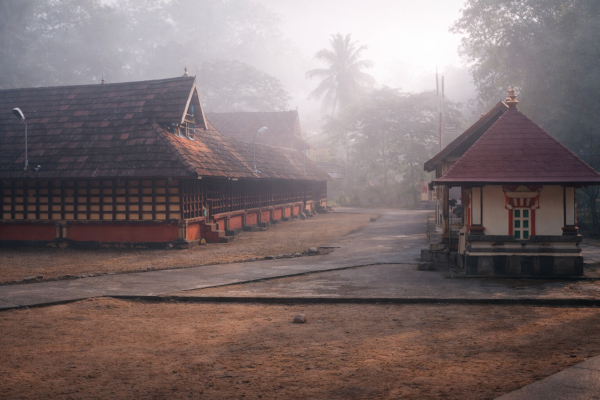
In the older sacred geography of Kerala, there are temples that sit in forests, temples that rise beside rivers, and temples that somehow keep their antiquity intact even after a city grows around them. Anandavalleeswaram Sri Mahadeva Temple belongs to that last category. Located in the heart of Kollam city, it is officially described by Kerala Tourism as one of the ancient Shiva temples of Kerala, traditionally associated with Sage Parashurama and counted among the 108 famous Shiva temples of Kerala. The main deities are Lord Shiva and Goddess Anandavally.
What gives the temple much of its charm is the way history and legend overlap without fully merging. The shrine is believed to be more than 1,400 years old, but also admits that there is no definitive historical record establishing its exact antiquity. The same note preserves multiple local traditions about its origin: one says the temple may have been built by Sri Lankan merchants who traded with ancient Kollam; another attributes it to Navakody Narayana Chettiyar, a wealthy merchant from Thanjavur who settled in Kollam. Later, the temple is said to have come under the rulers of Venad, whose early capital was Kollam. In that narrative, the deity became closely linked with the Venad royal house, the temple was renovated in 1806, and repairs were carried out again in 1823 after damage during the conflict-ridden period of Velu Thampi Dalawa and the British. These accounts should be read as preserved temple tradition rather than fully settled academic history, but they add depth to the shrine’s local memory.
The name of the temple itself carries a devotional softness unusual for a Shiva kshetram of such antiquity. Temple accounts widely describe Shiva here as Ananda Swaroopan, while the Devi is worshipped as Swayamvara Parvathy, also called Anandavally. The pairing is associated with a state of joy or auspicious harmony, and that devotional idea is reflected in the very name Anandavalleeswaram. Local temple descriptions also say that the shrine originally had only Shiva as the presiding deity and that the consecration of Anandavally came later, giving the temple its present dual identity as both a Shiva shrine and a Devi-centered sacred space.
Architecturally, the temple is especially fascinating because it combines the familiar grammar of Kerala temple design with features that devotees regard as highly unusual. Public descriptions of the shrine identify it as belonging to the Kerala Dravidian style, and its sreekovil is widely described as being made of teak wood, with the main sanctum often dated in temple accounts to around 1,200 years old. Even in a state known for wooden temple architecture, that teak sanctum is one of the first things that marks Anandavalleeswaram out as special.
The most distinctive feature of the sanctum is its internal sacred arrangement. The sreekovil is unique because it is the only Hindu shrine in India where the idols of Sree Krishna, Maha Vishnu, Bhoomi Devi, and Lakshmi Devi are consecrated under a single roof. Temple accounts add another rare layer: Shiva is described as west-facing, while Anandavally within the same sanctum is east-facing. That arrangement gives the temple an unusual theological and spatial character. It is a Shiva temple, yet it also carries a strong Vaishnava presence within its consecrated structure.
This unusual combination also explains why Anandavalleeswaram often leaves such a strong impression on devotees. Many Shiva temples are defined by severity, ascetic quiet, or fierce mythic energy. Anandavalleeswaram feels different in its remembered symbolism. Shiva is present, but so is the gentle domestic and auspicious dimension of the divine household. Krishna, Vishnu, Lakshmi, and Bhoomi Devi under one roof create a layered sacred mood, and the presence of Anandavally gives the temple a distinctly grace-filled identity. Temple narratives also connect the shrine with the broader sacred network of Kerala’s Shiva worship, and it is commonly listed among the three notable Mahadeva temples associated with Kollam in traditional recitation.
The annual festival cycle deepens that sense of lived tradition. The temple’s main annual festival begins with Thrikodiyettu and continues for ten days during March–April in the Malayalam month of Meenam. The observances include Pallivetta, Arattu, Arattu Ethirelpu, Ezhunallathu, Kazhcha Sribali, and Kettukazhcha, along with music, dance, drama, and pyrotechnic display. A separate Kerala Tourism festival note describes the shrine being decorated with plantain stems, coconut leaves, flowers, traditional lamps, and lights, while the festival days bring melam, elephants, sheevali processions, and the ceremonial bathing of the utsava murti on the final day. The result is a temple that is ancient in mood but very alive in public ritual.
The temple also has an important Navaratri presence. Kerala Tourism’s Navaratri note describes the festival here as a blend of devotion and art, with extended musical programmes, Sangeetha Katchery, and Vidyarambham on Vijayadashami. That is significant because it shows the shrine functioning not only as a place of Shiva worship but also as a living cultural centre in Kollam’s sacred life, where music, learning, and Devi devotion all converge.
How to reach
The temple is in Kollam city, near Civil Station Junction. Kerala Tourism places it about 2 to 2.5 km from Kollam railway station, around 1.5 km from the Kollam bus stand, and roughly 68 to 75 km from Thiruvananthapuram International Airport, depending on the source. From Thiruvananthapuram, the simplest route is by rail or road to Kollam, then a short auto-rickshaw or taxi ride within the city. Since the temple lies inside the urban area rather than in an isolated village setting, it is comparatively easy to include in a Kollam pilgrimage circuit along with other historic temples and nearby landmarks.
You may also like
-
Sindhu: The Indus Kingdom of Jayadratha in the Mahabharata
-
Kuninda or Kulinda: The Himalayan Realm of the Mahabharata in Uttarakhand and Himachal Pradesh
-
Durga versus Mahishasura: Weapons, Battlefield Tactics and the Triumph of Shakti
-
Kuluta: The Kullu Valley Kingdom of the Mahabharata
-
Trigarta: The Kangra–Jalandhar Kingdom of the Mahabharata
