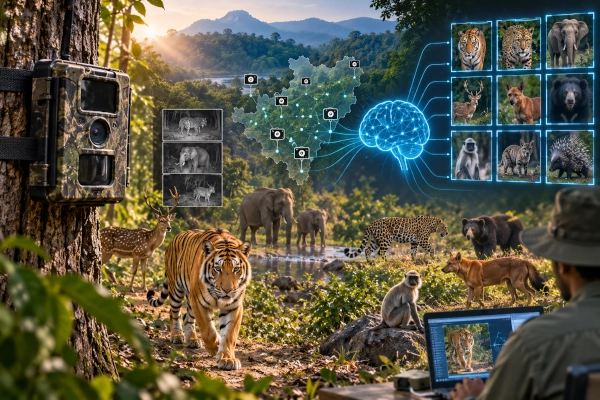
Wildlife researchers working across Central India now have a powerful new artificial-intelligence tool capable of automatically identifying animals captured by camera traps, potentially reducing one of the most labour-intensive parts of large-scale wildlife monitoring.
The Wildlife Conservation Trust (WCT), in collaboration with Netherlands-based Addax Data Science, has developed a species-recognition model specifically for the Central Indian landscape. The system has been designed to automatically process camera-trap imagery and classify wildlife into 40 distinct categories.
What makes the project particularly significant is the scale and geographic diversity of the data used to train it.
The model was built using approximately 1.1 million samples collected from 10,300 unique camera locations, giving the artificial-intelligence system exposure to wildlife photographed across a large variety of Central Indian habitats. The dataset particularly represents the dry and moist deciduous forests characteristic of the region.
Around 70% of the training dataset came from WCT’s own wildlife-monitoring archive. These images were gathered using systematically deployed, ground-based camera traps positioned to maximise the chances of detecting different animals moving through the landscape.
The remaining roughly 30% came from LILA BC, a public repository of camera-trap datasets. These additional images were used particularly for species or categories that were under-represented in WCT’s own collection, helping create a more balanced training dataset.
AI Built for Central India’s Forests
Rather than relying on a generic wildlife-recognition system trained predominantly on animals from other parts of the world, the new model has been fine-tuned specifically for the ecological conditions and wildlife communities found across Central India.
It uses a fine-tuned SpeciesNet architecture, with the resulting system designed to recognise the wildlife classes represented in its Central Indian training data.
This regional approach is important because camera-trap images can be considerably more difficult for automated systems than conventional wildlife photographs. Animals may appear only partially within a frame, move at night, be obscured by vegetation or be photographed at unusual angles and distances.
Training artificial intelligence using large volumes of imagery collected directly from the landscapes where it will eventually operate can therefore improve its usefulness for conservation researchers.
Tackling Millions of Wildlife Images
Camera traps have become one of the most important tools available to wildlife biologists.
Placed along forest trails, water sources, animal paths and other strategic locations, motion-triggered cameras can operate continuously without researchers physically being present. They allow scientists to monitor elusive animals, estimate populations, study habitat use and understand how species move across forests and wildlife corridors.
The advantage also creates a major problem: data volume.
Large monitoring programmes can generate hundreds of thousands or even millions of photographs. Researchers traditionally have to inspect and classify much of this material before it can be analysed.
Artificial intelligence offers a way to dramatically accelerate this process.
Addax develops computer-vision systems capable of automatically detecting animals within camera-trap photographs and identifying them to the relevant species or taxonomic category. Automated classification can allow conservation teams to concentrate more of their time on ecological analysis instead of manually sorting enormous image libraries.
Built on WCT’s Extensive Camera-Trap Network
The scale of WCT’s existing fieldwork provides an unusually large foundation for developing such a system.
The organisation conducts wildlife population assessments across several important Central Indian landscapes, including Pench, Navegaon-Nagzira, Tadoba-Andhari and Bor Tiger Reserves, Umred-Karhandla and Tipeshwar Wildlife Sanctuaries and the Brahmapuri Forest Division in Maharashtra, as well as Pench Tiger Reserve in Madhya Pradesh.
WCT says its monitoring programme conducts around 55,000 camera-trap nights annually, while its cumulative camera-trapping work has covered about 22,000 sq km of the Central Indian Landscape.
Camera traps are used extensively to estimate tiger and leopard populations, monitor other mammals and understand wildlife movement both inside protected areas and through the corridors connecting them.
That archive of field imagery has now become valuable not only for conventional ecological research but also as training material for artificial intelligence.
AI Could Strengthen Wildlife Corridor Monitoring
The technology could become particularly useful beyond national parks and tiger reserves.
WCT is already using camera traps along roads, railway lines and important wildlife corridors in Central India, including the Kanha-Pench, Satpura-Melghat, Tadoba-Kawal-Indravati and Bandhavgarh-Achanakmar corridors.
Automatically processing images from such networks could allow conservation teams to analyse wildlife movement over much larger areas.
This could eventually help scientists identify frequently used crossing points, understand seasonal movement, study fragmentation and provide better evidence for mitigation measures such as wildlife underpasses and overpasses.
The system should not be seen as replacing wildlife biologists. Instead, AI can perform the repetitive first stage of sorting and identifying images, while researchers remain responsible for validating data and interpreting what those detections mean for populations and ecosystems.
An Open-Source Conservation Tool
Another important feature is accessibility.
Addax has made the Central Indian Landscapes species-recognition model available through its open-source AddaxAI ecosystem, while recent information shared by Addax describes the Central India model as freely available. WCT-linked information also describes it as standalone software capable of operating locally and offline.
Offline operation can be especially useful in wildlife research, where field stations and protected landscapes may have limited or unreliable internet connectivity.
The approach also means that India’s enormous archive of camera-trap imagery can increasingly become machine-readable ecological data.
For Central India’s interconnected forests — home to tigers, leopards, dholes, sloth bears, gaur, deer and numerous smaller species — the combination of extensive field monitoring and increasingly capable artificial intelligence could allow conservationists to understand wildlife populations and movement at a scale that would have been extremely difficult through manual image analysis alone.
You may also like
-
Zoological Survey of India Discovers Three New Centipede Species in Western Ghats of Kerala and Karnataka
-
Scientists Document 3,261 Flowering Plant Species in Agasthyamalai Biosphere Reserve, Including 1,018 Indian Endemics
-
Scientists Discover Two Rare Blind Fish Species in Assam’s Underground Waters, Revealing Hidden Biodiversity
-
India Begins National Red List Assessment of 1,211 Bird Species to Strengthen Wildlife Conservation
-
Wild Water Buffaloes Return to Madhya Pradesh’s Kanha Landscape After Nearly 100 Years
