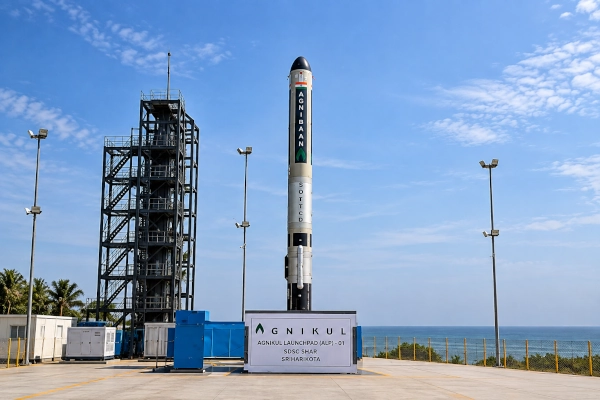
Indian space startup Agnikul Cosmos has expanded its reusable launch vehicle infrastructure in Chennai with two new facilities designed to test complete rocket stages and manufacture critical high-pressure components in-house.
The company has inaugurated the Stage Testing & Inspection Facility (STIF) and the Pressurant Tank Realisation, Over-wrapping and Outfitting Facility (PROOF) at its Assembly and Testing Facility. The new infrastructure strengthens Agnikul’s ability to develop, test, recover and eventually refly launch vehicle stages as it works towards its next flight, Mission-02.
The facilities were inaugurated in the presence of Group Captain Shubhanshu Shukla, the Indian astronaut who travelled to the International Space Station during the Axiom-4 mission.
STIF represents a significant expansion of Agnikul’s testing capability. Designed and fabricated in-house, the facility can test complete rocket stages under conditions intended to reproduce those experienced during flight. Rather than testing engines or individual subsystems separately, engineers can operate a stage with its propulsion and avionics integrated.
The facility can accommodate clusters of Agnikul’s single-piece, 3D-printed, semi-cryogenic, electric pump-fed engines and supports thrust levels ranging from 1 kN to 200 kN. It can handle liquid oxygen cooled to temperatures as low as 73 Kelvin and conduct full-duration burns lasting up to 150 seconds.
More importantly for Agnikul’s reusable-launch ambitions, STIF has been built to examine stages after they return from flight. Recovered hardware can be inspected, assessed and requalified before being prepared for another mission.
This creates the infrastructure needed for a repeated cycle of building, testing, flying, recovering, inspecting, requalifying and flying a rocket stage again. Reusability depends not only on recovering a launch vehicle but also on establishing whether the recovered structure, engines, avionics and other systems remain safe for another flight.
Agnikul says the capability makes it the only Indian private space company currently possessing in-house post-flight requalification infrastructure, although that distinction is based on the company’s own statement.
The second facility, PROOF, addresses another critical part of launch vehicle manufacturing: high-pressure composite overwrapped pressure vessels.
Such vessels are used to store gases at high pressure aboard launch vehicles and must combine low weight with considerable structural strength. PROOF allows Agnikul to manufacture these components internally rather than depending entirely on external suppliers.
The facility has a production capacity of more than 10 pressure vessels per month and can manufacture vessels with capacities of up to 3,500 litres and operating pressures reaching 350 bar. Bringing this process in-house should give Agnikul greater control over manufacturing quality, design changes and production turnaround times.
Together, STIF and PROOF deepen Agnikul’s vertically integrated approach to launch vehicle development. The company already develops its propulsion systems, avionics and several other vehicle technologies internally and manufactures its semi-cryogenic engines using additive manufacturing.
The new infrastructure extends that approach from individual components to complete stage testing, post-flight assessment and pressure-vessel production.
Agnikul co-founder and CEO Srinath Ravichandran said developing reusable launch systems requires capabilities extending well beyond a single successful flight. A recovered stage must be inspected and prepared for subsequent missions, making stage-level testing and requalification central to the company’s long-term strategy.
The facilities are particularly important as Agnikul prepares for Mission-02, which is expected to move the company beyond the technology-demonstration stage represented by its first flight.
Agnikul conducted Mission-01 on May 30, 2024, when its Agnibaan SOrTeD vehicle demonstrated a controlled ascent using the company’s single-piece 3D-printed engine and internally developed autopilot architecture.
That mission demonstrated several technologies individually. The infrastructure now being commissioned in Chennai is aimed at building the industrial and testing base needed to bring those systems together into increasingly capable launch vehicles.
For Agnikul, reusability is therefore becoming as much a manufacturing and inspection challenge as a propulsion challenge. STIF and PROOF give the company infrastructure to test entire stages before flight, manufacture specialised components internally and evaluate recovered hardware afterwards — capabilities that will become increasingly important if it succeeds in moving towards reusable launch operations and a higher launch cadence.
You may also like
-
ICAR Scientists Develop Indigenous Protective Gloves for Cotton Farmers, Sign Commercial Manufacturing Agreement
-
India Moves Towards Five-Year Assured Orders for Defence Startups Under New Procurement Reforms
-
BHEL–Coal India Joint Venture Begins Construction of ₹25,016 Crore Indigenous Coal Gasification Project in Odisha
-
Zen Technologies Introduces Indigenous Hyper-Strike Falcon AI-Guided Counter-Drone Interceptor
-
L&T and Germany’s SCHOTTEL Expand Partnership for Controllable Pitch Propeller Systems in Indian Shipbuilding
