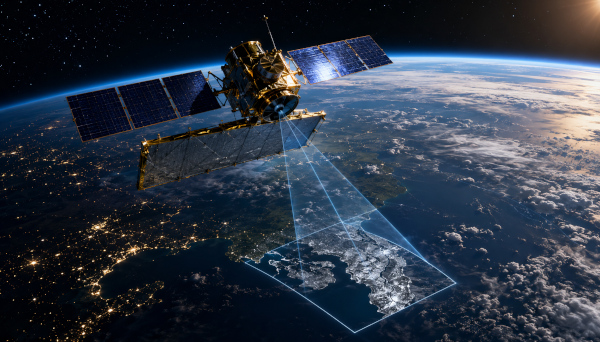
Indian space-tech company GalaxEye has secured a United States patent for the core architecture behind its OptoSAR satellite imaging system, which combines optical and Synthetic Aperture Radar sensors on a single spacecraft.
The patent covers the alignment and synchronisation of optical and microwave sensors so that both datasets can be collected over the same area during the same pass. GalaxEye says the technology has already been patented in India and that it is the first Indian startup to secure a US patent specifically for satellite imaging technology.
The approach is designed to address a basic limitation of Earth observation. Optical imagery provides detailed visual and spectral information but is affected by darkness, cloud cover, haze and smoke. SAR can operate at night and through many weather conditions.
GalaxEye’s system places both sensors on the same platform, reducing the timing and geometric differences that arise when radar and optical imagery come from separate satellites. Its architecture uses an X-band SAR sensor alongside a seven-band multispectral imager, with software used to co-register the resulting data.
Mission Drishti Takes the Technology Into Orbit
The architecture forms the basis of GalaxEye’s first satellite, Mission Drishti, launched aboard a SpaceX Falcon 9 from California on May 3, 2026.
The roughly 190-kg spacecraft operates at an altitude of about 500 km and carries an X-band SAR payload capable of Stripmap and Spotlight imaging, along with a seven-band multispectral camera covering visible and near-infrared wavelengths.
GalaxEye lists SAR resolution of up to 0.9 metre in Spotlight mode, while the fused OptoSAR product is designed to provide imagery at around 1.8-metre resolution.
The practical advantage is in obtaining two complementary views of the same scene without waiting for another satellite pass.
For a port or airfield, for example, radar can continue collecting information through cloud or at night, while optical imagery can add visual and spectral detail when conditions permit. Because the observations are closely matched in time, changes in ships, aircraft, vehicles or infrastructure can be assessed with less uncertainty.
Defence and Surveillance Applications
The system has direct relevance for defence and strategic surveillance.
Airfields, ports, border infrastructure, military facilities and logistics areas often need to be monitored regardless of weather or lighting conditions. Combining SAR and optical data can support change detection, activity monitoring and analysis of locations where conditions may change quickly.
GalaxEye lists defence among the intended applications for the technology, alongside infrastructure monitoring, agriculture, insurance and disaster response. The company says its sensors and processing systems underwent more than 400 test flights on drones, aircraft and high-altitude platforms before the satellite programme.
The technology does not by itself identify or classify a military target. Its usefulness still depends on resolution, revisit frequency, processing quality and analysis. Its advantage lies in giving users closely matched radar and optical data from a single observation.
Patent Strengthens GalaxEye’s Commercial Position
The US patent gives GalaxEye protection in one of the largest markets for Earth-observation data and satellite services.
The company plans to move beyond Mission Drishti and build a larger constellation. Reuters reported that GalaxEye intends to deploy as many as 30 satellites over the next five years.
A larger constellation would reduce the interval between observations of the same location, which is particularly important for maritime surveillance, defence monitoring and disaster response.
GalaxEye is also developing the data side of the business through Chitra, an imagery platform designed to provide customers with processed and georeferenced OptoSAR products.
The US patent is therefore important not only as an intellectual-property milestone but as protection for the architecture GalaxEye intends to use across future spacecraft.
You may also like
-
ICAR Scientists Develop Indigenous Protective Gloves for Cotton Farmers, Sign Commercial Manufacturing Agreement
-
India Moves Towards Five-Year Assured Orders for Defence Startups Under New Procurement Reforms
-
BHEL–Coal India Joint Venture Begins Construction of ₹25,016 Crore Indigenous Coal Gasification Project in Odisha
-
Zen Technologies Introduces Indigenous Hyper-Strike Falcon AI-Guided Counter-Drone Interceptor
-
L&T and Germany’s SCHOTTEL Expand Partnership for Controllable Pitch Propeller Systems in Indian Shipbuilding
