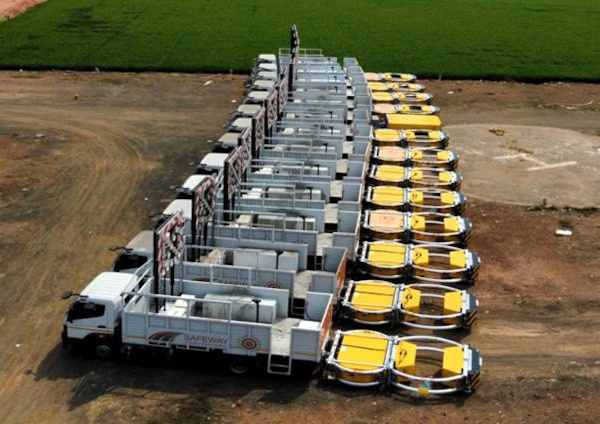
As Ministry of Road Transport and Highways (MoRTH) continues to expand the country’s National Highways network, it is placing equal emphasis on improving safety standards. Modern infrastructure development is no longer just about faster connectivity—it is increasingly focused on safeguarding the lives of both road users and on-ground workers. In line with this vision, advanced safety solutions like Truck Mounted Attenuators (TMAs) are being deployed across multiple highway stretches.
Highway construction and maintenance zones are among the most hazardous work environments, where workers face constant risks from high-speed traffic and limited visibility. To address these challenges, MoRTH has been encouraging concessionaires to adopt global safety practices. Acting on this, one concessionaire has introduced TMAs equipped with integrated wig-wag warning systems across its projects.
This concessionaire manages nine National Highway projects covering a total of 681 kilometres across Andhra Pradesh and Gujarat, marking a significant step forward in improving on-site safety standards.
Truck Mounted Attenuators are specially engineered impact-absorbing devices designed to reduce the severity of collisions. In the event of a crash, they absorb and disperse kinetic energy, helping protect road workers stationed ahead and minimizing injury risks for vehicle occupants. In essence, they act as a protective buffer in high-risk work zones.
The deployed systems also feature high-intensity wig-wag lights that flash in directional patterns, providing early warnings to approaching drivers. This is particularly crucial on high-speed corridors, during night operations, and in low-visibility conditions such as fog, where timely alerts can prevent accidents altogether.
Across these projects, 33 TMAs and 15 towable variants have been installed. All units meet globally recognised safety benchmarks, including MASH Test Level-3 and NCHRP 350 Test Level-3 standards, and are capable of handling impacts at speeds of up to 100 km/h.
This initiative demonstrates how policy vision is being translated into real-world safety improvements. As India’s highway network continues to expand, the integration of such technologies highlights a broader shift—where infrastructure growth is measured not just by scale and speed, but by the safety and protection it ensures for every user on the road.
Reference: PIB
You may also like
-
PM Dhan-Dhaanya Krishi Yojana Completes One Year: Gaya, Nagaur and Umaria Emerge as Best-Performing Districts
-
Political Protests in India: Economic Losses, Export Disruptions and the Impact on Investor Confidence
-
Jeeraphool Rice of Chhattisgarh — Surguja’s Fragrant Cumin-Shaped Heritage Grain
-
India’s E-Commerce Platforms Record ₹24,000 Crore Festive Sales in Two Days as Meesho Reports 75% Surge in Orders
-
India’s Economic Warfare Challenge: Strategic Autonomy, Energy Security and the Rise of a Global Power
