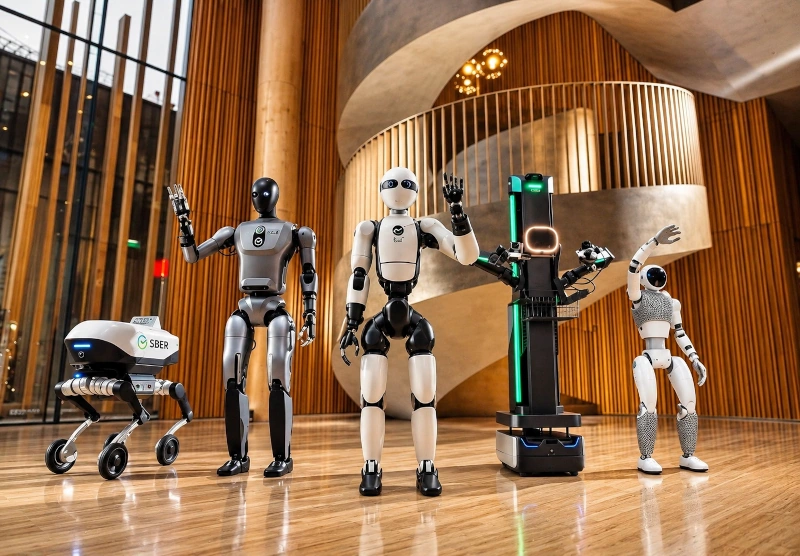
Russia’s Sber has unveiled a new generation of artificial intelligence-powered robotic platforms at the international AI Journey conference in Moscow on 26 November 2026, marking a significant development in its Physical Artificial Intelligence programme. The new robotic family comprises the versatile anthropomorphic robot Green 2.0, the athletic humanoid robot Yuni and a specialised last-mile delivery robot, all powered by Sber’s proprietary GreenVLA 2.0 neural network model. The technology was further showcased through pioneering ballet and ice-skating performances involving humanoid robots alongside professional human performers.
Marking its 185th anniversary, Sber brought together engineers, artificial intelligence researchers, choreographers, musicians and internationally recognised athletes to demonstrate how intelligent machines can interact with the physical environment. The presentations extended beyond conventional robotic demonstrations to address complex challenges involving object manipulation, dynamic movement, balance, coordination and human–robot interaction. Together, these developments illustrate Sber’s efforts to translate advances in artificial intelligence into practical capabilities across industry, logistics, retail, sports and the creative arts.
Physical Artificial Intelligence: Extending AI into the Real World
While much of the recent development in artificial intelligence has focused on digital applications such as language processing, image generation and information analysis, Physical AI addresses the challenge of enabling intelligent systems to interact with the material world. Robotic platforms operating in physical environments must combine perception, movement planning, mechanical control and coordination to perform tasks under varying conditions. These requirements introduce engineering challenges that extend beyond the capabilities of conventional software-based artificial intelligence.
Sber’s latest robotic platforms are designed to address different dimensions of these challenges through a common technological foundation. Green 2.0 focuses on navigation and object manipulation, Yuni provides a platform for developing complex dynamic movements, and the delivery robot addresses practical transportation challenges in urban environments. The three platforms collectively represent an approach in which artificial intelligence is integrated with specialised mechanical systems to develop capabilities suited to different real-world applications.
GreenVLA 2.0: A Common Artificial Intelligence Foundation
At the centre of Sber’s new robotic ecosystem is GreenVLA 2.0, a proprietary neural network model designed to support different categories of intelligent machines. The model provides a common AI foundation for general-purpose anthropomorphic robots as well as specialised robotic platforms developed for particular commercial and operational requirements. Rather than developing each machine around an entirely independent intelligence architecture, Sber is pursuing a shared technological framework capable of supporting multiple robotic configurations.
According to the company, GreenVLA 2.0 enables its robotic platforms to accumulate experience through interaction with the physical environment while supporting the continued development of their control technologies. The approach is intended to facilitate the acquisition of new physical skills across robotic systems with different mechanical characteristics. However, Sber has not disclosed detailed model architecture, training dataset specifications or independently benchmarked performance metrics in the latest announcements.
The development of a common AI foundation also has implications for the scalability of robotic technologies. A shared intelligence architecture could potentially reduce the need to develop entirely separate systems for every new robotic application, allowing engineering efforts to concentrate on mechanical design, task-specific capabilities and operational requirements. Sber’s approach represents an effort to establish an integrated Physical AI ecosystem rather than a collection of unrelated robotic products.
Green 2.0: A More Versatile Anthropomorphic Robot
Green 2.0 represents the next generation of Sber’s general-purpose anthropomorphic robotic platform. Designed to perform tasks requiring both movement through physical spaces and interaction with objects, the robot uses coordinated control of its arms, legs and torso to execute complex sequences of actions. Compared with its predecessor, Green 2.0 incorporates additional degrees of freedom, greater arm payload capacity and improved overall flexibility.
The expanded range of movement is intended to enable the robot to acquire more sophisticated physical skills and perform a broader range of tasks. Greater mechanical flexibility can improve the ability of anthropomorphic robots to operate in environments originally designed for humans, where objects, equipment and workspaces may require varied physical interactions. Sber has positioned Green 2.0 as a versatile development platform capable of acquiring additional skills through continued training.
The development of Green 2.0 is accompanied by an expansion of in-house robotic component manufacturing at Sber’s Robotics Center. This reflects the company’s efforts to integrate artificial intelligence research with mechanical engineering, hardware development and domestic component production. The establishment of these complementary capabilities could support the evolution of increasingly sophisticated robotic platforms while strengthening Russia’s domestic robotics engineering ecosystem.
Yuni: Developing Athletic Humanoid Robotics
Yuni is Sber’s athletic humanoid robot, developed to perform complex dynamic movements, including choreographic and acrobatic sequences. Unlike robotic platforms primarily focused on object manipulation or repetitive industrial operations, Yuni serves as a research platform for developing precise body control, movement coordination, stability and dynamic balance. These capabilities are particularly important for robots intended to operate in changing physical environments shared with humans.
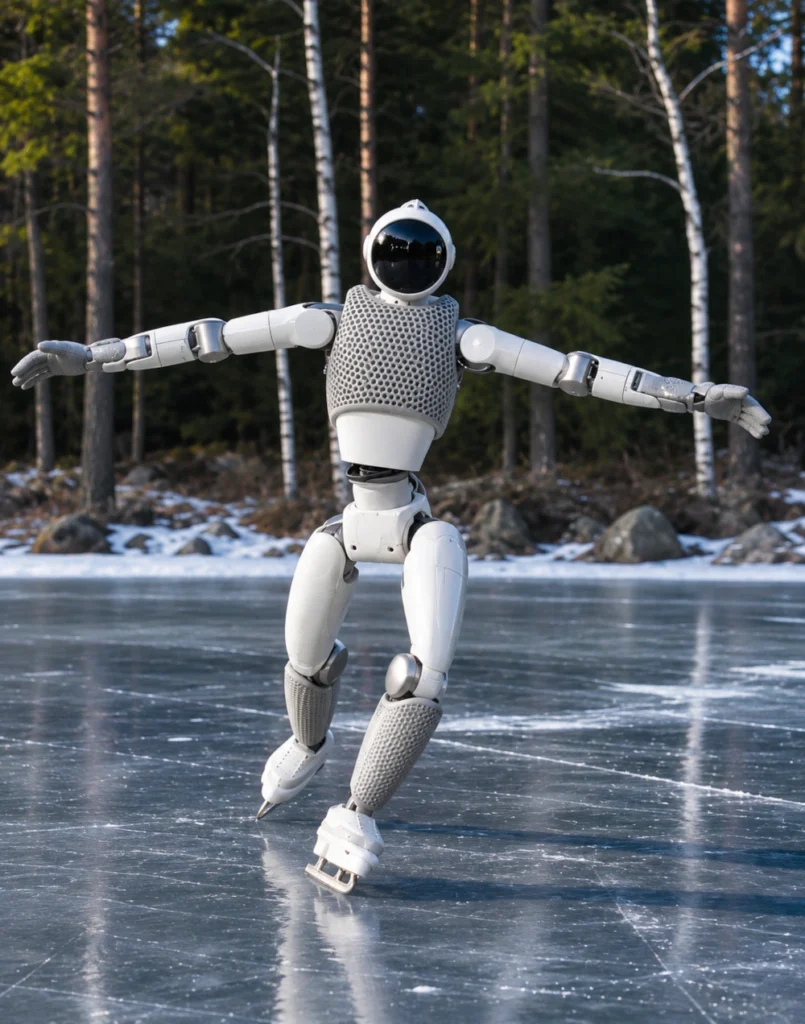
Dynamic humanoid movement requires the coordination of numerous mechanical joints while maintaining stability and adapting to external conditions. Activities such as dancing demand controlled weight transfer, rhythm, posture and the synchronisation of movements with other performers. The development of these capabilities provides engineers with opportunities to investigate problems that may also arise in practical robotic applications outside controlled laboratory environments.
Sber demonstrated Yuni’s capabilities through two distinct artistic and engineering experiments at AI Journey. The robot participated in a ballet production developed with the Boris Eifman Dance Academy and an ice performance featuring Olympic figure skating champion Anna Shcherbakova. Both presentations were described by Sber as world premieres in their respective fields, combining human artistic expression with the precision and movement capabilities of intelligent robotic systems.
Sber and Boris Eifman Dance Academy Present Humanoid Robot Ballet
On the opening day of AI Journey, Sber presented what it described as the world’s first ballet performance featuring its Yuni humanoid robots, developed in collaboration with the Boris Eifman Dance Academy. The production brought together students of the academy and robotic performers in a shared choreographic presentation. The initiative builds upon a partnership between Sber and the academy that has continued for more than 15 years.
The Boris Eifman Dance Academy combines the traditions of classical ballet with contemporary approaches to choreography and professional dance education. Its collaboration with Sber introduced an engineering dimension to the artistic process, requiring specialists from both disciplines to develop movements that could be performed by humans and humanoid machines. The production was conceived as an exploration of how technological precision and human creativity could complement one another within a shared artistic environment.
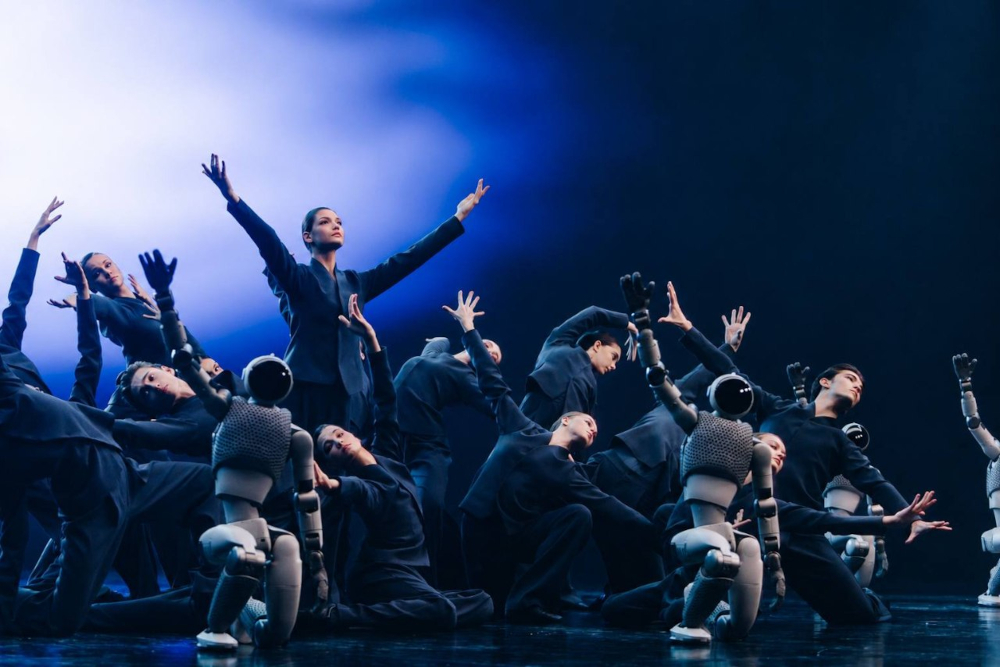
The training process involved students demonstrating individual movements and choreographic elements, which Sber’s engineers subsequently used to teach the robots corresponding physical actions. The robots progressed from executing individual movements to combining them into sequences, maintaining rhythm and synchronising their actions with human partners. The resulting performance provided a demonstration of Sber’s proprietary robotic control, coordination and synchronisation technologies.
Boris Eifman, artistic director and president of the Boris Eifman State Academic Ballet Theater of St. Petersburg, described the initiative as an unexpected challenge that the academy accepted in the spirit of artistic innovation. He characterised the resulting dance as a reflection of the relationship between opposing forces and humanity’s continuing pursuit of progress. The project demonstrates how established cultural institutions can participate in technological experimentation without losing their emphasis on human creativity and artistic expression.
From Choreography to Advanced Robotic Control
Ballet presents a particularly demanding environment for humanoid robotics because the quality of a performance depends upon more than the successful execution of individual movements. Performers must maintain balance, preserve rhythm, coordinate their actions with partners and transition smoothly between different positions. For a humanoid machine, these requirements involve sophisticated integration between its mechanical structure and movement-control systems.
Andrey Belevtsev, Senior Vice President and Head of Technology and AI at Sberbank, explained that the project demonstrated how Physical AI could perceive its surroundings, coordinate movements and interact with humans in real time. He emphasised that the performance resulted from extensive collaboration between Sber’s engineering teams and professionals from the ballet community. The initiative provided an opportunity to examine robotic capabilities through tasks that demand precision, timing and sensitivity to the actions of surrounding performers.
Vladislav Kreynin, Head of Sberbank’s Marketing and Communications Department and a member of the Board of Trustees of the Boris Eifman Dance Academy, presented the collaboration as an alternative to narratives in which robots merely serve humans or replace them. The production instead explored the possibility of cooperation between human performers and intelligent machines, with each contributing distinct characteristics to the artistic process. Human emotion and robotic precision were presented as complementary elements within a shared creative endeavour.
Yuni Performs on Ice Alongside Olympic Champion Anna Shcherbakova
In another demonstration of Physical AI, Sber presented what it described as the world’s first ice show featuring a humanoid robot. Yuni performed alongside Olympic figure skating champion Anna Shcherbakova in a production developed with the participation of engineers from Sber’s Robotics Center. The performance required the robot to execute dance combinations, interact with its human partner and maintain stability on a slippery ice surface.
Ice presents a distinct set of challenges for robotic locomotion because its low-friction characteristics reduce the stability ordinarily available on conventional surfaces. Operating under such conditions requires effective coordination between movement control, balance and continuous assessment of the robot’s physical position. The ability to maintain coordinated movement during an artistic performance adds further complexity to these engineering requirements.
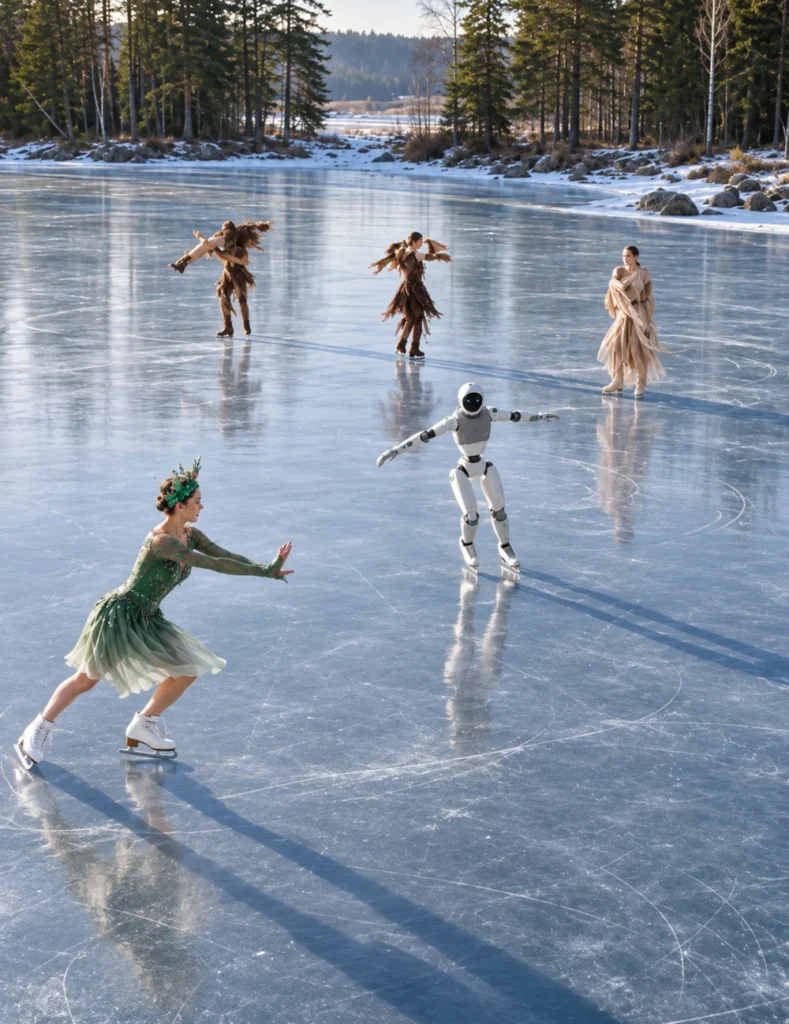
According to Sber, the ice arena served as an experimental environment for advancing technologies associated with physical stability, coordination and human–robot interaction. Belevtsev highlighted the importance of teaching robots to operate within changing physical environments rather than simply executing isolated commands. The collaboration with Shcherbakova enabled the engineering team to draw upon the expertise of an accomplished athlete while developing the robot’s movement capabilities.
The demonstration also illustrates why unconventional experimental environments can contribute to robotics research. Challenges encountered on ice may help engineers refine approaches to stability and movement control that could subsequently inform robotic operations in industrial, commercial and everyday environments. The performance nevertheless represents a technology demonstration rather than evidence of unrestricted autonomous robotic operation across all types of slippery terrain.
Russian Cultural Heritage Meets Artificial Intelligence
The ice performance was based on the traditional Russian fairy tale The Frog Princess and was developed as part of Sber’s 185th anniversary celebrations. Composer Pyotr Dranga and stage director Ilya Averbukh collaborated on the production, combining music, theatrical presentation, figure skating and robotic engineering. Their objective was to integrate human and robotic movements into a coherent artistic narrative rather than present an isolated demonstration of mechanical capabilities.
Anna Shcherbakova contributed her experience in competitive figure skating, while Averbukh developed the choreographic framework within which the robotic movements could become part of the performance. Dranga’s musical composition provided the artistic structure that connected the technological experiment with the traditional fairy tale. The production illustrates how cultural heritage can provide inspiration for contemporary engineering research and technological experimentation.
Sber has also indicated that the performance represents an initial step towards a proposed ice show titled Russian Fairy Tales, in which robots would participate alongside professional figure skaters. The concept builds upon the company’s earlier Russian Fairy Tales ballet, presented at the Bolshoi Theatre in connection with its anniversary celebrations. The larger robotic ice production remains a future initiative, while the demonstration at AI Journey represents the completed experimental performance announced by the company.
Last-Mile Delivery Robot Undergoes Urban Pilot Testing in Moscow
Alongside Green 2.0 and Yuni, Sber unveiled a specialised robotic platform designed for last-mile delivery applications. The robot is currently undergoing pilot testing in one of Moscow’s districts, providing an opportunity to evaluate its capabilities within an actual urban environment. Unlike conventional wheeled delivery robots, Sber’s platform incorporates a combined wheeled-legged configuration intended to overcome a wider range of physical obstacles.
The mechanical design enables the delivery robot to navigate curbs, stairs and other obstacles commonly encountered in urban transportation environments. Sber states that the platform is designed to operate in both rain and snow, addressing some of the environmental challenges associated with year-round delivery services. These capabilities are intended to improve accessibility in areas where conventional wheeled robotic systems may encounter difficulties.
The eventual objective is to develop robotic delivery services capable of transporting orders directly to customers’ doors, including locations that require navigation beyond ordinary pavements and roadways. Such applications could have implications for retail distribution, e-commerce fulfilment and urban logistics. However, the platform remains at the pilot-testing stage, and Sber has not announced a large-scale commercial deployment schedule or disclosed quantified operational performance results.
From Artistic Experiments to Commercial and Industrial Applications
The ballet and ice-skating demonstrations form part of a broader research approach in which complex physical activities are used to develop robotic capabilities with potential applications outside the performing arts. Balance, spatial awareness, movement coordination and interaction with humans are relevant to a wide range of environments in which intelligent machines may eventually operate. Improving these capabilities could support the development of robots capable of performing increasingly varied tasks.
Industrial environments, warehouses and retail establishments frequently require equipment to operate around obstacles, handle objects and respond to changing conditions. Similarly, domestic and public environments introduce challenges associated with irregular spaces and unpredictable human movement. Research conducted through demanding experimental applications can help identify limitations in robotic control and provide opportunities to refine the underlying engineering systems.
Sber’s development programme connects these experimental activities with practical commercial testing. While Yuni provides a platform for investigating complex dynamic movement, Green 2.0 addresses broader physical manipulation capabilities and the delivery robot focuses on an identifiable logistics application. This combination allows the company to investigate different dimensions of Physical AI through a portfolio of complementary robotic platforms.
Developing Russia’s Domestic Robotics Manufacturing Ecosystem
Sber’s robotics programme extends beyond artificial intelligence software to include the development of domestic engineering infrastructure and robotic component manufacturing. The company has stated that it is expanding its in-house manufacturing capabilities at its Robotics Center, alongside the development of its proprietary neural network models. The approach reflects the importance of integrating software, mechanical systems, electronic components and production infrastructure within a comprehensive robotics development programme.
Speaking about the latest announcements, Herman Gref, Chief Executive Officer and Chairman of Sberbank’s Executive Board, highlighted the progress made since the company announced its intention to develop robots capable of complex movement and improved environmental adaptation a year earlier.
“A year ago, we announced the creation of a group of robots capable of performing highly complex movements and adapting more effectively to their environment. Today, we are unveiling three new robotic platforms, all powered by a shared AI model. Our goal is for these robots to independently carry out tasks that are useful to humans. We are currently actively testing our technologies in the retail and delivery sectors, while our experiments in art, ballet, and sports are pushing the boundaries of what is considered possible,” Gref said.
He further emphasised that Sber is developing its own engineering infrastructure and manufacturing robotic components within Russia. Green 2.0, Yuni and the new delivery platform have now joined Sber’s existing robotic portfolio, which already includes the Green and Worker robots. Together, these platforms provide the company with a foundation for pursuing research, experimentation and potential commercial applications across multiple sectors.
AI Journey and International Artificial Intelligence Cooperation
AI Journey is an annual international conference organised around developments in artificial intelligence and their implications for science, economic activity and society. Held with the support of AI Alliance Russia, the conference brings together researchers, technology companies, engineers and other professionals involved in the development and application of AI technologies. It also promotes innovation among young researchers and emerging technology professionals.
According to Sber, the previous edition of the conference featured more than 300 speakers from several countries, including Russia, India, China and the United States. The international participation reflects the increasingly global character of artificial intelligence research and the growing importance of interdisciplinary technological collaboration. The 2026 announcements concerning humanoid robotics further extend the conference’s coverage into the emerging field of Physical AI.
For India, developments in Physical AI are relevant to the broader evolution of advanced manufacturing, industrial automation, indigenous robotics and intelligent logistics systems. India’s expanding technology ecosystem is increasingly examining the integration of artificial intelligence with physical machinery and commercial operations. International developments such as those presented at AI Journey provide opportunities to observe emerging engineering approaches and understand how advanced robotic capabilities are being developed across different technological ecosystems, although the latest Sber announcements do not identify any specific new partnership with Indian organisations.
Human–Robot Collaboration as the Next Frontier of Physical AI
Sber’s latest demonstrations highlight an approach to robotics that emphasises cooperation between intelligent machines and human beings. The ballet production and ice performance required robots to function within environments where human movement, creativity and coordination were central to the activity. The experiments consequently addressed not only mechanical performance but also the broader challenge of integrating robotic systems into spaces and activities shared with people.
The technological significance of such cooperation extends beyond artistic presentations. Robots intended to assist humans in industrial, commercial or everyday environments must possess sufficient physical awareness and movement control to operate effectively alongside them. Developing these capabilities will require continued research into mechanical reliability, artificial intelligence, operational safety and the adaptability of robotic systems.
The latest demonstrations represent measurable progress in specific experimental applications, while broader autonomous operation and commercial scalability remain objectives for future development. By combining controlled technology demonstrations with practical pilot projects, Sber is pursuing multiple pathways towards the development of robotic platforms capable of performing useful physical tasks.
Conclusion: Bringing Artificial Intelligence into the Physical World
The unveiling of Green 2.0, Yuni and Sber’s last-mile delivery robot at AI Journey 2026 represents an important milestone in the company’s Physical Artificial Intelligence development programme. The integration of three distinct robotic platforms around the proprietary GreenVLA 2.0 model demonstrates an effort to establish a common technological foundation for applications ranging from general-purpose humanoid robotics to specialised urban logistics. The accompanying ballet and ice-skating performances provide examples of how advanced robotic movement and human–machine coordination can be explored through interdisciplinary collaboration.
Sber’s simultaneous emphasis on artificial intelligence research, domestic component manufacturing, practical commercial testing and cultural experimentation illustrates the multidimensional nature of contemporary robotics development. Although many of the broader commercial applications remain under development, the latest announcements demonstrate how engineering teams can use diverse physical environments to investigate the capabilities and limitations of intelligent machines. The convergence of artificial intelligence, mechanical engineering and human creativity provides a foundation for further innovation across industrial, commercial and cultural domains.
As Physical AI continues to evolve, its long-term significance will depend upon the ability of robotic systems to perform useful tasks safely, reliably and effectively within environments shared with humans. Sber’s demonstrations in Moscow offer an example of how technology and cultural traditions can intersect to expand the boundaries of robotic engineering. By treating intelligent machines as potential collaborators in human activity, the programme opens avenues for technological development that can complement human expertise and contribute to future economic and societal progress.
Sources
Source Courtesy: Sber Press Office and NW Advisors, International Communications.
You may also like
-
India Reaffirms Its Position on Indus Waters Treaty Amid Pakistani Minister’s Visit
-
India Condemns False Narratives as Chinese Influencers Allegedly Portray Dhaka Neighbourhoods as New Delhi
-
Japan’s Emerging Indo-Pacific Security Network: Why India Is Becoming a Strategic Partner in Asia’s Balance of Power
-
Philippine Marine Wargames Reportedly Show BrahMos Can Penetrate Chinese Destroyer Air Defences
-
Adani Power and Druk Green Power to Develop 770 MW Chamkharchhu-I Hydropower Project in Bhutan
