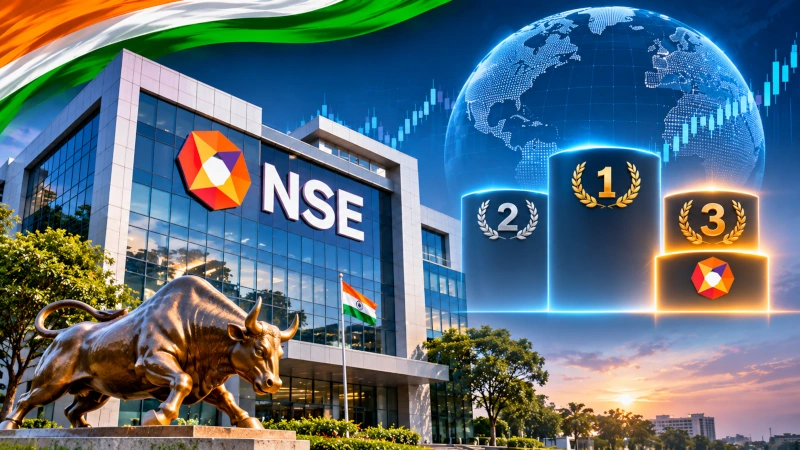
The National Stock Exchange of India (NSE) has emerged as the world’s third-largest publicly listed stock exchange operator by market capitalisation, overtaking Germany’s Deutsche Börse and the United Kingdom’s London Stock Exchange Group. The milestone, reported by Akashvani News on November 26, 2026, follows an increase in NSE’s corporate valuation to approximately US$64.1 billion, equivalent to nearly ₹6 lakh crore. The achievement highlights the growing international significance of India’s financial market infrastructure.
NSE Advances in Global Exchange Rankings
NSE now ranks behind the United States-based CME Group and Intercontinental Exchange (ICE) among the world’s most valuable publicly listed exchange operators. CME Group leads the global rankings with a valuation of approximately US$111.6 billion, followed by Intercontinental Exchange at US$99.4 billion. NSE’s latest valuation places it ahead of several established international financial market infrastructure providers.
Deutsche Börse and the London Stock Exchange Group were valued at approximately US$63.4 billion and US$62.4 billion, respectively, at the time of the reported comparison. NSE’s advancement to third position follows its emergence among the world’s five most valuable listed exchange operators earlier in November. These rankings remain subject to fluctuations in share prices and currency exchange rates.
Strengthening India’s Global Financial Market Presence
The rise of NSE among the world’s most valuable exchange operators reflects the increasing prominence of India’s capital market infrastructure. Since its establishment in 1992, NSE has contributed to the modernisation of Indian securities markets through electronic trading, technological integration and improved market accessibility. Its infrastructure supports transactions across equities, derivatives, debt instruments and other financial products.
The exchange has also played an important role in expanding access to organised capital markets across India. Technological developments have enabled investors from geographically diverse regions to participate in financial markets, while the expansion of digital financial services has contributed to greater accessibility. These developments form part of India’s broader financial sector transformation.
Distinguishing Exchange Valuation from Market Capitalisation
NSE’s latest global ranking is based on the corporate market capitalisation of the exchange operator itself, rather than the combined valuation of companies whose securities are traded on its platform. Corporate market capitalisation represents the market value of a company’s outstanding equity shares. Consequently, the ranking measures NSE’s valuation as a financial infrastructure enterprise and not the overall size of India’s equity market.
This distinction is important because stock exchanges can also be ranked according to trading volumes, derivatives contracts, transaction values and the aggregate market capitalisation of listed securities. NSE occupies significant positions across several of these categories, but each ranking represents a different dimension of financial market activity.
Supporting India’s Expanding Capital Market Ecosystem
A well-developed stock exchange ecosystem provides businesses with opportunities to access capital while enabling investors to participate in economic growth. NSE’s infrastructure facilitates financial transactions, price discovery, liquidity and investment across multiple asset classes. These functions are important to the efficient mobilisation and allocation of financial resources within the economy.
The continued development of India’s capital markets can support industrial expansion, infrastructure financing, entrepreneurship and long-term investment. Maintaining technological resilience, transparent market operations, effective risk management and investor protection will remain essential as the scale and complexity of financial market activity increase.
A Milestone for India’s Financial Infrastructure
NSE’s emergence as the world’s third-largest listed exchange operator represents a significant milestone in the international recognition of India’s financial market infrastructure. Although corporate valuations fluctuate according to market conditions, the achievement demonstrates the scale NSE has attained as a financial services enterprise within the global exchange industry.
As India continues to expand its capital markets and strengthen its digital financial ecosystem, institutions such as NSE can play an increasingly important role in supporting domestic capital formation and international financial integration. Continued investment in technology, regulatory compliance and market accessibility can help consolidate India’s position as a major participant in the evolving global financial landscape.
You may also like
-
India Tracks ₹38.11 Lakh Crore Infrastructure Investment Pipeline
-
Suzlon Energy Lays Foundation Stone for 1 GW AI-Enabled Wind Turbine Blade Factory in Tamil Nadu
-
Avore Electric Reports 90 Per Cent Domestic Component Sourcing for Electric Motorcycles
-
Indian Nuclear Startup SUK-M Secures Funding to Develop Indigenous Thorium Microreactor
-
Jupiter Wagons Partners South Korea’s Woojin to Manufacture Metro Trains and Propulsion Systems in India
