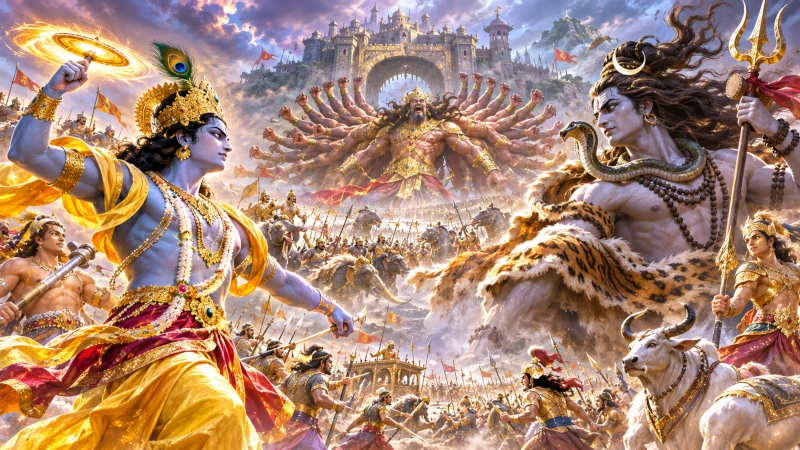
Among the extraordinary military confrontations described in the Bhāgavata Purāṇa, the war between Krishna and Bāṇāsura occupies a distinctive position. What began as the imprisonment of Aniruddha, the grandson of Krishna, developed into a confrontation involving the Yādava army, Shiva, Kārttikeya, the Gaṇas and numerous supernatural combatants. The narrative encompasses large-scale military mobilisation, siege warfare, strategic alliances, simultaneous battlefield engagements, celestial weapons and specialised countermeasures.
The Bāṇa War is particularly significant because it does not follow the conventional Purāṇic framework of a straightforward confrontation between the Devas and Asuras. Shiva enters the conflict in defence of his devotee, while Krishna intervenes to secure the release of his grandson and confront Bāṇāsura’s aggression. The resulting battle presents a complex study of alliance-driven escalation, battlefield adaptation, selective neutralisation of opposing forces and the termination of hostilities upon achieving strategic objectives.
The Strategic Background: Bāṇāsura and the Kingdom of Śoṇitapura
Bāṇāsura was the eldest of the hundred sons of Mahābali and ruled the prosperous kingdom of Śoṇitapura. The Bhāgavata Purāṇa describes him as possessing a thousand arms, an extraordinary attribute symbolising his immense strength and martial capabilities. He was also a devoted worshipper of Shiva, whose favour he had earned through devotion and service.
Shiva had granted Bāṇāsura a boon and agreed to protect his city. The combination of a fortified capital, extraordinary personal martial capabilities and the protection of a powerful divine ally established a formidable defensive arrangement for Śoṇitapura. Over time, however, Bāṇāsura became increasingly proud of his strength and complained to Shiva that he could find no opponent capable of satisfying his desire for combat.
Rather than encouraging this arrogance, Shiva warned Bāṇāsura that the destruction of his battle standard would herald the arrival of an adversary capable of breaking his pride. The warning establishes an important strategic theme within the narrative. Military superiority, fortified infrastructure and external security guarantees cannot compensate for the absence of strategic judgement and responsible political leadership.
The Imprisonment of Aniruddha: Covert Entry and Intelligence Gathering
The immediate cause of the conflict emerged through Uṣā, the daughter of Bāṇāsura, who encountered Aniruddha in a dream and subsequently became deeply attached to him. Her companion Citralekhā identified Aniruddha and, through her supernatural abilities, brought him from Dvārakā to Śoṇitapura. Citralekhā’s supernatural transportation of Aniruddha constitutes a Purāṇic representation of covert entry into a protected royal establishment without the knowledge of its authorities.
Aniruddha remained secretly within Uṣā’s private residence until his presence was discovered by the palace authorities. When Bāṇāsura confronted him, the young Yādava warrior resisted his forces with considerable strength. Unable to secure Aniruddha through ordinary confrontation, Bāṇāsura employed the Nāgapāśa, a celestial serpent-binding weapon that restrained the opposing warrior rather than immediately killing him. His capture transformed a private royal affair into a crisis involving two powerful ruling houses.
The Yādavas remained unaware of Aniruddha’s whereabouts until the sage Nārada informed them of his imprisonment. Nārada’s disclosure supplied the Yādavas with critical intelligence concerning Aniruddha’s location and captivity, establishing the informational foundation for their subsequent military expedition. Krishna consequently organised a campaign against Śoṇitapura, with the recovery of Aniruddha constituting its immediate objective rather than territorial expansion.
Large-Scale Military Mobilisation and Siege Warfare
The Bhāgavata Purāṇa describes Krishna and Balarāma leading a force of twelve Akṣauhiṇīs against Śoṇitapura. The expedition included prominent Yādava commanders such as Pradyumna, Sātyaki, Sāmba, Gada, Sāraṇa, Nanda and Upananda. The mobilisation of twelve Akṣauhiṇīs represents a large-scale combined military formation encompassing infantry, cavalry, war elephants and chariots within the traditional Indian military organisation.
The Yādava army surrounded Śoṇitapura and attacked its defensive structures, including ramparts, gateways and watchtowers. The encirclement of Śoṇitapura and the assault on its defensive infrastructure constitute a clear description of siege warfare within the Purāṇic narrative. Bāṇāsura responded by deploying a force of comparable size, bringing the confrontation beyond the city’s defensive perimeter.
Shiva, accompanied by Kārttikeya and his supernatural attendants, entered the battlefield in fulfilment of his commitment to Bāṇāsura. The intervention of Shiva and his supporting forces transformed a bilateral military confrontation into a wider alliance-driven conflict involving multiple categories of combatants and extraordinary capabilities. The episode illustrates how security commitments can substantially expand the scale and complexity of an initially limited confrontation.
Multiple Commanders and Simultaneous Battlefield Engagements
The Purāṇa describes several major confrontations unfolding simultaneously across the battlefield. Krishna engaged Shiva, Pradyumna confronted Kārttikeya, Balarāma fought Kumbhāṇḍa and Kūpakarṇa, Sāmba engaged Bāṇāsura’s son, and Sātyaki initially confronted Bāṇāsura himself. The distribution of combat among several prominent commanders presents the battle as a series of simultaneous engagements rather than a single decisive duel.
Each major combatant faced opposition while the wider armies continued their confrontation. Developments involving individual warriors consequently influenced the broader balance of the conflict. The narrative reflects the importance of interconnected battlefield engagements, in which the outcome of one confrontation can affect the availability of supporting forces elsewhere.
The presence of Brahmā, celestial beings and great sages as spectators further emphasises the extraordinary nature of the confrontation. Within the Purāṇic cosmology, the battle attracted attention not merely because of its military scale but because it involved divine personalities whose powers extended beyond ordinary warfare.
Krishna and Shiva: Celestial Weapons and Specialised Countermeasures
The encounter between Krishna and Shiva forms the central military episode of the Bāṇa War. Shiva employed numerous celestial weapons against Krishna, while Krishna responded with corresponding countermeasures. The confrontation is characterised by successive exchanges of specialised celestial weapons, with each offensive capability encountering a distinct form of opposition.
The Bhāgavata Purāṇa describes Shiva employing the Brahmāstra, a celestial weapon of extraordinary destructive potential. Krishna countered the Brahmāstra with another Brahmāstra, establishing a literary representation of equivalent celestial capabilities neutralising one another. The encounter demonstrates that the possession of a formidable weapon does not necessarily guarantee an uncontested advantage within the Purāṇic framework.
Shiva subsequently employed the wind weapon against Krishna. Krishna countered the wind weapon with the mountain weapon, representing the opposition of immovable elemental strength against the destructive force of wind. The confrontation subsequently expanded into further exchanges involving other manifestations of elemental power.
When Shiva employed the fire weapon, Krishna responded with the rain weapon, presenting another example of a specialised countermeasure based on opposing elemental forces. Shiva also employed the formidable Pāśupatāstra, which Krishna countered with the Nārāyaṇāstra. These exchanges establish one of the most elaborate descriptions of celestial weapon-counterweapon engagements in the Bhāgavata Purāṇa.
The episode illustrates the distinction between possessing powerful weapons and possessing the knowledge required to respond to them. Adaptability, versatility and the availability of corresponding defensive capabilities emerge as central themes throughout the celestial confrontation. These descriptions belong to Purāṇic cosmology and should be understood as literary representations of extraordinary warfare rather than documented historical weapons technology.
Jṛmbhaṇāstra: Temporary Battlefield Neutralisation
Following the exchanges of celestial weapons, Krishna employed the Jṛmbhaṇāstra against Shiva. The weapon caused Shiva to yawn, temporarily interrupting his participation in the battle. Unlike the previously exchanged celestial weapons, the Jṛmbhaṇāstra is portrayed as a specialised means of temporarily incapacitating an opposing combatant without destroying him.
This episode introduces an important distinction between neutralisation and destruction. Krishna’s immediate objective did not require the annihilation of Shiva, whose involvement arose from his obligation to Bāṇāsura. The temporary interruption of Shiva’s participation represents a Purāṇic example of non-destructive battlefield neutralisation, in which the removal of immediate opposition is distinguished from permanent elimination.
The episode also establishes the theological character of the battle. Krishna and Shiva are not portrayed as permanent enemies, despite their temporary confrontation. Their subsequent reconciliation demonstrates that opposing battlefield responsibilities need not amount to irreconcilable antagonism.
Kārttikeya, Balarāma and the Collapse of Bāṇa’s Supporting Forces
While Krishna confronted Shiva, the other Yādava commanders continued their respective engagements. Pradyumna overcame Kārttikeya’s resistance, compelling him to withdraw from the confrontation on his peacock mount. Balarāma defeated Kumbhāṇḍa and Kūpakarṇa, further weakening Bāṇāsura’s supporting forces.
The defeat and withdrawal of prominent commanders progressively diminished the strength of Bāṇāsura’s defensive coalition. Krishna also confronted the supernatural attendants associated with Shiva, including various categories of Gaṇas and other beings described in the Purāṇa. Their dispersal further reduced the support available to the ruler of Śoṇitapura.
Bāṇāsura’s position deteriorated as the forces upon which he depended became unable to sustain their participation. His considerable personal strength remained, but the military and supernatural support surrounding him had diminished. The narrative demonstrates the vulnerability of a powerful individual combatant when the broader network of supporting formations and allied capabilities begins to collapse.
The Battle of the Jvaras: Warfare Through Opposing Elemental Forces
One of the most extraordinary episodes of the Bāṇa War involves the confrontation between the Māheśvara-jvara and the Vaiṣṇava-jvara. The former is described as a supernatural manifestation of fever associated with Shiva, possessing three heads and three feet and radiating immense heat. Krishna responded by releasing the Vaiṣṇava-jvara, associated with an equally extraordinary power of cold.
The confrontation between the Māheśvara-jvara and the Vaiṣṇava-jvara introduces a distinctive form of celestial warfare in which opposing manifestations of extreme heat and cold become the principal instruments of combat. Unlike conventional physical engagements involving bows, chariots or other weapons, the episode portrays supernatural conditions themselves as active participants in the confrontation. It represents an imaginative extension of warfare into the domain of environmental and elemental forces.
The Māheśvara-jvara was eventually overwhelmed and sought refuge in Krishna. After offering prayers, the personified fever received Krishna’s assurance of protection and departed from the battlefield. The confrontation concluded through submission and the withdrawal of the opposing supernatural entity rather than its destruction.
These descriptions belong to the cosmological and theological framework of the Bhāgavata Purāṇa. They should not be interpreted as historical evidence of biological, nuclear, climatic or directed-energy weapons. Their significance within the Warcraft Purāṇas framework lies in the literary representation of extraordinary offensive phenomena and corresponding countermeasures.
Bāṇāsura’s Thousand Arms: Simultaneous Archery and Offensive Concentration
Despite the deterioration of his supporting forces, Bāṇāsura continued his confrontation with Krishna. The Purāṇa describes him employing five hundred bows simultaneously, an extraordinary manifestation of his thousand-armed form. The simultaneous employment of five hundred bows represents an exceptional Purāṇic depiction of concentrated offensive capability, in which a single supernatural warrior delivers the martial output of numerous archers.
Krishna overcame this extraordinary offensive display by destroying Bāṇāsura’s bows and disabling his chariot. The destruction of Bāṇāsura’s weapons and the loss of his chariot deprived him of both his immediate offensive capability and his battlefield mobility. The episode illustrates the limitations of overwhelming numerical strength when confronted by superior divine capabilities.
After temporarily withdrawing into Śoṇitapura, Bāṇāsura returned to the battlefield and renewed his attack. His willingness to continue the confrontation despite earlier setbacks reflected his confidence in his extraordinary physical strength. However, the loss of supporting forces and the destruction of his weapons had already diminished the military advantages upon which he depended.
Sudarśana Chakra: Selective Reduction of Bāṇāsura’s Martial Power
Krishna subsequently employed the Sudarśana Chakra against Bāṇāsura, gradually severing his numerous arms. The celestial discus reduced the extraordinary physical advantage upon which Bāṇāsura had constructed his sense of invincibility. The employment of the Sudarśana Chakra is presented as a decisive reduction of Bāṇāsura’s exceptional combat capabilities rather than the immediate destruction of the opposing ruler.
The thousand arms represented both Bāṇāsura’s immense strength and the source of his arrogance. Their removal consequently carries a significance beyond the immediate battlefield outcome. The episode portrays the selective dismantling of an adversary’s extraordinary military power while preserving the possibility of survival and subsequent reconciliation.
Within the theological framework of the narrative, the reduction of Bāṇāsura’s arms symbolises the destruction of excessive pride and the restoration of appropriate limits to power. Krishna’s eventual decision to permit him to retain four arms reinforces the distinction between removing excessive capabilities and denying the defeated ruler his existence.
Shiva’s Intervention: Battlefield Diplomacy and Negotiated De-escalation
As Krishna continued to sever Bāṇāsura’s arms, Shiva intervened out of compassion for his devotee. His intervention marked a fundamental transformation in the conflict, shifting the confrontation from the exercise of military power towards dialogue and reconciliation. Shiva acknowledged Krishna’s divine nature and requested that Bāṇāsura’s life be spared.
Shiva’s intervention represents a transition from battlefield confrontation to negotiated de-escalation, seeking the preservation of the defeated ruler after his extraordinary offensive capabilities had been substantially reduced. His appeal was grounded in his earlier assurance of protection to Bāṇāsura. Although the ruler’s arrogance had brought destruction upon his martial capabilities, Shiva remained concerned for his devotee’s survival.
Krishna accepted Shiva’s request and recalled his earlier promise to Prahlāda that he would not kill his descendants. Bāṇāsura, being a descendant of Prahlāda through Mahābali, was consequently spared. The resulting settlement accommodated the commitments of both opposing divine figures while preventing the continuation of unnecessary hostilities. Krishna permitted Bāṇāsura to retain four arms and assured him freedom from fear, old age and death, allowing him to become one of Shiva’s principal attendants.
War Termination: Achieving Strategic Objectives Without Annihilation
Following Krishna’s assurance of protection, Bāṇāsura acknowledged his defeat and offered his respects. He subsequently presented Aniruddha and Uṣā before Krishna, allowing the original cause of the conflict to be resolved. Krishna took leave of Shiva and returned to Dvārakā with the newly married couple.
Krishna terminated the military campaign after overcoming Bāṇāsura’s resistance, securing Aniruddha’s release and reducing the excessive martial capabilities that had encouraged the ruler’s arrogance. The continuation of hostilities was unnecessary once these objectives had been achieved. The conclusion establishes a distinction between the legitimate purpose of a military campaign and the unrestricted pursuit of destruction.
Bāṇāsura survived, Shiva’s commitment to his devotee was respected, and Krishna’s earlier promise to Prahlāda was preserved. The war therefore concludes through a combination of military victory, selective reduction of hostile capabilities, diplomatic reconciliation and the restoration of political and moral order. The settlement demonstrates that victory need not require the permanent elimination of the defeated adversary.
Warcraft Methods Described in the Bāṇa War
| Warcraft method | Purāṇic manifestation |
|---|---|
| Strategic security guarantees | Shiva’s commitment to protect Śoṇitapura |
| Defensive fortifications | Ramparts, gateways and watchtowers of Śoṇitapura |
| Covert entry | Citralekhā’s supernatural transportation of Aniruddha |
| Non-lethal restraint | Bāṇāsura’s employment of Nāgapāśa |
| Intelligence gathering | Nārada revealing Aniruddha’s whereabouts |
| Large-scale mobilisation | Deployment of twelve Yādava Akṣauhiṇīs |
| Siege warfare | Encirclement and assault on Śoṇitapura |
| Alliance-driven escalation | Intervention of Shiva, Kārttikeya and the Gaṇas |
| Simultaneous battlefield engagements | Multiple commanders confronting opposing warriors |
| Equivalent celestial countermeasures | Brahmāstra against Brahmāstra |
| Elemental countermeasures | Mountain against wind and rain against fire |
| Specialised celestial countermeasures | Nārāyaṇāstra against Pāśupatāstra |
| Temporary incapacitation | Jṛmbhaṇāstra against Shiva |
| Disruption of supporting forces | Defeat and withdrawal of allied combatants |
| Supernatural elemental warfare | Māheśvara-jvara against Vaiṣṇava-jvara |
| Concentrated offensive capability | Bāṇāsura employing five hundred bows |
| Loss of battlefield mobility | Destruction of Bāṇāsura’s chariot |
| Selective reduction of martial power | Sudarśana Chakra against Bāṇāsura’s arms |
| Battlefield diplomacy | Shiva’s appeal to Krishna |
| Negotiated de-escalation | Krishna’s decision to spare Bāṇāsura |
| Objective-based war termination | Release of Aniruddha and cessation of hostilities |
Strategic Lessons from the Bāṇa War
Military Strength Without Strategic Wisdom
Bāṇāsura possessed formidable personal capabilities, a fortified capital, a substantial army and the protection of Shiva. Nevertheless, these advantages encouraged a sense of invulnerability that contributed to his downfall. His desire for confrontation illustrates the danger of treating military strength as an end in itself rather than as an instrument of legitimate political and ethical objectives.
Military preparedness and extraordinary offensive capabilities cannot substitute for strategic wisdom, political judgement and an accurate understanding of one’s limitations. The narrative suggests that sustainable security requires restraint alongside material strength. A ruler who actively seeks conflict simply because he possesses formidable capabilities may eventually encounter circumstances that expose the limitations of those advantages.
The Responsibilities and Limitations of Strategic Alliances
Shiva’s commitment to Bāṇāsura demonstrates the importance of loyalty and the obligations associated with promises of protection. However, the narrative also illustrates how the conduct of a protected ruler can draw his supporters into a confrontation that might otherwise have been avoided. Bāṇāsura’s arrogance ultimately placed his powerful protector in opposition to Krishna.
Strategic alliances provide security but can also create obligations that expose supporting powers to conflicts originating from the decisions of their partners. Shiva’s eventual intervention secured Bāṇāsura’s survival without restoring the excessive martial power that had encouraged his behaviour. The settlement consequently distinguishes the fulfilment of a protective commitment from the unconditional endorsement of aggression.
Adaptability and the Importance of Countermeasures
The exchanges of celestial weapons between Krishna and Shiva illustrate the literary significance of adaptability. Each extraordinary offensive capability encountered an opposing force, demonstrating that power within the narrative is not necessarily absolute or without limitation. Krishna’s responses emphasise knowledge and versatility rather than dependence upon a single weapon.
The Purāṇic representation of weapon-counterweapon exchanges highlights the limitations of relying exclusively on offensive superiority when opposing capabilities remain adaptable. The narrative presents flexibility and knowledge as important dimensions of strength. Its enduring philosophical significance lies in recognising that even extraordinary power must operate within a changing environment of competing capabilities.
The Distinction Between Neutralisation and Destruction
The employment of Nāgapāśa, Jṛmbhaṇāstra and the Sudarśana Chakra illustrates different outcomes within the Purāṇic representation of warfare. Aniruddha was restrained, Shiva was temporarily incapacitated, and Bāṇāsura’s extraordinary martial capabilities were substantially reduced. These episodes demonstrate that the narrative recognises several forms of overcoming opposition.
Captivity, temporary incapacitation, the reduction of offensive capabilities and complete destruction represent distinct outcomes of confrontation within the Bāṇa War narrative. The eventual preservation of Bāṇāsura’s life reinforces this distinction. Military success is portrayed not exclusively through destruction but also through the removal of immediate resistance and the restoration of appropriate limits to power.
Restraint as an Instrument of Victory
Krishna’s decision to spare Bāṇāsura establishes restraint as one of the defining characteristics of the campaign’s conclusion. The ruler’s capacity for aggression had been substantially reduced, and the original objective of securing Aniruddha’s release had been achieved. Further destruction would not have contributed to the restoration of order described in the narrative.
The Bāṇa War presents the termination of hostilities upon achieving legitimate objectives as an essential dimension of responsible warfare. Restraint becomes an expression of confidence, ethical responsibility and strategic clarity. The ability to recognise when the purpose of a conflict has been fulfilled is portrayed as equally significant as the ability to prevail in battle.
The Theological Significance of the Krishna–Shiva Confrontation
The confrontation between Krishna and Shiva must also be understood within the theological framework of the Bhāgavata Purāṇa. As a Vaiṣṇava scripture, the text presents Krishna as the Supreme Being and describes Shiva acknowledging his divine nature. Other Hindu scriptural traditions express the relationship between Shiva and Vishnu through different theological perspectives.
The episode should therefore not be reduced to a sectarian contest between the worshippers of Shiva and Vishnu. Shiva’s defence of his devotee, Krishna’s acceptance of Shiva’s request and their peaceful departure reveal a narrative in which divine responsibilities temporarily produce opposing positions without establishing permanent enmity. Their reconciliation demonstrates that even an extraordinary military confrontation need not prevent the subsequent restoration of harmonious relations.
The conclusion also demonstrates the compatibility of justice and compassion. Krishna addresses Bāṇāsura’s arrogance and aggression, while Shiva seeks mercy for his devotee. Their interaction ultimately restores harmony through the fulfilment of earlier commitments and the preservation of life.
Conclusion: The Greater Victory Lies in the Restoration of Dharma
The Bāṇa War stands among the most elaborate accounts of celestial warfare in the Bhāgavata Purāṇa. Its narrative encompasses intelligence gathering, military mobilisation, siege warfare, alliance-driven escalation, simultaneous battlefield engagements, specialised countermeasures, temporary incapacitation, elemental warfare and negotiated conflict termination. Yet its ultimate significance lies not in the magnitude of destruction but in the manner in which the conflict concludes.
Bāṇāsura’s arrogance is overcome, Aniruddha is released, Uṣā is united with her husband, and the commitments of both Krishna and Shiva are honoured. Military power serves the restoration of Dharma rather than becoming an unrestricted instrument of destruction. The reconciliation between Krishna and Shiva establishes the restoration of order, rather than the annihilation of the adversary, as the defining achievement of the campaign.
Within the Warcraft Purāṇas framework, the Bāṇa War offers an enduring lesson in the relationship between strength, wisdom and restraint. Extraordinary capabilities acquire their greatest significance when exercised with discernment and directed towards legitimate objectives. The highest expression of military power is not merely the ability to defeat an opponent but the wisdom to restore order, preserve legitimate commitments and recognise when the purpose of warfare has been fulfilled.
Scriptural References
The principal source for this article is the Śrīmad Bhāgavata Mahāpurāṇa, Daśama Skandha (Tenth Canto), Adhyāyas 62 and 63. These chapters provide the narrative foundation for the military, philosophical and theological observations presented throughout the article.
- Bhāgavata Purāṇa 10.62.1–9: Bāṇāsura’s ancestry, devotion to Shiva, extraordinary strength, defensive security guarantee and Shiva’s warning concerning his arrogance.
- Bhāgavata Purāṇa 10.62.10–33: Uṣā, Citralekhā, Aniruddha’s covert arrival in Śoṇitapura and his capture through the Nāgapāśa.
- Bhāgavata Purāṇa 10.63.1–9: Intelligence concerning Aniruddha, Yādava military mobilisation, siege warfare and principal battlefield confrontations.
- Bhāgavata Purāṇa 10.63.10–14: Krishna’s confrontation with Shiva, celestial weapons, specialised countermeasures and the Jṛmbhaṇāstra.
- Bhāgavata Purāṇa 10.63.15–21: Engagements involving Kārttikeya, Balarāma and Bāṇāsura.
- Bhāgavata Purāṇa 10.63.22–30: Confrontation between the Māheśvara-jvara and the Vaiṣṇava-jvara.
- Bhāgavata Purāṇa 10.63.31–33: Employment of the Sudarśana Chakra against Bāṇāsura.
- Bhāgavata Purāṇa 10.63.34–49: Shiva’s prayers, request for mercy and Krishna’s decision to spare Bāṇāsura.
- Bhāgavata Purāṇa 10.63.50–53: Reconciliation, release of Aniruddha and return to Dvārakā.
*The warfare terminology and strategic observations presented in this article constitute literary
You may also like
-
India Reclaims Three Historic Bronze Antiquities from the United States and Netherlands
-
Warcraft of the Purāṇas: Krishna versus Bāṇāsura — Divine Alliances, Numerical Superiority and Strategic Restraint
-
Satyabhāmā in the Narakāsura Campaign: Warrior Queens, Combat Readiness and Battlefield Resilience
-
Rāma and the Ocean: Persuasion, Patience and Coercive Diplomacy Before the Lanka Campaign
-
Warcraft in the Purāṇas: Krishna’s Destruction of Mura and the Defences of Pragjyotiṣa
