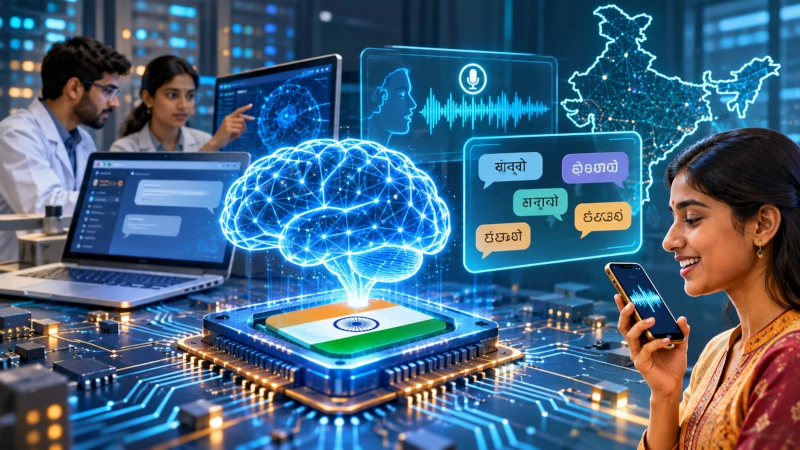
Chariot Artificial Intelligence Private Limited has unveiled its Chariot-1 family of foundation models under the IndiaAI Mission, advancing India’s domestic capabilities in artificial intelligence research and development. The Ministry of Electronics and Information Technology formally announced the development on 26 November 2026 following a launch and research showcase at Bharat Mandapam in New Delhi. The model suite comprises a large language model and a multilingual text-to-speech system, both pretrained from scratch in India and designed to address the country’s diverse linguistic and computational requirements.
Building Indigenous Artificial Intelligence Foundation Models
Chariot Artificial Intelligence was among the first four teams selected under the IndiaAI Mission to develop sovereign foundation models. Its research focuses on improving computational efficiency, multilingual processing and deployment flexibility through innovations in model architecture and language representation. The development of these models from scratch establishes domestic research capabilities extending beyond the adaptation of existing international foundation models.
The Chariot-1 large language model employs a Mixture-of-Experts architecture containing approximately 11 billion parameters, of which four billion are activated for each token processed. Three model configurations have been developed, allowing the technology to address different computational environments and application requirements.
| Model Configuration | Parameters |
|---|---|
| Large | 10.7 billion |
| Medium | 1.7 billion |
| Small | 745 million |
The availability of multiple model sizes provides opportunities for deployment across centralised computing infrastructure, personal computers and resource-constrained devices. This flexibility is particularly relevant to India, where access to advanced computing infrastructure varies considerably across institutions, enterprises and geographical regions.
IndicShift: Improving Artificial Intelligence Processing of Indian Languages
One of the principal research innovations incorporated into Chariot-1 is IndicShift, an open-source language representation technology developed to improve the processing of Indian scripts. The approach establishes a shared representation system that maps 1,012 characters from 12 Indian scripts into a common set of approximately 350 symbols. This enables artificial intelligence models to utilise linguistic similarities across Indian languages more efficiently.
According to the research results presented during the launch, IndicShift substantially reduces token requirements for Indian-language content compared with conventional tokenisation methods. The researchers also reported improvements of between five and eight per cent in Indian-language model performance under equivalent computing conditions. These findings indicate opportunities for reducing the computational disadvantages traditionally associated with processing linguistically diverse Indian content.
Nested Training: Developing Multiple Models Through a Single Training Process
Chariot’s second major innovation, Nested Training, enables several model sizes to be developed simultaneously through a shared training process. Conventional approaches may require separate computational resources to train models of different sizes, increasing the overall cost and duration of development. Nested Training seeks to address this challenge by allowing smaller model configurations to share parameters within a larger training architecture.
The development team reported a 62 per cent improvement in training speed compared with independently training the three model configurations. The approach could help developers optimise foundation models for different hardware environments without repeating the entire training process. Such innovations are particularly relevant to research institutions and enterprises seeking to manage the substantial computational costs associated with advanced artificial intelligence development.
Mixture of Vocabularies Enhances Computational Efficiency
The third research innovation, Mixture of Vocabularies, reorganises the model’s vocabulary into 11 specialised groups. Instead of evaluating every possible vocabulary entry during word generation, the architecture selectively processes relevant groups. This reduces unnecessary computational operations while preserving the model’s language-generation capabilities.
The researchers reported a 5.7-fold reduction in the number of vocabulary entries evaluated during the selection process, alongside a 38 per cent improvement in training speed using equivalent GPU resources. The reported results suggest that architectural improvements can complement investments in computing infrastructure by making more efficient use of available hardware. Further independent evaluation will help establish how these efficiencies translate across different applications and deployment environments.
Multilingual Text-to-Speech Capabilities
The Chariot-1 text-to-speech system supports English and ten Indian languages, addressing an important requirement for accessible digital services in a multilingual society. The languages covered in the official announcement include Hindi, Bengali, Marathi, Tamil, Telugu, Kannada, Malayalam, Gujarati, Punjabi and Odia. The system incorporates contextual language processing to improve the pronunciation of numbers, dates, currencies, abbreviations and other non-standard textual expressions.
The research team reported verbalisation accuracy exceeding 97 per cent on a specialised pronunciation benchmark. The model also recorded a character error rate of 7.60 per cent for Hindi and an average of 6.47 per cent across nine other Indian languages in the reported evaluations. These results highlight the potential of specialised language research to improve speech-generation capabilities for Indian users.
Potential Applications Across India’s Digital Ecosystem
Multilingual foundation models offer opportunities to develop artificial intelligence applications tailored to India’s linguistic diversity. Potential applications include educational platforms, voice-enabled banking services, digital healthcare interfaces, agricultural advisory systems, customer support and public service delivery. Smaller model configurations could additionally support applications operating on devices with limited computational resources.
The integration of language and speech technologies could help make digital services more accessible to individuals who prefer interacting in their native languages. However, successful deployment will require application-specific evaluation, appropriate data protection measures and continuous improvements in linguistic accuracy. The launch establishes a technological foundation upon which such applications can be developed rather than confirming their widespread implementation.
Advancing India’s Sovereign Artificial Intelligence Ecosystem
The Chariot-1 initiative demonstrates the importance of developing domestic expertise across the artificial intelligence value chain, including language representation, model architecture, training methodologies and deployment engineering. Indigenous research in these areas can provide Indian enterprises and academic institutions with greater opportunities to develop technologies aligned with domestic requirements. The open-source release of IndicShift also creates possibilities for wider research participation and collaborative development.
The IndiaAI Mission supports such initiatives through a broader framework intended to strengthen computing infrastructure, research capabilities and indigenous foundation model development. Supporting domestic intellectual property creation and specialised engineering expertise can contribute to a more diversified artificial intelligence ecosystem while reducing excessive dependence on externally developed technologies.
Building a Multilingual and Technologically Self-Reliant India
The launch of Chariot-1 represents an important milestone in India’s efforts to develop advanced artificial intelligence technologies through indigenous research. Its combination of multilingual language processing, computational efficiency and flexible model configurations addresses several challenges associated with deploying artificial intelligence across a diverse and resource-sensitive digital environment. The research innovations also demonstrate that technological progress can arise through improvements in underlying model architectures rather than simply increasing computational scale.
Continued research, transparent performance evaluation and practical deployment will determine the long-term impact of these technologies. By combining domestic scientific expertise with linguistic diversity and an expanding digital infrastructure, India can strengthen its position in the global artificial intelligence ecosystem while developing technologies that are increasingly accessible to its own population.
Reference
Ministry of Electronics and Information Technology, Press Information Bureau — India AI Mission-Supported Chariot-1 Foundation Models Launched, Strengthening India’s Indigenous AI Capabilities, 26 November 2026, 11:23 AM. Release ID: 2341725.
You may also like
-
Warangal Chapata Chilli — Telangana’s Brilliant Red Tomato Chilli and the Agricultural Heritage of Warangal
-
ISRO Successfully Tests Indigenous Gas Generator for Next-Generation Methane Rocket Engine
-
Indian and Russian AI Agents Conduct First Cross-Border Trade Deal on SBER Platform
-
Vindhyagiri Delivery Marks Completion of India’s Project 17A Stealth Frigate Programme
-
Hetero Begins Exporting Generic HIV Prevention Medicine to Africa
