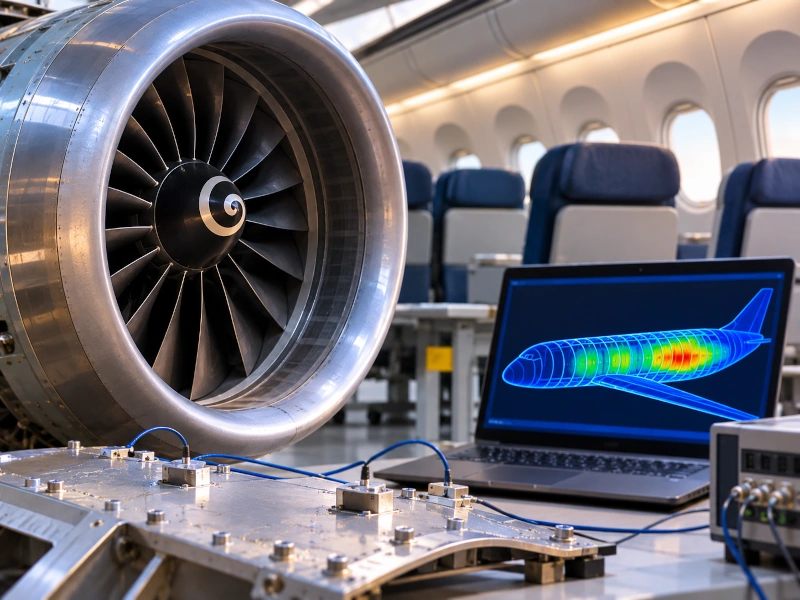
The Indian Institute of Technology Kanpur (IIT Kanpur) and Rolls-Royce have announced a collaborative research project to investigate technologies for reducing aircraft cabin noise. Announced on 25 November 2026 and reported by DD News on 26 November, the six-month research initiative will focus on structure-borne noise arising from aircraft engine vibrations. The partnership brings together academic research and industrial aerospace engineering expertise to address an important aspect of aircraft design and passenger comfort.
Understanding Engine-Induced Aircraft Cabin Noise
Aircraft cabin noise originates from several sources, including propulsion systems, aerodynamic airflow and vibrations transmitted through structural components. Unlike airborne noise, structure-borne noise travels through solid materials and interconnected mechanical structures before generating audible sound within the aircraft cabin. Understanding these transmission mechanisms is essential for developing effective noise reduction strategies.
Aircraft engine vibrations can propagate through engine mounting systems and surrounding airframe structures, contributing to the acoustic environment experienced by passengers. The collaborative research project will investigate this phenomenon, contributing to a better understanding of the relationship between propulsion system vibrations, structural dynamics and cabin acoustics.
Advancing Aerospace Engineering Research
The partnership brings IIT Kanpur’s academic research capabilities together with Rolls-Royce’s experience in aerospace propulsion and engineering. Research into vibration transmission requires expertise in structural mechanics, acoustics, materials science and computational engineering. The collaboration provides a platform for applying interdisciplinary research to practical challenges associated with commercial aviation.
Improved understanding of structure-borne noise could support the development of more effective vibration isolation and noise attenuation strategies in future aircraft designs. Such advances would require careful consideration of structural integrity, manufacturing requirements and aircraft weight. The research project represents an investigative effort rather than the announcement of a commercially validated noise reduction technology.
Improving Passenger Comfort in Commercial Aviation
Cabin acoustics are an important consideration in commercial aircraft design, particularly for long-duration flights. Reducing unwanted noise can improve passenger comfort, facilitate communication and contribute to a more pleasant onboard environment. Aircraft manufacturers and propulsion system developers therefore continue to investigate methods of reducing noise without compromising operational performance or safety.
Addressing engine-induced structural vibrations at their source could complement existing approaches involving acoustic insulation and vibration management. The research undertaken by IIT Kanpur and Rolls-Royce could provide engineering insights relevant to future aircraft development, subject to the findings and subsequent validation of the project.
Strengthening India’s Aerospace Research Ecosystem
The collaboration highlights the role of Indian academic institutions in addressing complex engineering challenges within the global aerospace industry. Partnerships between universities and international aerospace companies create opportunities for knowledge exchange, specialised research and the development of advanced engineering capabilities. Such engagements can also help strengthen the connection between academic investigation and industrial requirements.
India’s expanding aerospace ecosystem requires sustained investment in research disciplines extending beyond aircraft manufacturing and propulsion development. Structural dynamics, aeroacoustics, computational modelling and advanced materials are important components of this broader technological ecosystem. Research collaborations of this nature can contribute towards building specialised expertise in these fields.
Building Capabilities for Next-Generation Aviation
The six-month research partnership between IIT Kanpur and Rolls-Royce represents a focused effort to address an established challenge in aircraft engineering. Its immediate objective is to investigate structure-borne noise associated with engine vibrations, with the potential for generating insights relevant to future noise reduction technologies. The practical applicability of the findings will depend on the research outcomes and subsequent engineering validation.
By connecting Indian academic expertise with international aerospace engineering capabilities, the initiative provides an opportunity to advance specialised research while strengthening India’s participation in global aviation innovation. Continued industry–academia collaboration can support the development of quieter, more comfortable and technologically advanced aircraft in the future.
Reference
DD News — Rolls-Royce, IIT Kanpur Launch Research Project to Further Reduce Aircraft Cabin Noise, 26 November 2026.
You may also like
-
Indian Scientists Pioneer Solar Particle Detection from Both Polar Regions
-
First North-East India-Specific Antivenom Developed Against Neglected Pit Vipers Species
-
ISRO Advances Preparations for First Uncrewed Gaganyaan Mission
-
Indian Scientists Discover Rare Stellar Fossil from the Early Universe
-
India Inaugurates First Dedicated Human Metabolic Chamber at CMC Vellore
