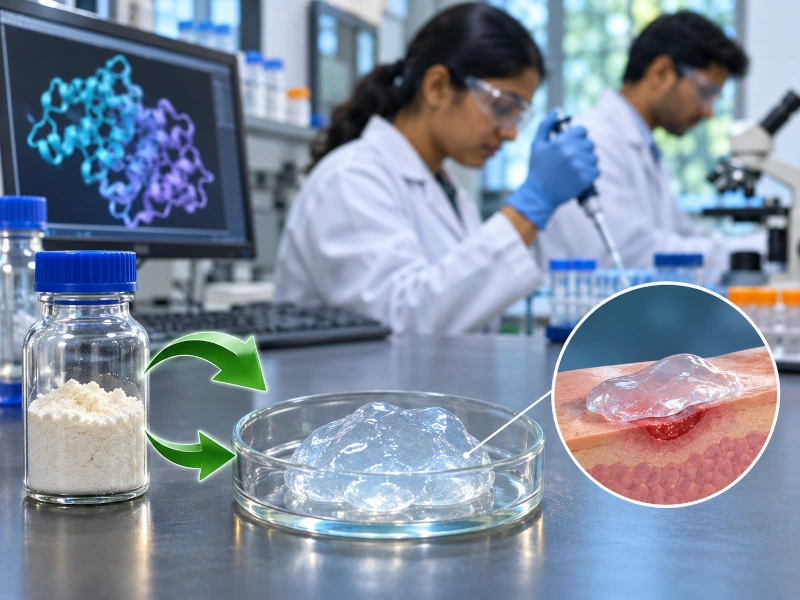
Researchers at the National Institute of Technology Rourkela (NIT Rourkela) have patented a method for converting discarded pharmaceutical proteins into hydrogels with potential biomedical applications. Reported by DD News on 26 November 2026, the development brings together biomedical engineering, sustainable materials science and industrial waste utilisation. The technology could open new avenues for developing materials intended for wound healing, tissue regeneration and controlled drug delivery.
Transforming Pharmaceutical Waste into Biomedical Resources
Pharmaceutical manufacturing generates biological residues, including proteins that have lost their original functional activity during processing. Although these proteins may no longer be suitable for their intended pharmaceutical applications, their molecular properties can potentially be utilised in the development of alternative materials. The patented method developed by NIT Rourkela researchers seeks to harness this residual value by transforming discarded proteins into hydrogels.
Hydrogels are three-dimensional networks of hydrophilic materials capable of absorbing and retaining considerable quantities of water. Their structural flexibility and moisture-retention properties make them attractive candidates for various biomedical applications. The ability to produce such materials from discarded proteins introduces a potential pathway for recovering valuable resources from pharmaceutical manufacturing waste.
Potential Applications in Wound Healing and Tissue Regeneration
Hydrogels are widely investigated in biomedical research because of their ability to maintain moist environments and provide structural support for biological processes. In wound management, appropriately designed hydrogels can help maintain conditions conducive to tissue repair. Their physical and chemical characteristics can also be tailored to meet different biomedical requirements.
Protein-based hydrogels may additionally offer opportunities in tissue engineering, where biomaterials are investigated as scaffolds that support cellular attachment and growth. However, the suitability of the newly developed material for these applications will depend on further evaluation of its biocompatibility, mechanical properties, purity and safety. The patent establishes an intellectual property milestone rather than confirmation of clinical effectiveness.
Opportunities in Controlled Drug Delivery
Another potential application of the technology lies in controlled drug delivery, an area of biomedical research focused on regulating the release of therapeutic substances. Hydrogels can be engineered to incorporate active compounds within their molecular networks and release them under specified conditions. Such properties make them relevant to research into localised treatments and advanced pharmaceutical formulations.
The utilisation of discarded pharmaceutical proteins as starting materials could introduce alternative approaches to biomaterial manufacturing. Further research would be necessary to establish whether the patented material can provide predictable drug-release characteristics, adequate stability and consistent performance under biological conditions.
Advancing Circular Economy Principles in Pharmaceutical Manufacturing
The research aligns with circular economy principles by exploring how industrial waste streams can be transformed into resources for new applications. Instead of treating discarded proteins exclusively as waste requiring disposal, the technology investigates their potential as feedstock for developing functional biomedical materials. This approach connects pharmaceutical manufacturing with sustainable materials research and resource recovery.
If successfully validated and scaled, the process could contribute towards improved resource efficiency within the pharmaceutical industry. Its environmental and economic advantages would, however, require assessment through manufacturing feasibility studies, lifecycle analysis and appropriate quality-control procedures. Biomedical applications would also demand stringent purification and regulatory compliance.
Strengthening India’s Biomedical Research Ecosystem
The patented innovation highlights the contribution of Indian academic institutions to interdisciplinary research at the intersection of biotechnology, pharmaceutical engineering and materials science. By addressing pharmaceutical waste utilisation alongside biomedical material development, the researchers have identified an area where environmental sustainability and healthcare innovation can complement each other.
The next stages of development will be important in determining the technology’s practical applicability, scalability and commercial potential. With appropriate scientific validation, industrial collaboration and regulatory assessment, research of this nature could contribute to the development of indigenous biomedical materials while encouraging more sustainable pharmaceutical manufacturing practices.
Reference
DD News — Report on NIT Rourkela’s patented method for converting discarded pharmaceutical proteins into hydrogels, 26 November 2026, 3:47 PM.
You may also like
-
Ayurveda During Spring: Lightening the Diet and Clearing Kapha
-
Ayurveda During Winter: Food, Oil Massage and Strength-Building
-
Ayurveda During the Monsoon: Protecting Agni and Immunity
-
India Inaugurates First Dedicated Human Metabolic Chamber at CMC Vellore
-
ICMR’s SAMPADA Survey Reports Lower Anaemia Prevalence Across India
